2.12.2007


Youth pay price of capitalism’s environmental destruction

Published Feb 9, 2007 9:45 AM

The Bush administration’s proposed 2008 budget calls for an extraordinary $2.9 trillion in spending.

A reasonable observer might expect that a budget that huge would allocate sufficient resources to fund the types of programs that would benefit young workers and students: universal higher education and the cancellation of existing student loan debt, job training, and public works programs employing young people to construct much-needed mass transit and energy-efficient affordable housing.
Instead, the Bush budget is designed to finance the escalation of conflict in the Middle East. It provides the Pentagon another $100 billion for the Iraq and Afghanistan wars this year, on top of the $70 billion already allocated by Congress, plus $141.7 billion for these wars next year—all to pay for death and destruction meant to crush opposition to the super-exploitation of the area by the major U.S. and British oil companies.

The total 2008 Pentagon budget, which also includes huge expenditures on costly weapons systems and basing troops around the world, would come to $624.6 billion.

Killing people quickly and slowly

The immediate human impact of the Iraq war is obvious. Over 3,100 U.S. soldiers have died in Iraq so far. Civilian Iraqi casualties of the violence are reported in excess of 60,000. The average age of a dead U.S. soldier in Iraq is less than 27.

The war in Iraq not only affects the young by sapping resources and sending them off to die. It also has dire environmental consequences for those with the longest time left to live on this planet.

The use of depleted uranium (DU), white phosphorus, MK77 Mod 5 napalm and other outlawed incendiary weapons in Iraq has an immediate and devastating effect on the health of soldiers and civilians. The Sierra Club of Canada pointed out as early as 1999 that “the environmental consequences of DU weapons residue will be felt for thousands of years as its decay products continually transform into other hazardous radioactive substances in the uranium decay chain.”

The U.S. economy was long ago deliberately structured to be dependent on oil by an agreement among the oil, rubber and automobile companies to stifle quality mass transit. (Eric Schlosser’s “Fast Food Nation” gives the details.) According to the Energy Information Association, U.S. petroleum consumption now exceeds 20.8 million barrels a day. It’s a perfect example of how, under capitalism, short-term economic growth prevails over long-term sustainability because of the drive for profits.

Most workers across the United States have no access to reliable public transportation and must have cars to get to work, to shop, to have a social life. This takes a toll on the young worker’s pocketbook as gasoline prices remain above $2 a gallon. The environment also suffers as increased travel eats up almost 9.2 million barrels of oil a day.

The Intergovernmental Panel on Climate Change (IPCC) met in Paris at the beginning of February and issued a long-awaited report that finally confirmed, with much scientific data, that human activity is the main factor behind global warming. The IPCC predicted that temperatures will continue to rise by as much as 7.2 degrees Fahrenheit by the end of the century.

Global warming is caused when the concentration of greenhouse gases such as carbon dioxide (CO2) rises and they begin to form a heat-trapping blanket around the Earth. More than half of the CO2 now in the atmosphere comes from the burning of fossil fuels—oil, coal and natural gas. Deforestation is another main contributor to CO2 because trees take in CO2 and put out oxygen.

Environmental degradation and profits

The history of capitalism is replete with examples of disregard for the environment and the lives of young workers. The industrial revolution saw the creation of marvelous new technologies and laid the material basis for capitalism’s ascendancy around the world. Since the capitalists used these technologies to maximize their profits, widespread pollution resulted.

Manchester, England, in the 19th century was an example of how capitalism’s implementation of technology was ruinous from the beginning. There was no space in this industrial town for gardens or green spaces. The sky was filled with thick smoke that polluted the lungs, clothing and homes of the workers forced to live in the city.

Fifty-seven percent of working-class children there died before they reached the age of five. The average life expectancy for the poor was just 17 years. A government report issued in 1842 left no doubt that many of these deaths were the consequence of severe environmental degradation. The co-founder of scientific socialism, Frederick Engels, wrote about this assault on the workers and the environment in his 1845 book “The Condition of the Working Class in England.”

As capitalism in some countries advanced into modern imperialism, with its territorial division of the world among capitalist powers, modern and frequent warfare also arose.

The first and second world wars saw the redrawing of maps in Africa, the Middle East and Asia by the colonial/imperialist powers. The U.S. later waged ruthless wars against national liberation movements in Vietnam and Korea that were led by communists. And the first Gulf War proved itself just a precursor to the current occupation of Iraq.

The U.S. military says that 617,000 U.S. soldiers died in combat in the 20th century. Most of these soldiers were young and recruited from the working class; many were also from the nationally oppressed.

One of the biggest environmental threats arose out of World War II with the development and use of nuclear weapons by the U.S. government. The bombings of Hiroshima and Nagasaki led to the deaths of an estimated 215,000 Japanese civilians. Black rain fell in some areas following the blast, bringing down radioactive material and creating a secondary source of exposure. Radiation-induced cancers and leukemia resulted along with widespread birth deformities and stillbirths.

The United States’ historical use of nuclear weapons and the recent threats of perpetual warfare under the Bush doctrine have made it necessary for countries such as the Democratic People’s Republic of Korea to develop nuclear technology for self-defense purposes.

U.S. imperialism’s current refusal to tackle the root causes of global warming is just the most recent example of the misuse of modern technology by the ruling class.

Capitalism’s derelict stewardship of the environment points to the necessity for workers and oppressed to control the means of production so that technology can be redirected to meet people’s needs.

Socialism: A sustainable model

There is nothing inherently bad for the environment about the scientific and technological advances made since the industrial revolution. In fact, socialist Cuba shines a bright light on how workers’ control can lead to a more sustainable implementation of modern inventions.

Cuba has fought its way to the forefront of conservation and sustainable development against the backdrop of a brutal U.S.-led blockade of the country. The island nation has made incredible advances in farming techniques, housing construction and energy conservation.

One of Cuba’s most impressive achievements is the development of organic agriculture, beginning in the early 1990s. It successfully combines organically produced fertilizer and crop rotation techniques with modern bio-pesticides that use non-toxic microbial formulations to control pests and increase soil nutrition.

Neighborhood vegetable gardens in cities have reduced the amount of transportation necessary to feed urban areas. Havana, for example, has developed 50,000 community gardens to help feed the city.

Cuba reduced its reliance on oil in transportation by fitting public buses with bike racks and distributing over one million Chinese-made bicycles to the Cuban people. Experimentation with more natural building materials, such as bamboo, for the construction of modern-style homes was developed in response to concerns over the amount of greenhouse gas emissions from traditional construction methods.

Cuba has also integrated environmental education as part of its national curriculum while implementing special conservation programs for mountainous areas.

The way forward

Young people and students in the United States have been in the vanguard of environmental preservation. It is not unusual that young workers with their whole life ahead of them, many of whom face the question of when or whether to begin raising a family, would look to the future dangers posed by pollution with a sense of moral outrage.

Students played a key role in the establishment of the first Earth Day in 1970 and young people today are involved in a variety of environmental causes. But a key ingredient is often missing. That ingredient is class-consciousness.

Environmental degradation occurs because the capitalists are in charge of technology. Not surprisingly the multinational working class suffers the most from the environmental damage that results.

It is important that militant environmental action not be separated from the broader revolutionary movement for working class power. The campaign for things like clean air, fresh drinking water and sustainable coastal areas should be linked to the workers’ broader economic demands for affordable housing, education, healthcare and living-wage jobs.

The only way for workers to secure these demands for themselves is to organize a political movement to take the power, which is denied them under the plutocracy that the capitalists call democracy. Young workers and students must strive to position themselves at the forefront of this revolutionary working class movement for environmental and social justice.

The writer is an organizer of FIST-Fight Imperialism, Stand Together—youth group. Contact fist@workers.org for more information.


Articles copyright 1995-2007 Workers World. Verbatim copying and distribution of this entire article is permitted in any medium without royalty provided this notice is preserved.

Coalition plans May Day actions

Immigrant rights activists meet in Los Angeles

Published Feb 8, 2007 1:38 AM

In an historic development in the U.S. immigrant rights struggle, a coalition of national organizations met in Los Angeles on Feb. 3-4 to plan and coordinate the “Great American Boycott II” for May 1.
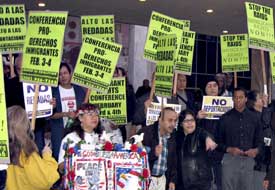
Federal Building. " border="0">

Feb. 2 protest in front of Los Angeles
Federal Building.
WW photo: Dante Strobino

Called by the March 25 Coalition, initiator of the 2006 May Day actions that brought millions into the streets, the coalition aims to defend immigrant workers and show their power by bringing “business as usual” to a halt across the country on May Day.

William Torres of the coalition described the boycott as “the ultimate fight for dignity and justice.”

After the 2006 actions, the U.S. Immigration and Customs Enforcement Agency (ICE) stepped up vicious raids and deportations in an attempt to stop immigrant workers from organizing.

In one of hundreds of examples, ICE combined union-busting with immigrant worker repression by arresting 21 workers at a North Carolina hog-processing plant on Jan. 24. The raid followed two major protests at the Smithfield plant: one initiated by Latina women to stop harassment over immigration papers, and another led by African-American workers to demand union recognition and Martin Luther King Day as a paid holiday. (Workers World, Feb. 2)

The Smithfield raids came after similar raids on thousands of workers at Swift and Co. meatpacking plants in six states on Dec. 12, 2006, when ICE agents terrorized and arrested workers from Mexico, Guatemala, Honduras, El Salvador, Sudan, Ethiopia and elsewhere.

Conference mobilizes to defend workers
taking half the workforce,
but she joined the Feb. 2
protest. " border="0">

ICE raided this Latina's job,
taking half the workforce,
but she joined the Feb. 2
protest.
WW photo: Cheryl LaBash

A press conference and demonstration condemning the raids, called by March 25 Coalition organizers on Feb. 2 outside the Los Angeles Federal Building, drew a militant 80 people. Two Latina women from a local factory raided the previous day came and described the brutalization by ICE agents, who had held guns to the heads of workers.

The next day Teresa Gutierrez of the New York May 1 Coalition and the International Action Center emphasized: “This conference gathers the movement to defend immigrant workers—from fighting ICE attacks to changing devastating day-to-day working conditions. By mobilizing in the streets, we defeated the Sensenbrenner bill. Together, we can stop the raids!”

Rep. Jim Sensenbrenner sponsored the racist and punitive H.R. 4437, passed by the U.S. House of Representatives in December 2005. One of its many discriminatory components was the proposed erection of a 700-mile wall along the U.S.-Mexican border. Because of massive worker protest in 2006, the bill died in the U.S. Senate.

Chito Quijano, of the progressive Filipino alliance BAYAN-USA and the California Nurses Association, recounted a call for help from a cousin, a documented worker and 20-year U.S. resident, arrested on a trumped-up charge by ICE and threatened with deportation. Quijano said: “Sensenbrenner was the fire that fed last year’s massive protest. This year, the raids will be the fuel.”

A plenary on “Globalization of Immigrant Labor and Transnational Capitalism” featured Teresa Gutierrez and William Robinson, professor of sociology at the University of California, Santa Barbara, and one of the leading U.S. academic critics of capitalism. Robinson outlined the growth of immigration and repression in the United States over the last 30 years, pointing out that contemporary “transnational capitalism” makes the profits it needs to sustain its existence through the value produced by low-wage labor of immigrants. To keep those profits it must maintain economic, legal and cultural control of immigrant workers.
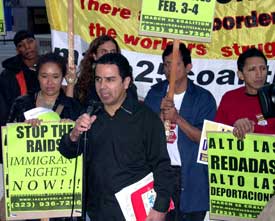
demands, "Stop the raids!" " border="0">

March 25 Coalition's William Torres
demands, "Stop the raids!"

Gutierrez highlighted the use of racism to divide the working class in its quest for profits. She cited recent inflammatory remarks by right-winger Pat Buchanan and former National Security Council member Samuel Huntingdon, that project when the United States will cease to have a “European” majority and characterize immigrants as threatening the country’s “national identity.”

Gutierrez posed a crucial question: “How, given the repression against immigrants, can we sustain the magnificent movement begun May Day 2006, and bring unity to the immigrant rights struggle?” She pointed out that the biggest fear of the right wing in the United States was that the immigrant question will cause all workers to question what kind of society the United States will be, and will raise the possibility of working-class unity across all nationalities.

Working-class unity

The theme of working-class unity across borders wove through the proceedings. Javier Rodríguez, a March 25 Coalition convener, said: “This conference is significant because it is the first organized national effort to convene the major coalitions and groups that are more to the left, that initiated last year’s May 1 boycott. This is the movement that will attempt to coalesce to establish a historical alliance of Latin@s and African Americans. All the roots are here at this conference, with significant representation from both groups.”

Clarence Thomas, an initiator of the Million Worker March, member of International Longshore Workers Union Local 10 and the Alameda County Central Labor Council’s Executive Board, paid homage to the country and people of Mexico for their support in the historical struggle against U.S. slavery, and called for the absolute right of Mexican@s to travel across the U.S.-Mexican border without reprisals. He noted that on May 1, 2006, in the ports of Los Angeles and Long Beach, immigrant truckers refused to move shipping containers, shutting down 90 percent of the shipping. Those ports handle 40 percent of all container traffic coming into the United States.

Thomas vowed to return to Local 10 to ask that it participate in May 1 in a “meaningful way,” adding, “This is a rank-and-file movement, and that’s what’s keeping it afloat.”

Another emphasis of the conference was on international unity across borders, with a plenary featuring Pablo Franco Hernández of the Unión de Juristas de México and attorney for Oaxacan political prisoners, and Senator José Medina of the PRD (Partido de la Revolución Democrática) of Mexico. Both spoke of the movement against repression in the state of Oaxaca and its importance to the immigrant rights struggle within U.S. borders, tied as both movements are to resisting the misery and death wreaked by forces of capitalist globalization. The Popular Assembly of the People of Oaxaca organized massive demonstrations during 2006 for people-directed political autonomy; the Mexican government mounted violent reprisals, including arrests of Flavio Sosa and other leaders.

Medina called for an immediate end to massive deportations within the United States, and emphasized his opposition to any temporary worker program—“modern slavery to a handful of corporations.”

In a plenary on “History and Analysis of the Immigrant and Civil Rights Movement 1968-2006,” Ché López of the Border Social Forum chronicled the immigrant rights movement in North America from 1848 to the formation of his own organization in 2006, drawing together activists on both sides of the border to internationalize the struggle. He connected the new surge of organizing to a rise in class struggle against the current U.S. imperialist agenda, calling for May 1 to represent millions of immigrant and migrant workers all over the world as International Workers Day: “Social change needs to be created from the bottom, and will be by immigrants.”

Stating “I’m here to say the face of the immigrant rights movement is international,” Vicente Panamá Alba of the May 1 Coalition, New York, affirmed, “We are committed to mobilizing the international working class in New York for May 1.”

A video message from Elvira Arellano brought forward the special oppression and resistance of women immigrant workers. Arellano, founder of La Familia Unida Latina, has been in sanctuary in Chicago for six months in defiance of threatened deportation. She affirmed, “I am not a criminal. I am a mother and a father to my son. I fight so the undocumented people will be respected.”

Speakers and workshops at the conference emphasized the need to highlight the issues of immigrant women, such as their vulnerability to rape, sexual harassment and domestic violence when deportation can be used as a threat. Participants called for greater visibility and representation by women in the struggle, and stressed the leadership and resistance of women. One such leader was María Guardado, a former member of the FMLN, the liberation movement of El Salvador, who praised the conference as “a day to launch a great, important movement that is much needed, as we have to organize against the entire system that is the enemy of us all.”

National and transnational action reports and report-backs from the workshops including statements from religious leaders. Mohammed Hanif, imam with the Muslim American Society Freedom Foundation, vowed support, saying, “We are all brothers and sisters, to live together and fight together.” Bishop Filipe C. Teixeira, OFSJC, originally of Angola, said, “As a religious leader, as an immigrant man, I find in this conference ... unity with my brothers and sisters who are struggling.”

Northern California organizer Evelina Molina reminded workshop participants, “The farm worker movement was a class struggle. Let’s name this movement for what it is: a class struggle!” Molina helped organize 40,000 in May 2006 with KBBF’s “Voice of the Worker” in Santa Rosa—the first community-based non-profit Spanish language radio station, which celebrated 35 years in 2006.

Leon Waters of the People’s Hurricane Relief Fund drew the connections between the immigrant rights struggle and that of people displaced internally, like the survivors of Hurricane Katrina.

Walter Sinche from Pachamama Ecuadorian Organizations stated that the rights of Indigenous people throughout the Americas must be raised in the immigrant rights struggle. Sinche said he will march on May Day because it “is better to lose your job than your dignity.”

The need to close the disconnect between the anti-war movement and the immigration struggle and to educate the anti-war movement on the “other wars” in the United States, as well as the need for the immigrant rights struggle to endorse anti-war actions, was part of the report-back from the “U.S. Wars, Iraq and Immigration” workshop by Dianne Mathiowetz of the International Action Center-Atlanta.

Participating groups and organizations included Chispa, ELAC, Students for Immigrant Rights, APALC, South Asian Network, Korea Truth Commission, Hands Off Public Housing-New Orleans, Coalición de Derechos Humanos, Committee for Justice for Héctor Rivas, Mujeres Unidas Y Activas, Comité Pro-Amnistía Y Justicia Social, Jobs with Justice, TIGRA, Voices Crossing Frontiers/Voces Cruzando Fronteras, Unión del Barrio, P.U.E.B.L.O., UCLA Labor Center, IBT 808, U.S.-Cuba Labor Exchange, SEIU 660, Bay Area Teamsters, FIST—Fight Imperialism, Stand Together, National Lawyers Guild, Sex Workers Across Borders, Workers World Party, Freedom Socialist Party, World Can’t Wait, and Peace & Freedom Party.

The conference closed with agreement on the points of unity and recommendations for action.

A statement by Emma Lozano, Director of the Chicago-based Sin Fronteras/La Familia Latina Unida, was given to each participant. It read in part: “Even the best spokespeople in Congress call our people lawbreakers and say we must go to the back of the line. ... While they debate, we must demand a moratorium! We must resist. ... We must join in the boycott!”

Fernando Ledezma, a teacher and member of United Teachers Los Angeles, said, “Martin Luther King spoke of ‘content of character’ and I think it is critical to measure people not by what they are worth in money, but by how they contribute toward society. May 1 will be a celebration of measuring people by the content of their character.”

John Parker from the March 25 Coalition commented about the conference, “This is a great beginning towards building a strong and united movement towards May 1, 2007 that could stop the raids and deportations and make a significant contribution to the struggle to win full legalization rights for all workers. And, given the makeup of labor, immigrant rights, social justice and anti-war organizations that participated in this conference a great contribution to unity and strength has been made.”


Articles copyright 1995-2007 Workers World. Verbatim copying and distribution of this entire article is permitted in any medium without royalty provided this notice is preserved.

New FIST chapter fights bigotry

Published Feb 4, 2007 9:42 PM

Baldwin-Wallace College, a small liberal arts school near Cleveland, has recently been the site of major racist attacks. Two Black students living in an all-girl dormitory opened their door one afternoon to find the N-word scribbled on it. As a result, the college held a “forum” and publicly denounced the action.

The very next day, the same epithet, followed by the word “lover,” was scrawled on the door of the resident assistant, who reported the attack. The term has long been used by racists to characterize white people who defend people of color.

The college again publicly denounced the act with statements, but the attacks went on. They dropped the racial language but repeated verbal abuse of the resident assistant, using a word insulting women and telling her to “Get out.”

A few of the young women living in the dorm transferred to other colleges out of a desire not to be forced to tolerate this kind of bigotry.

The Black Student Alliance, a strong organization at Baldwin-Wallace, took action. Members of the alliance called the media. Soon local television crews were interviewing the leaders of the BSA, who called for justice.

The BSA at Baldwin-Wallace College has a strong history of defiance. In years past, it won a cultural center and additional funding for students of color on campus after a sit-in at the president’s office.

The recent attacks provoked loads of outrage around the campus, but it soon simmered down. However, the attacks against the resident assistant continued.

The college administration repeatedly promised to put in video cameras to catch the perpetrators, a promise that never materialized.

This is not an isolated incident at Baldwin-Wallace. Students organizing for the World Can’t Wait campaign often found their literature and postings crumpled up or defaced with phrases like “Go Bush!” or “Bomb the —-!”—using a racist term for Muslims.

Recently a dorm where many members of the LGBT community lived had homophobic words painted on the wall.

In light of all this, several students at Baldwin-Wallace have decided to start a chapter of Fight Imperialism Stand Together (FIST).

Explaining their goal, they say, “We hope to bring together the struggles of people of color and the LGBT community, as well as the many other students from the working class on campus. We hope to show that unity is key to defeating racism, sexism, homophobia and classism. We hope to show the students that their real enemies are not people with a different skin color, nationality or sexual identity, but rather those who inhabit Wall Street and Washington, D.C.”


Articles copyright 1995-2007 Workers World. Verbatim copying and distribution of this entire article is permitted in any medium without royalty provided this notice is preserved.

FIST youth join protest

Published Feb 1, 2007 12:31 AM

Scores of youth and student activists from around the country joined the FIST (Fight Imperialism Stand Together) contingent at the Jan. 27 mass anti-war convergence on Washington, D.C.
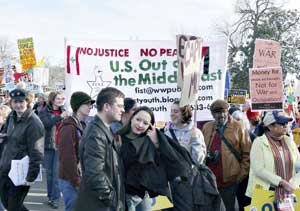
WW photo: G. Dunkel

FIST protested alongside thousands of other young people in a youth feeder march that began with a rally at the Smithsonian and ended in a united march around the Capitol.

Activists from over half a dozen cities, including Cleveland, Philadelphia, New York, New Brunswick, N.J., Raleigh, N.C., and Washington, joined the FIST contingent.

FIST activist Namibia Donadio organized about a dozen students from Rutgers University to attend the march, including several members of the Central and South American Alliance on campus.

Raleigh FIST organizers Peter Gilbert, Dante Strobino and Ben Carroll brought more than 80 students and working young people from the Raleigh-Durham-Chapel Hill triangle in North Carolina. Local activists from the newly refounded Students for a Democratic Society (SDS) also participated in the youth feeder march.

The youth distributed FIST leaflets, flyers for the Feb. 17 national day of actions called by the Troops Out Now Coalition and the March 17 united march on the Pentagon, and copies of Workers World newspaper to thousands of young people from around the country.

Many FIST members participated in a youth breakaway march. This bloc, made up mostly of anarchists and FIST cadre, engaged in a non-permitted march to a military recruiting center in the heart of D.C. to protest the lies that military recruiters tell young people and students, especially the working poor and people of color, in order to enlist them in imperialist wars such as those now raging in Iraq and Afghanistan.

After being violently dispersed from the recruiting center by police, the protesters continued to march through the streets, eventually meeting up with more FIST cadre who joined them on their march back to the Capitol.

The non-permitted march blocked traffic as police issued warnings over loudspeakers for demonstrators to return to the sidewalks. Car drivers and their passengers, however, honked and cheered the protesters on, often raising a clenched fist in the air to demonstrate support for ending the war.

Observers on the sidewalk clapped and shouted words of encouragement and several took time out to resist the police orders and march in the street themselves.


Articles copyright 1995-2007 Workers World. Verbatim copying and distribution of this entire article is permitted in any medium without royalty provided this notice is preserved.

1.22.2007

WW speaks to Willie 'JR' Fleming

'Hip hop: a platform to unite the people'

Published Jan 17, 2007 12:25 AM

Workers World newspaper recently interviewed Willie “JR” Fleming, a member of the Coalition to Protect Public Housing and chair of the Hip Hop Congress Community Development Chapters.

The Hip Hop Congress has 29 chapters nationwide. In Chicago, they have chapters at Columbia College, Loyola University, Morgan Park High School and University of Illinois at Chicago, and the Cabrini Green community.

Its Web site, www.hiphopcongress.com, describes the congress as “a 501(c3) non-profit corporation that uses hip hop culture to inspire social and civic action, and cultural diversity amongst young people.”

JR told WW: “Predominantly before, the Congress was basically set up in institutions like universities, affluent neighborhoods and certain high schools. Our vision was to change that, and put it in more local colleges, community-based colleges, communities where there’s a lot of African-American or urban population.

“The element of the Congress that we represent is activism, knowledge—I guess another word for that would be advancement of the Congress itself, or Hip Hop itself. By using Hip Hop as a platform or a bridge to get not only artists to be accountable and socially conscious to what’s going on, but also the community.”

He explained: “Music has always been a platform to unite the people, so we use Hip Hop as one of them tools to unite the people, educate them, and also at the same time, entertain them, or as some people would call, edutain, our people. There has always been a plight in various communities, a lot of social ills exist, a lack of social services, social injustices. So Hip Hop has become a platform to unite these people. We utilize that to the utmost. “

Fighting police brutality

JR led the Cabrini Green chapter of the HHC in an activist, struggle oriented direction. That was evident in the militant protests at Cabrini Green, organized under the leadership of the Hip Hop Congress, after the Aug. 7 shooting last year of Ellis Woodland, Jr., a 13-year-old African-American.

Woodland was shot three times by police. The killing took place in the North Side Cabrini-Green public housing development.

JR said: “I mean, make no mistake about it, he was shot three times, shot at four, he was hit three times by large caliber firearms. So their intention wasn’t to wound him, disarm him, or anything of that nature. Their intention was to take him out.”

First, police claimed the youth had a gun. Then, it became a BB gun. His father, Ellis Woodland Sr., publicly stated that neither he nor his mother ever purchased a BB gun for his son.

The shooting outraged the Cabrini Green community. Several days after the shooting, HHC organized a demonstration against police brutality in front of the police station at 1160 N. Larabee in the heart of Cabrini Green.

“We went around with the bullhorn of course to hype the people,” he said. “Word travels fast in this community, you know. Hip Hop Alliance played a role, Coalition to Protect Public Housing played a role.

“A lot of residents over here already know what’s going on. You know, this police shooting had more or less something to do with community development more than anything.”

There is a rising wave of gentrification of Cabrini Green. It is built on some of the most valuable land in Chicago and borders on one of its most expensive neighborhoods—the “Gold Coast.”

The police response was more racism and violence. Cops at the protest were heard taunting a 17-year-old Cabrini Green resident, Maurice Taylor. After he verbally confronted an officer, Taylor reported that cops threatened him. On Aug. 13, Taylor was stopped and viciously beaten by the cops.

“It’s just the nature of the treatment of the people” by the cops, JR said. “They feel that the people have been displaced out this community, population is dwindling, and they don’t have too many rights, where the people don’t really care about what’s going on around them. We say we beg to differ.

“We saw the results of the marches. After the shooting occurred, a lot of people, when they got out there, they wasn’t just really angry at the police, they was angry at politicians. They was angry at the mayor. They was angry at the Housing Authority. For a lot of people already know the reason behind that shooting stems from the gentrification of this neighborhood, or the urban cleansing of this community.

“So the people have realized that these are just tactics and ploys to make people want to leave this community, quicker than they need be.

“You know, everybody have a right to adequate housing,” HR concluded. “[T]he basic cutting of the budget for the housing problem is a crime against humanity. It’s plain and simple. That’s creating an atrocity. So until the people wake up, we’re going to have these problems.”


Articles copyright 1995-2007 Workers World. Verbatim copying and distribution of this entire article is permitted in any medium without royalty provided this notice is preserved.

True peoples' commemoration denounces police brutality

Published Jan 18, 2007 1:12 AM

On Martin Luther King Day, the temperature in Denver was forecasted to be in the teens. Early in the morning, when people were gathering to remember the great slain fighter who fought against war and racist repression, the temperature was in single digits and the ground was covered in snow, in what has been a near record of snowfall in the Denver metro area.

Communities United Against Police Brutality, a coalition of leftists from the Black, Mexican, Latin@, Arab and Asian communities, had called for a separate commemoration and feeder march to the city’s benign rally and parade, that has for the last several years been sponsored by none other than State Farm Insurance—an insurance company being sued for millions of dollars for refusing to pay out damages after hurricane Katrina.

The rally before the “Marade” drew nearly fifty people, while the city’s rally drew hundreds more. The CUAPB event attracted a lot of attention and many community members dropped by to use the open mike. Many people followed behind the CUAPB banner, and when the rally got to its destination, at one point more than 100 people stopped to rally with the true peoples’ commemoration and to condemn the rampant police brutality in the Metro area, the closing of schools and the building of a half-billion-dollar jail.

—Larry Hales

Protesters demand: close Guantánamo

Published Jan 18, 2007 11:45 PM

On Jan. 11 prominent anti-war mom turned activist Cindy Sheehan and others marched in Cuba to demand that the U.S. torture center at Guantánamo Bay be permanently closed. The mothers of a prisoner held at Guantánamo and of a New York City firefighter killed on 9/11 were among the protestors.

At a conference on the eve of the protest Sheehan identified “George Bush and his administration” as “enemies of humanity.” She also referred to the crimes at Guantánamo as “horrific” and “unspeakable.”

The event was given front-page coverage in the Cuban Communist Party’s daily newspaper, Granma. The Guantánamo facility is unlawfully located on a part of Cuban territory occupied by a U.S. naval base. Cuban authorities have previously referred to the U.S. center as a “concentration camp.”

The protests coincided with similar events held in Washington and London. The new U.N. Secretary-General, Ban Ki Moon, has also called upon U.S. officials to shut down the infamous detention center.

The Center for Constitutional Rights and Amnesty International co-sponsored the demonstrations in Washington. The aptly named Witness Against Torture Protest began at Upper Senate Park and marched to the Supreme Court and then to the U.S. Federal Court. Approximately 100 dissidents were arrested inside the federal courthouse for protesting conditions at Guantánamo.

On the steps of the Supreme Court, organizers demanded that those held at Guantánamo not be sent to other detention facilities, secret “black sites” or to third-party countries for torture by proxy. CCR President Michael Ratner pointed out, “Five years ago, the Bush administration brought the first detainees to Guantánamo hooded and shackled in an attempt to create an offshore penal colony free from the rule of law and hidden from the eyes of the world.”

More than 750 men have been imprisoned at Guantánamo. All detainees have been denied access to a court of law and an AI report issued in summer 2005 detailed a pattern of systematic torture at the Guantánamo facilities.

Extra-judicial intimidation

Senior Pentagon official Charles D. Stimson said in a recent radio interview that he was unhappy with the fact that lawyers at several of the nation’s top firms were representing the Guantánamo prisoners, and called on the firms’ corporate clients to end their business ties with the firms.

New York University law professor Stephen Gillers has called Stimson’s comments “prejudicial to the administration of justice.” Reports in the New York Times identified an immediate backlash from lawyers, legal experts and bar association officials.

The U.S. government’s use of intimidation tactics to pervert the legal process for justice was echoed by Bush administration allies at the Wall Street Journal in an editorial by Robert L. Pollock. In a move eerily reminiscent of the McCarthy era anti-communist witch hunts, Pollock’s editorial provided a list of law firms, alongside a quote from an anonymous government official demanding that “corporate C.E.O.’s seeing this should ask firms to choose between lucrative retainers and representing terrorists.”


Articles copyright 1995-2007 Workers World. Verbatim copying and distribution of this entire article is permitted in any medium without royalty provided this notice is preserved.

Reflections on the Duke Lacrosse rape case

Published Jan 13, 2007 7:33 AM

Following are excerpts.

On Dec. 22, Durham County, N.C., District Attorney Michael B. Nifong dropped the first degree rape charges against all three Duke lacrosse players. As of this writing, the kidnapping and sexual abuse charges against Dave Evans, Colin Finnerty and Reade Seligmann are still pending. According to the corporate media—including a recent editorial in the Washington Post—the remaining charges should also be dropped.

Meanwhile, the needs of the survivor are completely invisibilized and ignored.

Rape is a crime against humanity that violates and dehumanizes a person in the most invasive way imaginable. But rape is also a tool of sociopolitical dominance, and it is a main weapon in the arsenal of white male capitalist supremacy. Rape was and still remains a key component of genocidal imperialist campaigns across the globe. Imperialists understand very well the old dictum that once you have destroyed a nation’s women, you have subjugated that nation.

The concept of criminal law in the United States is based on capitalist property rights. This property concept includes interactions between individuals; in fact, all relations between people in U.S. society are commodified. Traditionally, women under capitalist law were defined as a man’s property, and the property rights over a woman were passed from her father to her husband upon marriage. Therefore, any injury upon the body of a woman was seen not as a violation of the woman’s bodily integrity, but as a breach of the man’s property rights. Even as women have fought for and won basic citizenship rights over the past two centuries, this basic ideological concept of rape as a breach of men’s property rights still stands.

This property concept forms the very basis of white supremacy in this country. Slavery as a system held Black bodies to be the property of white men, to be used for whatever purposes those men deemed fit. Male and female slaves were purposefully used as sexual and reproductive tools by slave-owners, in order to perpetuate and maintain white male wealth. Female slaves in particular were raped to ensure their total compliance to the master’s domination and will, and the children who were fathered as a result of these rapes legally assumed the class status of the slave mother, ensuring yet another generation of productive slave laborers. In short, it was a win-win situation for the slave-master.

From the beginning of the [Duke] case in March 2006, the corporate-owned media has sensationalized every detail of this case, while making no pretense at reporting the facts or informing the public.

Supporters of the three defendants profess an unerring faith in the criminal justice system, especially the supposed American principle of “innocent until proven guilty.”

When we are discussing sexual violence, or any issue of systemic power in society, it is imperative that we examine and question the conventional narratives that we have all been taught throughout our lives.

Yolanda Carrington
Raleigh, N.C.

The writer is a member of Raleigh FIST-Fight Imperialism, Stand Together-youth group.


Articles (c) copyright 1995-2007 Workers World. Verbatim copying and distribution of this entire article is permitted in any medium without royalty provided this notice is preserved.

King Day activities will evoke struggle, fightback

Published Jan 10, 2007 12:10 AM

Over the Jan. 15 weekend, cities across the United States will be holding parades and marches to honor the life of civil-rights, labor and anti-war leader Dr. Martin Luther King Jr.

Each year, many of these events attempt to downplay King’s legacy of struggle, with anti-worker corporate sponsors and even military processions. However, the spirit of Dr. King lives on, and will be reflected in resistance events:

DENVER

In Denver a rally will distinguish itself from the city’s official MLK “Marade,” which is sponsored by State Farm insurance and several other companies. Although these companies have huge advertising banners, the city tells the people to not bring banners and signs.

Speaking at the people’s rally will be Larry Hales, FIST leader and contributing editor of Workers World newspaper, on King’s legacy to the global struggle against oppression; Tizoc Martinez from the Mexican National Liberation Movement, on attacks against immigrant workers in Greeley, Colo.; and Loree McCormick-Rice, victim of police brutality, on police repression. Rock Em Sock Em, a youth-of-color spoken-word group, will perform. A feeder march with anti-war, anti-oppression banners and signs will then join the city’s march.

The call for a separate rally states:

“As the conditions of the society pit us against each other, they have also led us to the conclusion that our struggles are linked. The fight must be moved forward together. Therefore, activists from the Black, Mexican, Latin@, Asian and Arab communities have come together to move the age-old fight of liberation into the future—first, by reclaiming our history and using its lessons to shape our struggle; then, by once again taking hold of our future with the optimism and courage that will forever change the world. For neither history nor the future belongs to a book or a leader or a classroom, it belongs to the people. So, just as the people have reclaimed history today, so we will reclaim our future.

“In commemoration of Martin Luther King Jr. and the civil rights movement of the sixties, we ask all people of color to stay true to the values of all our fallen heroes. Year after year the MLK Marade passes, reminding us all of the potential of people of color to change their conditions. Our histories speak repeatedly of those who challenged the roles defined for them by their oppressor, those who refused to become tools for the oppressor, and those who died for the liberation of humankind. In uniting with our oppressed brothers and sisters, in believing in the people’s power to effect change, we are applying the values taught to us by these histories.

“We are calling for a separate rally and feeder march organized and led by people from the communities above to build a united front against racism, oppression, occupation and war.”

DETROIT

The Detroit Martin Luther King Day “Freedom from the shackles of war, racism and poverty” March gathers at Central United Methodist Church, Woodward at Adams in downtown Detroit, at noon on Jan. 15. This year’s rally and march will place special emphasis on the struggle to end the war in Iraq and the rising tide of racism in the United States, especially in light of the affirmative action ban passed on Nov. 7. A sound car sponsored by Latinos Unidos/United of Michigan to build for the march got an enthusiastic response on Jan. 7; more than 1,000 bilingual leaflets were distributed in the Latin@ community.

NEW YORK

In response to President Bush’s expected call for a troop “surge” in Iraq, the Troops Out Now Coalition in New York is calling for a united surge of antiwar forces to converge at Times Square on Jan. 15 at 4 p.m.

TONC leader Sara Flounders told WW: “On Dr. King’s birthday, TONC is working with antiwar forces around the country to launch a massive people’s offensive against the war, which will take us from the local battle fronts to Washington, D.C., this spring. Our central demands are the immediate, complete and unconditional withdrawal of all occupation troops from Iraq, and a cut off of all—not some, but all—funds for the war.”

NORTH CAROLINA

In Raleigh, Black Workers for Justice and UE Local 150 will hold a Community Speakout and Action Planning on Jan. 13. Their announcement reads, “King stood with sanitation workers in Memphis in 1968! You, your co-workers, family & friends are invited to stand with workers in your community today!”

City workers will discuss their strike, building the union, fighting City Hall, the struggle for collective bargaining rights and building for a mass Feb. 10 NAACP march, which will deliver the organization’s 2007 14-point program to the legislature. This includes demands of “U.S. out of Iraq!” as well as repeal of N.C. General Statute 95-98, an anti-collective-bargaining rights law.

On Jan. 15, a March against War and Racism will be held in Chapel Hill.

SAN DIEGO

The San Diego parade to honor the memory of Rev. Martin Luther King Jr. was, years ago, moved out of the Black community. For many San Diegans the ubiquitous presence of FBI, police, U.S. military and militarized student contingents has become increasingly offensive and intolerable.

In an effort to return the commemoration to the Black community and to restore the tone to one opposing war and racism, the San Diego International Action Center initiated a coalition, the King/Chavez Coalition for Justice and Unity, which will hold a community rally and picnic at Martin Luther King Jr. Park, 6401 Skyline Avenue, on Jan. 15.

Coalition organizer Gloria Verdieu explained the purpose of the coalition is “to reclaim our legacy and cultural heritage in an effort to continue the advancement of social justice and unity.”

Uniting the names of two great leaders in the struggle for social justice, Martin Luther King and Cesar Chavez, is a defiant answer to Minutemen types active in Southern California, who, as part of their efforts to criminalize undocumented workers, seek to drive a wedge between Black and Latin@ communities.

Larry Hales, Larry Holmes, Cheryl LaBash, Bob McCubbin and Dante Strobino contributed to this report.


Articles (c) copyright 1995-2007 Workers World. Verbatim copying and distribution of this entire article is permitted in any medium without royalty provided this notice is preserved.

Imperialists stand by as AIDS crisis grows

Published Dec 23, 2006 12:24 AM

In the year to come, thousands of Caribbean people will die of AIDS and thousands more will become infected with the HIV virus. In just the past two decades, over 6,000 AIDS deaths were reported in the Caribbean, but the actual number is admittedly higher due to underreporting or misdiagnosis.

All the while, as people die and infection increases, imperialist governments in the United States and Europe reveal their racism as they economically strangle Caribbean countries such as Haiti and the Dominican Republic. They offer no reparations for the centuries of damage and exploitation done to these nations and peoples. Capitalist drug companies are even reluctant to provide the desperately needed antiretroviral drugs that can improve the quality of life and life expectancy for those living with HIV/AIDS.

In Haiti, the Bahamas, Barbados, the Dominican Republic and Guyana, the AIDS epidemic has spread beyond those called “high risk” to the general population. This occurs once the infection rate in the general population reaches approximately 5 percent. At such a rate the HIV virus spreads even more rapidly.

AIDS is most devastating to Haiti, where 12 percent of the urban and 5 percent of the rural population are estimated to be infected with the terrible disease.

By the end of 1999, 83,000 children under the age of 14 had been orphaned by AIDS in the Caribbean.

Furthermore, the AIDS epidemic is placing tremendous burdens on health care systems and on the labor force. As of 2006, 83 percent of AIDS cases in the Caribbean were found in the age group 15 to 54 years old, considered the prime age span of the work force. This epidemic not only affects personal lives and relationships but has the potential to negatively impact various key sectors, from agriculture, tourism and

mining to trade, as well as national budgets.

In the Caribbean, AIDS is a “hurricane” disaster, said Dominica’s Minister of Planning Artherton Martin in his closing statement at a recent HIV/AIDS conference: “We must deploy against HIV/AIDS as we would any other disasters. In fact, it is worse than hurricanes because it destroys people, our most important resource.”

Haitians in Dominican Republic

Amelia Cayo, 53, who is part Haitian and a Creole speaker, is one of 43 AIDS patients receiving free antiretroviral therapy from a clinic in the Dominican Republic sponsored by Bateye Relief Alliance Dominicana, a nongovernmental organization. She is one of many people who will be destroyed by AIDS if left untreated. Like many victims to the virus, she is on a time-consuming regimen of antiretroviral treatments, taking as many as four to seven different pills three times a day.

Cayo comments, “I feel better since I started the pills, and you can be sure I will keep taking them.” She and other descendants of Haitian sugarcane workers are part of an estimated 200,000 residents of bateyes, migrant worker communities adjacent to the mostly now-fallow sugarcane fields. Before the opening of the center, the estimated 3,000 bateye residents in the area received no medical care whatsoever.

There are currently only 3,500 people taking drugs, and they receive little or no medical attention. Among the country’s bateye inhabitants, roughly 5 to 12 percent are HIV-positive. Alliance Executive Director María Virtudes Berroa says sugarcane workers have been systematically excluded from the public health system because of racial, economic and social discrimination.

The Bateye health group has already lost funding in education and prevention programs for 30 bateye communities and at this point is reaching only a tiny portion of the people with AIDS in the bateyes. Wendy Valdez, a physician in the Cinco Casas bateye, said, “It would be disastrous if we had to stop.”

It has been suggested that an individual could receive antiretroviral therapy for less than $1 a day—which of course would exclude profits for the drug companies. However, under common political and funding trends, including all the programs underway and all the funds donated towards the Global AIDS effort, these medicines reached fewer than 1 million people by the end of 2005.

Worldwide, including the Caribbean, 5 to 6 million people urgently need antiretroviral treatment (ART), due to the severity of their illness, but only 300,000 people in developing countries receive these medicines. Many grassroots efforts have shown that ART can be delivered in poorer countries as effectively as developed countries. The World Health Organization says that increasing the availability of antiretroviral therapy makes it more likely that people will come forward for HIV testing, learn their status, receive counseling and care and become knowledgeable about preventing the spread of the virus.

Nevertheless, by the year 2015 the Caribbean region stands to have nearly 3.5 million people living with the virus, according to UNAIDS.

Yet there is a small beacon of light in the Caribbean, 90 miles from U.S. shores on the island of Cuba. The Cuban government has sent at least 4,000 doctors and health personnel to the poorest countries in the Caribbean, those most hard hit by AIDS, with the idea of creating an infrastructure able to provide the population with medications and the necessary follow-up. (www.cubaweb.com)

The immediate ongoing need is for the international community to come forward with the raw materials for further products and services. Yet, with the ongoing war on people of color and the poor, what can Caribbean countries and individuals like Amelia Cayo hope for from greedy capitalist nations?

Melissa Kleinman is a FIST member and a Denver public health care HIV/AIDS worker.


Articles (c) copyright 1995-2007 Workers World. Verbatim copying and distribution of this entire article is permitted in any medium without royalty provided this notice is preserved.

Youth continue effort to close recruiting station

Published Dec 19, 2006 10:09 PM

Some 50 youth and community members held a demonstration Dec. 15 at the recently opened Army recruiting station in Chapel Hill, N.C. The demonstration, organized by the University of North Carolina at Chapel Hill Students for a Democratic Society (SDS), was scheduled to coincide with an official ribbon-cutting ceremony at the station by the Chapel Hill Chamber of Commerce.

About 10 youth activists, including members of Raleigh FIST (Fight Imperialism, Stand Together), were prepared to attend the ceremony posing as onlookers. When the ribbon was cut, they would unzip their jackets to reveal shirts that read “Iraqi Civilian” splattered with red paint and fall to the ground in a die-in. The direct action was called off at the last minute, however, as the activists received word from a Town Council member, from recruiters present for the ceremony and from the media that the ceremony had been canceled.

Youth activists then joined community members in a picket line in front of the recruiting station. With chants of “Out of Iraq! Out of our schools!” and “No justice, no peace! U.S. out of the Middle East!” the demonstrators made their presence known.

After several minutes of the moving picket line, about 10 police officers and the property manager descended on the group of demonstrators and ordered them to leave the supposedly public ceremony. Using their physical prowess, the cops herded the demonstrators from the shopping center and onto the sidewalk.

It became apparent that the ceremony was indeed taking place, even without the Chamber of Commerce present. Three older community members who had remained at the ceremony then revealed signs that read, “Hands off my grandchildren—no recruiting” and “We mourn the dead.” These peaceful demonstrators were promptly arrested and hauled off to jail. Additionally, two youth activists received citations for holding a banner.

The Chapel Hill Chamber of Commerce later issued a public statement claiming it had received credible information that the demonstration was going to be “non-peaceful” and that it felt the “safety of Chamber staff and volunteers” was threatened. The Chamber used this violence-baiting not only as a tactic to avoid addressing the political content of the demonstration, but also to justify the police repression under the guise of “public safety.”

Youth activists from FIST and SDS said the reaction by both the Chamber and the police reveals the strength of the movement the youth are building. These organizations have vowed to continue confronting this recruiting station until it is forced to close its doors for good.

Anti-recruiting in New York

Anti-recruiting activists from North Carolina attended the Troops Out Now Coalition Antiwar Summit meeting in Harlem last Nov. 18, where the breakout group on counter-recruiting decided to do something concrete to impact the ability of Washington to wage war. “The one way we could do that,” Dustin Langley said, “was to hinder military recruiting.”

“So far,” Langley continued, “we in New York have been picketing at the Chambers Street recruiting station each Tuesday and Thursday. Our plans for the New Year are to hold a counter-recruiting activists meeting in January and see if we can organize picketing outside the station every day.

“After the New Year, we will also be calling on antiwar activists across the U.S. to ‘adopt a recruiting station’ and maintain a regular presence at that site with the goal of shutting it down. So far we’ve gotten a friendly reception on the street, and even a small protest will bring all the recruiters out and stop them from recruiting.”


Articles (c) copyright 1995-2007 Workers World. Verbatim copying and distribution of this entire article is permitted in any medium without royalty provided this notice is preserved.

Statewide Day of Action Against Smithfield

Published Dec 8, 2006 11:27 PM

More than 700 people gathered in 11 cities across the state of North Carolina on Dec. 2 to support the just demands of workers at Smithfield, the world’s largest hog slaughtering plant located in Tar Heel. The statewide day of action was held at North Carolina-based Harris Teeter grocery stores to demand that they support the largely immigrant workforce by not selling the company’s pork.
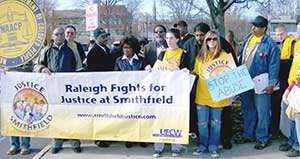
Smithfield workers " border="1">

Dec. 2 Raleigh solidarity action with
Smithfield workers
Photo: Donald Minor

Most of the Smithfield plants across the country are unionized through the United Food and Commercial Workers (UFCW). But pork and turkey coming out of the North Carolina plants find their way into several local grocery stores, including Harris Teeter, which uses mostly Smithfield meat for its store-packaged pork.

The USDA requires that codes be placed on all meat designating its origin. Any meat containing codes 18079 or 79c is processed at the Smithfield plant by oppressed workers.

Demonstrations organized by UFCW and community supporters were held in Asheville, Charlotte, Durham, Fayetteville, Greensboro, Hickory, High Point, Raleigh, Rocky Mount, Wilmington and Winston-Salem. At each site there was a media conference where workers—most of whom were Latin@ or Black—spoke out about the conditions in the plant. After the press conference, workers and union organizers marched into the stores and delivered a statement requesting that Harris Teeter stop doing business with Smithfield.

The biggest demonstration was in Raleigh where almost 200 people gathered, including members of the NAACP, the N.C. Council of Churches, N.C. Public Sector Workers Union (UE local 150), Fight Imperialism, Stand Together (FIST), Farm Labor Organizing Committee (FLOC), N.C. State University Student-Worker Alliance, College Democrats, Action for Community in Raleigh (ACRe), Teamsters, AFL-CIO, and high school students from Raleigh Charter and Athens High, amongst other organizations. Student Action with Farmworkers (SAF) also played an important role statewide in mobilizing to support the demonstration.

Participants, stretched at arms length, nearly surrounded the entire parking lot of a Raleigh Harris Teeter and handed leaflets to customers that explained the union’s main grievances are that Smithfield “has used violence, threats and intimidation against workers to suppress their rights; creates a dangerous workplace with fast line speeds and inadequate training; routinely fires injured workers and denies their workers’ compensation claims; and stirs racial tensions among African-American and Latino workers.”

Supporters’ signs read “Power to Immigrant Workers, Union Rights Now” and “Black and Brown Unity—UNIDAD Moren@ y Latin@.”

North Carolina is ripe for class struggle. It is the second-least unionized state in the country and also has the fastest growing immigrant population. Led by two Latina women still wearing their hair nets and work hats, more than 1,000 workers walked out of the Smithfield plant, shutting down two shifts of production on Nov. 16. Even the private police force could not coerce workers back into the plant as they continued to exercise their class power through unity.

It is only through unity amongst the Black and Latin@ workers that the will of workers will be exercised. The majority Black workforce of city workers across the state continues to organize their union, UE 150, and build their power following the historic strike of Raleigh sanitation workers two mornings in mid-September. Durham city workers later held a two-hour work stoppage on Nov. 27.

UE150 is convening a Statewide City Workers Summit on Dec. 9, drawing union workers from Chapel Hill, Charlotte, Durham, Fayetteville, Greensboro, Greenville, Raleigh, Rocky Mount and Wilson.

The struggle continues as these two strong workforces continue to learn from each other and mutually build working-class power in North Carolina.

The writer is an organizer with Raleigh FIST (Fight Imperialism, Stand Together) youth group. Contact fist@workers.org.

Youth fight back on Rosa Parks Day

Published Dec 7, 2006 10:36 PM

A march was held in New York to commemorate Rosa Parks Day, Dec. 1, and continue that legacy of struggle. Organized by FIST (Fight Imperialism, Stand Together) leader and high school student Mia Cruz, the march focused on the criminalization of youth, demanding removal of the roving police scanners recently implemented in New York City schools. Students have suffered physical and emotional abuse at the hands of the cops who enforce the scanners, as well as have had their personal property, such as cell phones, markers and iPods, confiscated.

—Report and photo by LeiLani Dowell

12.07.2006

South Africa: same-sex marriage legalized

By LeiLani Dowell

South Africa became the first African country and the fifth country worldwide to legalize same-sex marriage on Nov. 30.

The government was forced to enact legislation on same-sex marriage after the country's highest court gave it a year, expiring Dec. 1, to change laws that denied lesbian, gay, bi and trans couples the same constitutional rights as heterosexual couples.

Home Affairs Minister Nosiviwe Mapisa-Nqakula said, "In breaking with our past ... [we] need to fight and resist all forms of discrimination and prejudice, including homophobia." (iafrica.com, Nov. 14)

The first legal gay marriage took place the next day, when Vernon Gibbs and Tony Halls were married on World AIDS Day, Dec. 1. Vernon Halls-Gibbs told the BBC, "This marriage ... is for all HIV/AIDS sufferers and gay people who have experienced discrimination." (BBC, Dec. 1)

Mexico: president inaugurated under backdrop of repression, resistance

By LeiLani Dowell


Resistance to the Dec. 1 swearing in of Mexican President Felipe Calderón turned the traditional ceremony into a farce, symbolic of the fraudulent elections that granted Calderón the victory in July.

Legislators from the Democratic Revolution Party (PRD) of Andrés Manuel López Obrador--who was sworn in as Mexico's legitimate president at a people's inauguration on Nov. 20--used chairs to barricade most of the doors to the Legislative Palace where Calderón's inauguration was to take place. He was forced to use a back entrance to take the oath of office.

The Los Angeles Times reports: "With European princes, Latin American leaders, former President Bush and other dignitaries looking on, Calderón was inaugurated amid a chorus of derisive whistles in a ceremony that lasted less than two minutes. 'Felipe will fall! Felipe will fall!' leftist legislators shouted."

Meanwhile, resistance continues as 159 people were swept up off the streets of Oaxaca and arrested over the weekend of Nov. 24-26, for charges related to recent protests. The Narco News Bulletin reports that 141 of those have been moved by helicopter to the penitentiary in San José del Rincón, Nayarit--a twenty-hour drive away from Oaxaca. None of the arrested has had access to legal support, reporters or family members. (Nov. 29)

It is feared that the rape and torture of prisoners--of the kind witnessed during the struggle of flower vendors at Atenco this May--will occur with impunity and without exposure. A tour of Mexico recently completed by The Other Campaign of the Zapatista National Liberation Army found hundreds of political prisoners, thousands of people facing arrest warrants or charges for political organizing, and family members of political activists that had been "disappeared" throughout the country. (narconews.com, Nov. 29)

Federal police in Oaxaca are now conducting house-to-house raids throughout the state, searching for leaders of the Popular Assembly of the Peoples of Oaxaca.

Bolivia: massive land reform passed

By LeiLani Dowell


Bolivian President Evo Morales signed into law several progressive measures on Nov. 28, including a bill to reclaim tens of thousands of square kilometers of unproductive land from wealthy farmers.

The law will allow the redistribution of land in the eastern lowlands region to poor landless farmers, and states that land whose use is against the collective interest will be taken without compensation. The Inter Press Service reports that between 60 and 70 percent of the country's farmland is owned by a handful of families. (Nov.29)

More than 4,000 Indigenous people had marched on the capital city of La Paz to demand its passage; three died during the march, two of a suspicious car accident, one by lightning.

The measure was passed despite political maneuvering by the opposition parties to block it by boycotting the 27-member Senate, making it impossible to reach the 14-seat quorum needed to meet. However, after Morales threatened to pass the law by presidential decree, three opposition senators returned to the table with the 12 senators from Morales' Movement Towards Socialism party.

In addition to the land reform bill, contracts were passed with 10 foreign oil companies, in relation to the nationalization of Bolivia's natural gas reserves; and an economic cooperation agreement with Venezuela was approved. Morales also announced plans for other measures, such as nationalizing Bolivia's tin and mineral mines.

Sudan: African leaders denounce U.N. 'colonization'

By LeiLani Dowell

Leaders of African countries continue to voice their opposition to the imposition of U.N. troops in Sudan.

At a Nov. 19 meeting of Sudanese government officials and members of the Sudan Liberation Army, Libyan President Muammar Qaddafi told participants: "Western countries and America are not busying themselves out of sympathy for the Sudanese people or for Africa but for oil and for the return of colonialism to the African continent. ... The biggest disaster is if the Atlantic army came and positioned itself in Sudan."

Qaddafi continued: "The West exploits tribalism, sectarianism and {skin} color to feed war, which leads to backwardness and Western intervention in a number of countries. All the conflicts in Africa are caused by colonialism, which does not want the rise of the United States of Africa and works for division and interference and for military coups." (Al Jazeera, Nov. 19)

The Associated Press reported on a meeting of the heads of state of the African countries of Central African Republic, Chad, Egypt, Eritrea, Libya and Sudan on Nov. 21, saying that "the African leaders support Sudan's cautious attitude toward deploying U.N. troops in Darfur." (Nov. 21)

While agreeing to a combination of African Union and U.N. troops on Nov. 27, Sudanese President Umar al-Bashir reiterated Qaddafi's words, saying that Sudan "should not be the first recolonized country under the banner of humanitarian action in Darfur."(allAfrica.com, Nov. 27)

North Carolina organizers hold 'Statewide Day of Action Against Smithfield'

By Dante Strobino
Raleigh, N.C.

More than 700 people gathered in 11 cities across the state of North Carolina on Dec. 2 to support the just demands of workers at Smithfield, the world's largest hog slaughtering plant located in Tar Heel. The statewide day of action was held at North Carolina-based Harris Teeter grocery stores to demand that they support the largely immigrant workforce by stop selling the company's pork.

Most of the Smithfield plants across the country are unionized through the United Food and Commercial Workers (UFCW). But pork and turkey coming out of the North Carolina plants find their way into several local grocery stores, including Harris Teeter, which actually uses mostly Smithfield meat for its store-packaged pork.

The USDA requires that codes be placed on all meat designating its origin. Any meat containing codes 18079 or 79c is processed at the Smithfield plant by oppressed workers.

Demonstrations organized by UFCW and community supporters were held in Asheville, Charlotte, Durham, Fayetteville, Greensboro, Hickory, High Point, Raleigh, Rocky Mount, Wilmington and Winston-Salem. At each site there was a media conference where workers--most of whom were Latin@ or Black--spoke out about the conditions in the plant. After the press conference, workers and union organizers marched into the stores and delivered a statement requesting that Harris Teeter stop doing business with Smithfield.

The biggest demonstration was in Raleigh where almost 200 people gathered, including members of the NAACP, the N.C. Council of Churches, N.C. Public Sector Workers Union (UE local 150), Fight Imperialism, Stand Together (FIST), Farm Labor Organizing Committee (FLOC), N.C. State University Student-Worker Alliance, College Democrats, Action for Community in Raleigh (ACRe), Teamsters, AFL-CIO, high school students from Raleigh Charter and Athens High, amongst other organizations. Student Action with Farmworkers (SAF) also played an important role statewide in mobilizing to support the demonstration.

Participants, stretched at arms length, nearly surrounded the entire parking lot of a Raleigh Harris Teeter and handed leaflets to customers that explained the union's main grievances are that Smithfield "has used violence, threats and intimidation against workers to suppress their rights; creates a dangerous workplace with fast line speeds and inadequate training; routinely fires injured workers and denies their workers' compensation claims; and stirs racial tensions among African-American and Latino workers."

Supporters' signs read "Power to Immigrant Workers, Union Rights Now" and "Black and Brown Unity--UNIDAD Moren@ y Latin@."

North Carolina is ripe for class struggle. It is the second-least unionized state in the country and also has the fastest growing immigrant population. Led by two Latina women still wearing their hair nets and work hats, more than 1,000 workers walked out of the Smithfield plant, shutting down two shifts of production on Nov. 16. Even the private police force could not coerce workers back into the plant as they continued to exercise their class power through unity.

It is only through unity amongst the Black and Latin@ workers that the will of workers will be exercised. The majority Black workforce of city workers across the state continues to organize their union, UE 150, and build their power following the historic strike of Raleigh sanitation workers two mornings in mid-September. Durham city workers later held a two-hour work stoppage on Nov. 27.

UE150 is convening a Statewide City Workers Summit on Dec. 9, drawing union workers from Chapel Hill, Charlotte, Durham, Fayetteville, Greensboro, Greenville, Raleigh, Rocky Mount and Wilson.

The struggle continues as these two strong workforces continue to learn from each other and mutually build working-class power in North Carolina.

The writer is an organizer with Raleigh FIST (Fight Imperialism, Stand Together) youth group. Contact fist@workers.org

‘Stop racist killer cops’

Killings of 23-year-old unarmed groom, 92-year-old woman are not isolated acts

Published Nov 30, 2006 12:59 AM

Sean Bell was killed on what was supposed to be the morning of his wedding, Nov. 25, when police unloaded more than 50 bullets into the car he and two friends—all African American and all unarmed—were in. The three were leaving Bell’s bachelor party in Queens, N.Y.

Bell’s friend Joseph Guzman is in critical condition after being hit at least 11 times. The other, Trent Benefield, was hit three times. A report from New York in the Sydney Morning Herald said the two had been shackled to their hospital beds. (Nov. 28)

One white officer alone, Detective Mike Oliver, emptied a full magazine of bullets, reloaded and then emptied a second magazine—a total of 31 bullets. New York Police Department policy on shooting at moving vehicles clearly states that police cannot fire at a moving vehicle “unless deadly force is being used ... by means other than a moving vehicle.” (AP, Nov. 26) The officers involved were placed on administrative leave, yet are still being paid.

Not just ‘bad apples’

Authorities are scrambling to come up with excuses for Bell’s death. The police claim that one of Bell’s friends made reference to a gun. “Experts” discuss the problem of “contagious shooting”—which was amplified in 1993 when the NYPD switched from revolvers to semiautomatic weapons. The media is quick to point out that a multinational group of officers were involved in the incident—two white, two Black and one Latino—to downplay the racism in the killings. However, to reiterate, all the victims are Black.

But despite any excuses and “bad apple” theories, police violence and terror in communities of color is systemic, not individual. The police act as an indiscriminate, armed occupying force, with the mentality that the poor and people of color are disposable. Brutality against these communities is a daily occurrence.

As if to prove this point, the next day in the Bronx police attacked and then arrested Juanita Young, an activist against police brutality and the mother of Malcolm Ferguson, who had been killed by the NYPD in March 2000. According to a press release by the October 22nd Coalition, as many as eight cops participated in the attack, kicking her in the chest and back.

In addition, the group TransJustice has called for a press conference and rally on Nov. 29 to denounce the Nov. 1 beating and arrest of two African American men beaten by cops in the West Village of New York City. When a white male police officer pushed a young African-American woman without provocation, 23-year-old African-American college student Shakur Trammel requested his badge number. In response, the officer punched Trammel in the face and chest, threw him onto the police van and choked him with his nightstick. Eyewitnesses report that between four to six mostly white cops then kicked and punched Trammel and another African-American man who was being very vocal about his outrage at Trammel’s beating.

State violence grows with class tensions

Frederick Engels, Karl Marx’s closest collaborator and co-founder of scientific socialism, described the state as a public power that “consists not merely of armed men but also of material adjuncts, prisons and institutions of coercion of all kinds.” Engels continues to explain, “It [the public power] grows stronger ... in proportion as class antagonisms within the state become more acute.” (Engels, “The Origin of the Family, Private Property and the State,” 1884)

Anger in poor communities and communities of color is growing over the lack of jobs, healthcare and social services, the number of soldiers coming home dead or maimed from a war for big business, the news that the rich are getting even richer while the poor are still getting poorer. As during the Vietnam War, the ruling class fears organization and rebellion in the communities. The police apparatus is stepped up to keep these communities in line, to remind them of their “place.”

But this kind of repression inevitably leads to resistance. At a rally held the day after Bell’s killing, New York City Councilperson Charles Barron told the crowd, “I am fed up. I am not asking my people to do anything passive anymore. ... Don’t ask us to ask our people to be peaceful while they are being murdered. We are not the only ones that can bleed.”

A rally against the police state is planned for Dec. 6, 4:30 p.m., at One Police Plaza in downtown New York City. A statement by the December 12th Movement, organizers of the event, reads, “The issues on the agenda include the police profiling of Black youth; NYPD/Homeland Security occupation of the Black community; police aggression, harassment and overkill, as well as President Bush’s assault on Habeas Corpus; the erosion of civil rights; and Iraq war for oil.”

Atlanta cops kill 92-year-old woman

Police brutality of course is not unique to New York City. In Atlanta, 92-year-old Kathryn Johnston was killed Nov. 21 when an Atlanta drug squad executed a “no-knock” search warrant at her home.

Johnston’s neighborhood is close to an area known for drug trafficking and crime. According to her family, she was very concerned about being victimized and so had bars on her windows and doors and a permit for a pistol.

When Atlanta police pried the bars off the front door and broke it down, Johnston fired her rusty gun in self-defense, wounding three of the cops. They responded with a barrage of bullets.

Initially, the police claimed an undercover agent had purchased drugs at her home. Then the story changed: an informant had purchased crack cocaine with city-supplied funds at the address.

This informant allegedly told police that there were surveillance cameras at the house—an element which increased the likelihood of a “no-knock” warrant being granted. On Nov. 21 around 6 p.m., a Fulton County magistrate issued that warrant, based on an affidavit with these details submitted by narcotics investigator Jason R. Smith.

Barely more than an hour later, Atlanta police smashed through the front door of Johnston’s home.

Outraged neighbors and family insist that she lived alone. No one recognizes the description of the drug suspect, “Sam,” named in the warrant.

Johnston’s long-time neighbor Curtis Mitchell said, “I think that’s just something they made up.” Her niece, Sarah C. Dozier, agreed, saying, “As far as I am concerned, they shot her down like a dog.”

That suspicion was verified six days after Johnston’s death, when the informant publicly stated that he provided no such information to the police. He says that shortly after the shooting occurred, police called him, telling him to back up their story. According to the Atlanta Journal-Constitution, he has told internal affairs investigators and local media that the police fabricated the whole thing and told him to lie about his role in it. (Nov. 28)

Johnston’s killing came on the same day that the district attorney in adjacent DeKalb County announced that she will ask a grand jury to review a string of deadly police shootings there to determine whether criminal charges should be filed. Organized pressure forced this move by local officials, though it is only a modest response to community demands for police accountability and civilian review.

Since January 2006, DeKalb police have shot and killed 12 people and admit that several officers violated standard procedures. A 13th person died in custody after being hit with a baton and pepper-sprayed. Just days before the DA’s announcement, a 34-year-old woman was fatally shot by a police officer who said she came at him with a knife. Others at the scene said that she was scared and running away.

Congressperson Cynthia McKinney made a formal request on Nov. 25 for an immediate Department of Justice investigation into “a developing national pattern of police misconduct and abuse.”

From New York to Colorado to Milwaukee to Georgia, family members, community activists and progressive elected officials have demanded not only answers to what happened to these individuals but an end to police disregard for the lives of residents of working class and poor neighborhoods.

For weeks in Atlanta, there have been vigils, press conferences, rallies and other protests that have forced the issue of police killings into the public spotlight. Over and over, the people have made it clear: “No justice, No peace.”


Copyright © 1995-2006 Workers World. Verbatim copying and distribution of this entire article is permitted in any medium without royalty provided this notice is preserved.

Katrina survivors face eviction

Published Dec 2, 2006 10:22 PM

One hundred residents of the Woodlands apartment complex in New Orleans face eviction by a double-dealing landlord and the property management group to which he sold the complex.

The complex was being managed by the Common Ground Collective. The collective’s stated mission is to provide short-term relief for victims of hurricane disasters in the Gulf Coast region, and long-term support in rebuilding the affected communities in the New Orleans area.

Common Ground is a community-initiated volunteer organization offering assistance, mutual aid and support. The work gives hope to communities by working with them, providing for their immediate needs. The emphasis is on people working together to rebuild their lives in sustainable ways.

Common Ground Collective had taken over managing the apartment complex known as the Woodlands. The collective wanted to provide affordable housing, and its long-term goal was to purchase the property to create cooperative housing, small-business cooperatives, social programs and human-services offices. Common Ground would maintain rents that were the lowest in the city.

Common Ground had rehabilitated more than 100 housing units in the Woodlands complex and provided for 100 residents who signed leases with the group.

The owner of the complex, Anthony Regenelli, who had entered into an agreement with Common Ground to purchase the complex, sold the Woodlands out from under the collective to the Johnson Property Group, LLC. Both Reginelli and the new owners are trying to evict 100 residents during this holiday season.

The collective—begun after Hurricane Katrina had pass over, and its after-effects and the criminal neglect of the poor and Black residents were being felt—stands in the way of those who want to gentrify the whole city.

After Hurricane Katrina, rents in New Orleans skyrocketed—all part of a process to push out the poor and mostly Black residents to reinvent New Orleans as a play destination for the rich.

Before Katrina, the average rent for a one-bedroom apartment was $578 a month. After the storm the average rent shot up to $803 a month. The city has also slated 5,000 public housing units for demolition.

Developers, landlords and bankers in the area salivated at the prospects, and even conspired to try to oust a mayor they had once helped to elect because he is Black and remarked on keeping New Orleans a “chocolate city.”

The people of New Orleans, though dispersed throughout the country, have vociferously expressed their desire to keep their city—by marching, protesting and re-electing Mayor Ray Nagin. Though Nagin represents the aims of the New Orleans ruling elite, the re-election campaign had become a matter of self-determination for the city that was nearly 70-percent Black before the storm.

The residents of the Woodlands are ready to fight, once again showing that the people of New Orleans—a city where the culture was forged during slavery and the racist repression that followed the end of chattel slavery—will not simply let their city be taken from them.

The residents will be in court to fight the eviction orders at 9 a.m. on Nov. 28, at the Second City Court, at the Historic Algiers Courthouse. They have initiated a letter-writing campaign and will be calling news conferences and protests.

Sample letters can be found at: www.commongroundrelief.org/files/woodlands1.pdf.

The group can be contacted via e-mail at nolaevictiondefense@gmail.com.


Copyright © 1995-2006 Workers World. Verbatim copying and distribution of this entire article is permitted in any medium without royalty provided this notice is preserved.

Youth, community confront recruiting station

Published Nov 26, 2006 10:02 AM

Over 70 youth, students, and community members marched and rallied Nov. 15 against the first U.S. Army recruiting station to open in Chapel Hill, N.C.

Anti-war and counter-recruitment activists marched two miles from the University of North Carolina at Chapel Hill’s campus to the new recruiting station at 1502 E. Franklin St., led by a banner which read, “Army recruiters out.” UNC-Chapel Hill Students for a Democratic Society (SDS) was the primary organizer of the demonstration.

The rally outside the station consisted of speeches by members of FIST (Fight Imperialism, Stand Together) and SDS, as well as representatives from Feminist Students United and NC Choices, a Quaker group which advocates choices for young people after high school other than the military. Speakers focused on topics such as sexual violence in the military, the ongoing occupation of Iraq, and cuts in funding for educational opportunities. Speakers highlighted the fact that over a third of women in the military report experiencing sexual assault and that reports have been filed against over 100 recruiters for sexually assaulting and harassing young women.

In response to the youth and community demonstration, the military mobilized eight World War II and Korean War veterans, dressed in uniforms and military decorations. They continually harassed demonstrators, yelling racist, anti-gay and sexist slurs at speakers and protestors alike. While the veterans’ appearance at the demonstration was unexpected, the protestors were unfazed and organizers called the rally “an unconditional success.”

This recruiting station will be the target of a continuing fight from youth and student activists, who vow to end the targeting of youths in their community, especially poor youths and youths of color. “We won’t allow the military to come into our community and practice the same deceptive and racist tactics they have practiced for so long in other communities,” said FIST member Peter Gilbert. “This struggle is just beginning and we won’t stop until military recruiters leave our town.”


Copyright © 1995-2006 Workers World. Verbatim copying and distribution of this entire article is permitted in any medium without royalty provided this notice is preserved.

Youth, community confront recruiting station

Published Nov 26, 2006 10:02 AM

Over 70 youth, students, and community members marched and rallied Nov. 15 against the first U.S. Army recruiting station to open in Chapel Hill, N.C.

Anti-war and counter-recruitment activists marched two miles from the University of North Carolina at Chapel Hill’s campus to the new recruiting station at 1502 E. Franklin St., led by a banner which read, “Army recruiters out.” UNC-Chapel Hill Students for a Democratic Society (SDS) was the primary organizer of the demonstration.

The rally outside the station consisted of speeches by members of FIST (Fight Imperialism, Stand Together) and SDS, as well as representatives from Feminist Students United and NC Choices, a Quaker group which advocates choices for young people after high school other than the military. Speakers focused on topics such as sexual violence in the military, the ongoing occupation of Iraq, and cuts in funding for educational opportunities. Speakers highlighted the fact that over a third of women in the military report experiencing sexual assault and that reports have been filed against over 100 recruiters for sexually assaulting and harassing young women.

In response to the youth and community demonstration, the military mobilized eight World War II and Korean War veterans, dressed in uniforms and military decorations. They continually harassed demonstrators, yelling racist, anti-gay and sexist slurs at speakers and protestors alike. While the veterans’ appearance at the demonstration was unexpected, the protestors were unfazed and organizers called the rally “an unconditional success.”

This recruiting station will be the target of a continuing fight from youth and student activists, who vow to end the targeting of youths in their community, especially poor youths and youths of color. “We won’t allow the military to come into our community and practice the same deceptive and racist tactics they have practiced for so long in other communities,” said FIST member Dante Strobino. “This struggle is just beginning and we won’t stop until military recruiters leave our town.”


Copyright © 1995-2006 Workers World. Verbatim copying and distribution of this entire article is permitted in any medium without royalty provided this notice is preserved.

Board of Education: ‘Recognize our rights!’

Published Nov 22, 2006 12:30 AM

The New York City Board of Education (BOE) has been the key factor in the miseducation occurring in the city’s public and charter schools. Thanks to the curricula approved by Joel Klein, students learn how “White colonists helped Africa” and how “Hezbollah was involved in 9/11.” This kind of misinformation has led to hate toward and discrimination against certain cultures.

If the teachers are trained to teach this false history, then the students are taught to believe it. One of the rights in the New York City students’ Bill of Rights, written by the Urban Youth Collaborative (UYC) Student Union, states that we students should be taught about the history and diversity of the schools’ student populations. This means Black students learning about Black history, but true history, not white colonial lies. Any person of color knows that white colonists never helped the people of Africa—they tortured, raped and murdered them.

Joel Klein also implemented school safety laws which make cell phones and iPods “contraband” in school buildings. He’s implemented “roving scanners.” This not only enforces the ‘electronics ban’ but also inhibits a learning environment.

We have a right, as students, to study in a safe and nonthreatening environment, according to the student Bill of Rights. This right directly counters the roving scanners policy by the BOE. Roving scanners is a recent manifestation of ‘school security’ which had security officers showing up one morning, without informing the student body or parents, with metal detectors and handcuffs on the belts of every officer. This violates the Bill of Rights in another way, infringing on the right to have students and parents involved in the school’s decision making process.

We students are fed up with the violation of our rights, privacy, security and confiscation of our personal items. We are calling for students, parents, teachers and advocates to come out and demand student rights, including protection for all small schools and better equipment and trained school security officers for larger schools. No longer should students feel like prisoners at a place of learning.

Come out on Dec.1

Dec. 1 is Rosa Parks Day. This marks the 51st anniversary of Parks’ courageous arrest for refusing to give up her seat on a segregated Montgomery, Ala., bus. Before her, many young women were arrested for the same reason. Even though Mrs. Parks was the one to make headlines, it was the youth who inspired this courageous act.

Last year in October, students of color in France realized the racism of their society and rose up. This only came after the death of other youth of color. This uprising made headline news because the youth are powerful in numbers. Youth put a stop to business as usual in France. And for one day, we need to put a stop to business as usual in New York City!

Dec.1 is a day of commemoration and a day of strike. It is a day of impunity. This is so we can take off, celebrate and stand up for our civil rights without the harassment of being marked absent. We need to stand up for our rights as the civil rights movement and the students and youth of France so courageously did in the past.

We will gather at the northern end of Cadman Plaza, Brooklyn, at 11:30 am. We will march across the Brooklyn Bridge, and we will tell the Board of Education how it feels to have our student rights violated! They need to know what happens to us when the BOE picks a school to scan and allows students to be harassed, physically, sexually and mentally. No school, no work, no shopping on Dec. 1!!!

The writer is an organizer with FIST-Fight Imperialism, Stand Together, youth and student group. For more information about FIST, e-mail fist@workers.org. To contact the writer, e-mail poweractivist@yahoo.com.


Copyright © 1995-2006 Workers World. Verbatim copying and distribution of this entire article is permitted in any medium without royalty provided this notice is preserved.

11.22.2006

Immigrant workers lead wildcat strike

Solidarity is key to reinstating fired workers

Published Nov 22, 2006 1:10 AM

Five hundred workers walked off the job here at Smithfield Packing Nov. 16 in response to the recent firing of 75 immigrant workers, many of whom support efforts to unionize the plant. The next day, the plant was shut down again when over 1,000 workers, including many African Americans, walked out.

After the two-day walkout, Smithfield Packing bosses agreed to workers’ demands to halt the wholesale firings, and to reconsider their implementation of immigration policies in the plant. For the first time, the company also agreed to meet with a group of workers elected by the workers themselves to further negotiate about plant issues and employee concerns. That meeting will take place Nov. 21.

Workers have been struggling for 12 years to bring a union to the world’s biggest hog processing plant, located in a poor, rural region of eastern North Carolina.

North Carolina is a “right to work”—that is, officially anti-union—state. The work force is the second least unionized in the country. There is a fast growing new Latin@ population.

Against this background, Smithfield Packing has spent millions of dollars in a campaign to intimidate the workers and keep the union out.

When the United Food and Commercial Workers initiated an organizing campaign at Smithfield in 1994, the work force was mostly African American. Now, it is at least 65 percent Latin@, about 30 percent African American, with the rest white and Native workers.

The company has used racism, fear and other intimidation tactics to keep the union out. In the 1997 election, Smithfield was found guilty of violating over 40 federal labor laws. But the bosses tied up the court decision in appeals for eight years.

As detailed in a 2005 Human Rights Watch report titled “Blood, Sweat, and Tears,” Smithfield workers have been maimed, injured and killed as a result of the working conditions in the plant. Union supporters and organizers have been wrongfully imprisoned and beaten by Smithfield’s private police force.

Over the past several months, support for the union has grown. This, coupled with the company’s loss of its last appeal of the National Labor Relations Board decision, has encouraged the workers who say they feel they are close to winning a historic victory and a contract.

In the weeks leading up to the walkout the company fired 75 Latin@ workers claiming their Social Security paperwork could not be verified. Some of these workers had been at the plant for two to three years. In an interview at Smithfield, one worker said the workers believed the company was using the paperwork claim as an excuse to fire union supporters.

New immigrant workers are realizing their power. On May Day 2006 thousands of Smithfield workers and their families united behind the immigrant-rights struggle. The May Day demonstrations around the country showed that this community has power and that unity behind the immigrant-rights struggle and the struggle for worker justice can move the overall working-class struggle forward.

The campaign for Justice at Smithfield continues. It will not end until the workers win a contract and union recognition.


Copyright © 1995-2006 Workers World. Verbatim copying and distribution of this entire article is permitted in any medium without royalty provided this notice is preserved.

11.17.2006

Youth host women’s fightback conference

Published Nov 9, 2006 7:50 PM

Young people from North Carolina and three other states gathered together on Nov. 4 to have a conference with the goal “to push the struggle against gender oppression to the very front of the social justice movement—to look at where we are, how we relate to each other, and how to move forward.” The Women’s Fightback Conference reached and exceeded this goal with the help of youth from North Carolina State University, the University of North Carolina at Chapel Hill, local Raleigh high schools, the Socialist Unity League of UNC at Asheville, the N.C. Green Party, and Raleigh FIST (Fight Imperialism, Stand Together).

Women’s Fightback Conference. " border="1">

Raleigh FIST and other participants at
Women’s Fightback Conference.
Photo: Tony Macias

This conference brought together 95 people of many ages, genders, sexualities and nationalities in a safe space to talk about the disempowerment of women in society and how it affects the movement. The all-day event included four workshop sessions with topics ranging from “Imperialism, Women and War” to “Sexist Language and Meeting Dynamics.”

One workshop entitled “Women in the Workplace and the Labor Movement” featured a young woman who is currently incarcerated and being exploited in a work release program. She talked of not being able to confront her boss because she had no one at the women’s facility to back her up. She said it was their word against hers, and that no one would believe her. She also explained that she gets paid $1 a day and that they take rent out of her meager checks every month.

A member of UE Local 150 was on the panel to discuss their struggle as well.

The conference culminated with a cultural event that combined speakers, spoken word performances and some inspirational music. Fruit of Labor, which is the cultural arm of Black Workers for Justice, had the crowd singing, “Organize, organize, organize!” They ended the night with the Diane Reeves song “Endangered Species,” and conference participants all joined in the chorus: “I am an endangered species / But I sing no victim’s song / I am a woman, I am an artist / And I know where my voice belongs.”


This article is copyright under a Creative Commons License.
Workers World, 55 W. 17 St., NY, NY 10011
Email: ww@workers.org
Subscribe wwnews-subscribe@workersworld.net
Support independent news http://www.workers.org/orders/donate.php

11.01.2006

World condemns Czech Republic’s ban on Communist Youth Union


Published Oct 28, 2006 12:14 AM

The Czech Republic outlawed the Communist Youth Union (KSM) earlier this month after an announcement by the Ministry of Interior ordered the group to disband. The KSM has close ties to the Communist Party of Bohemia and Moravia which controls 13 percent of the seats in parliament.

The official reason given for KSM’s ban was its program for the replacement of the private ownership of the means of production with collective ownership. The government was also unhappy with KSM’s advocacy of socialist revolution and used this as a pretext to attack its status as a civic organization.

The Interior Ministry’s decision to ban the KSM came a month after the far-right Civic Democrats (ODS) took power after winning a slim plurality of seats in June’s parliamentary elections. The ODS is led by Prime Minister Mirek Topolanek, who has been implicated by the Czech media in several business scandals. The ODS failed to win a vote of confidence taken in the lower house of parliament at the beginning of October.

An international campaign brought together hundreds of youth and student organizations, trade unions and political parties to defend the KSM and protest the Ministry of Interior move at Czech embassies around the world.

A defiant KSM has vowed to carry forward the struggle “for the rights of the majority of young people—students, young workers and unemployed—and for socialism” despite the government ban. The KSM has grown in popularity in recent months by leading a major campaign against a U.S. proposal to build a strategic missile base in their country. The ruling ODS supports this proposal.

The KSM can trace its roots to the former Communist Party in Czechoslovakia, which held power before the bourgeois counterrevolution of 1989 dismantled the country’s socialist system. The subsequent introduction of a market economy has brought on a constant attack against workers, young and old, who have seen their standard of living threatened as homelessness and poverty—societal ills eliminated under the socialist system—have re-emerged.

Fight Imperialism Stand Together (FIST) stands in solidarity with the KSM and its struggle to liberate young workers and students and to defend itself against the attacks of the Czech government. FIST denounces the actions of the Interior Ministry as an attack on workers, young people, and students.

FIST is a group of multinational students and young workers living in the United States who fight for socialism in that country and around the world.

The writer is a FIST organizer. Contact FIST@workers.org.

10.11.2006

Victims of racist cop lead protest

Published Oct 5, 2006 8:23 PM

On Sept. 30 CopWatch activists, community members and victims of police brutality—Loree McCormick-Rice and her family—protested against the latest case of police brutality in Aurora, Colo.

Cassidy McCormic

Cassidy McCormic

Pedestrians and people in cars showed a lot of support. People also stopped to recount horrible incidents of terror at the hands of Aurora and Denver cops. Many people talked about being stopped by cops for no reason and being made to strip on the side of the road, a violation of all their rights.

The protest was called for Loree McCormick-Rice and her daughter, Cassidy McCormick, who say Aurora cop Sgt. Charles DeShazer beat them brutally on June 17.

What makes this latest case even more despicable is that McCormick-Rice is disabled. She suffers from severe asthma and has had one of her lungs removed. Cassidy, her daughter, is only 12 years old.

Workers World interviewed them after the demonstration to get their take on what happened last June. Their story follows:

On the night they were beaten, McCormick-Rice and Cassidy were leaving a King Soopers supermarket in Aurora. DeShazer, who moonlights as a security guard for the supermarket, approached them.

McCormick-Rice was parked in a handicapped parking spot. DeShazer asked where her handicapped placard was and she pointed it out. She had to point it out twice to him, and then pointed to her carbon dioxide and a nebulizer to relieve asthma, which were on her seat.

Cassidy McCormick. " border="1">

Loree McCormick-Rice and her daughter,
Cassidy McCormick.

A white woman who did not have her placard displayed openly approached McCormick-Rice. The white woman remarked: “That’s just pure racism. When will it ever end? I’m parked right here next to you in a handicapped zone without a placard and he walked right pass me and didn’t question me, and yet he’s harassing you.”

DeShazer, as he was walking away, said, “F—king n——s.” The woman talking to McCormick-Rice volunteered her name and number as a witness. Other witnesses also said they overheard the slur.

When DeShazer admitted to McCormick-Rice that he had used that racist insult, Cassidy suggested they report him to the store manager. Back in the store, another woman of color, overhearing McCormick-Rice’s complaint at the Service Desk, volunteered that she had had problems with DeShazer before.

As McCormick-Rice was walking to her car after lodging a complaint, DeShazer, who was sitting in a blue Ford Taurus, called her a “f—king idiot.” She responded.

McCormick-Rice and Cassidy drove out of the parking lot. DeShazer pulled up behind them and flashed his lights. McCormick-Rice turned to pull back into the parking lot, which is well lit. It was 10 p.m. She and her daughter were afraid. DeShazer blocked their way and yelled for them to “Get out of the f—king car.”

McCormick-Rice asked DeShazer if they could go into the parking lot where there were witnesses, and DeShazer again yelled at her, this time saying, “Turn off your f—king engine.”

McCormick-Rice told Cassidy to go and get help. DeShazer grabbed the young girl by her arm, after threatening her if she didn’t get back into the car. DeShazer, a large man, shook the small, young girl repeatedly.

Cassidy screamed for help from her mother. DeShazer threw the child against the car and put her in handcuffs, while McCormick-Rice pleaded for him to let her daughter go and not to hurt her.

McCormick-Rice then got out of the car and put her arms around her daughter. DeShazer threw the mother to the ground. Witnesses noticed the attack. McCormick-Rice picked herself off the ground and tried to get her cell phone, which was ringing. It was her 15-year-old son, and she told him she needed help.

DeShazer grabbed her and threw her to the ground again. He put McCormick-Rice in handcuffs, stood up, stepped down on her and kicked her. He then threatened the witnesses who were gathering.

The “back-up” that DeShazer called for arrived. McCormick-Rice told them what had happened, but they laughed her off and refused to give her her medicine. When asked what he was charging them with, DeShazer said, “I’ll think of something.”

McCormick-Rice was having difficulty breathing, but was repeatedly denied her medicine and was told that she was faking.

DeShazer continued to be belligerent, even asking, “You still want to screw with me?”

The full-time security guard for the store came and corroborated McCormick-Rice’s story about the racial slur, but was told to accompany DeShazer into the middle of the street, where they had a brief conversation.

McCormick-Rice said she was worried about her daughter because they were put in separate cars. She heard Cassidy screaming and crying. Finally, one cop said that McCormick-Rice should be let go. A female cop threw McCormick-Rice’s shoes at her when she asked if she could have them back.

When McCormick-Rice returned to her car, she noticed that her purse had been rummaged through and that the witness list was gone. Cassidy was taken to the Aurora police station. The 12-year-old was bruised and crying when her family picked her up.

Cassidy’s shoulder was fractured, it was later discovered. McCormick-Rice and Cassidy were charged with obstructing a peace officer, resisting arrest and failure to obey. McCormick-Rice also received a charge of disturbing the peace.

This is their story. This latest episode is an outrage for many reasons, but it illustrates that incidents of police brutality are not isolated.

Young Cassidy would later ask her mom, “Is this what we get for being Black?”

The reality is that cops are agents of the racist capitalist state. But what’s more, the agenda of the racist state filters down through the capitalist-run media, which constantly demonizes people of color. Even a 12-year-old Black woman, who has received numerous school accolades and, after this ordeal, support letters from teachers, principals and deans of students of schools she has attended, is seen as less than human and brutally attacked.

However, the family has vowed to fight until DeShazer is fired, and to continue to fight against racism and police brutality. And the community has rallied around them, even trying to start a defense campaign.

DeShazer, though, is not an anomaly, a bad cop among good cops. He is one among an army of thugs whose job is to protect capital and to keep the poor, people of color and workers in line.

Sanitation workers force mayor to meet demands


Published Oct 7, 2006 12:38 AM

Raleigh sanitation workers have taken a step forward and forced Mayor Charles Meeker to meet with the union to discuss their demands.

The elected workers’ committee and union representatives met with the mayor on Sept. 26 demanding an end to forced overtime, time-and-a-half pay for all overtime, immediate hiring of all temporary city workers as permanent workers, an end to bosses’ harassment, and the right to organize.

The city has hired at least 10 temporary workers to full-time positions, and committed to hire more. The city has also been forced to pay the workers regular overtime pay.

Workers will meet with the mayor again Oct. 3 to further press their demands.

The North Carolina Public Service Workers’ Union, United Electrical Local 150, represents a large majority of sanitation workers, as well as other city workers in Raleigh and throughout the state along with a variety of other public-sector workers. North Carolina is the only state with a law preventing any public workers from having a contract—a relic of the racist Jim Crow era and a clear violation of the workers’ human rights.

The courageous work stoppage of the sanitation workers that took place for several hours on Sept. 13 and their struggle for justice that continues to gain momentum are a first step toward pushing back a century of anti-worker laws and racist repression in the U.S. South.

The spirit of these workers, taking a stand for dignity to improve their conditions, is resonating with workers across the South and the entire United States. When the most oppressed sector of the work force, low-paid Black sanitation workers, take such a stand it encourages the working class as a whole.

Workers across North Carolina and other city workers are being drawn further into this struggle. They are building power to overturn the state’s racist anti-worker laws. Solidarity statements are also coming in from fighting unions across the country.

Building community solidarity

Inspired by the sanitation workers’ struggle, community groups and leaders are coming together. Anti-war and anti-racist activists have covered the city with signs and leaflets. Supporters and activists with Raleigh FIST—the youth group Fight Imperialism Stand Together—travel the city every day in a sound truck, holding street meetings, distributing yard signs, and building visible solidarity with the workers.

Union supporters from the International Action Center in New York and Atlanta have traveled to Raleigh to help in the fight. Activists in at least four other cities have helped organize through computer help. The North Carolina conference of the NAACP has been very vocal in its support of the sanitation workers; its president, Rev. Dr. William Barber, serves as UE-150’s most vocal champion in the fight for full collective-bargaining rights.

Ministers at Black churches from across the state have motivated their congregations and are organizing mass support for these workers. Residents across the city have expressed continuous solidarity, putting signs on their trashcans or in their yards, honking and waving at the trucks, offering cookies and coffee to the workers on their routes.

Although the workers have now won significant gains, and continue to meet and confer with the mayor and other city officials, they have their eyes constantly on a larger struggle—that is to win full union recognition, collective-bargaining rights, and to help organize all unorganized workers in the U.S. South.

The writer is an organizer with Raleigh FIST. Contact FIST@workers.org for more information.

FIST leader confronts police, metal detectors


Published Oct 1, 2006 4:27 PM

Sept. 26--After two days of protests, metal detectors had been removed. The following is an account by the organizer of the protests.

On the morning of Sept. 22, dozens of police officers armed with guns and scanners monitored the doorway of Humanities Preparatory School, making students of Humanities and two smaller schools inside of the building walk through metal detectors. This was in response to a rumored stabbing at the Bayard Rustin High School for the Humanities.

This police occupation not only violated the students’ personal space, but also turned students into petty criminals. Students were suspended for personal possessions the law might call “illegal”, but things that were no threat at all. Police officers took away cell phones, iPods, and even artistic markers—claiming they were for graffitti. Threats of confiscation escalated to arrests.

I happen to go to one of the smaller schools in the building, James Baldwin School. As I arrived that day, it looked like a police state. Since the original fight had nothing to do with either of the smaller schools, I staged a picket across the street to give a statement to the Board of Education that we do not approve of these scanners.

What was planned as an hour-long picket turned into an hour-and-a-half of explaining to officers, teachers and students why we need our cell phones—on a Friday—and why we need our privacy. The police were stopping students as far away as the subway station, searching them for inappropriate reasons and saying inappropriate things. Altogether, about 40 students joined us and 23 of them signed in and spent time on the picket with me. Students and an administrator who wanted to join us were intimidated and some went home. Some others went into the school, but promised to spread the word and tell others to join us on Monday’s picket!

After about an hour-and-a-half, officers and the principal of Humanities told us that truancy officers would be picking us up, so more students went into the school and more left. They tried to take us into the school before the truancy officers came, but I refused to go through the scanners. They finally called my mother and told her to pick me up so I would not be marked truant. They then took me inside the school without being scanned, and the principal whispered in my ear, “I’m proud of you.”

I was held in the Dean’s office of Humanities, until my mother picked me up. While waiting, I heard stories of experiences that these students will never forget. A classmate of mine was bodily searched and arrested. Objects were confiscated which didn’t even fall into any illegal category. The police seemed to be scared by what they didn’t recognize.

Cruz is a member of FIST—Fight Imperialism, Stand Together

Raleigh, N.C., sanitation workers’ struggle heats up


Published Sep 29, 2006 11:03 PM

“What do we want? Justice! What do we want? Collective Bargaining!” chanted more than 100 sanitation workers and supporters in front of Raleigh’s City Hall on Sept. 25, in response to City Manager Russell Allen’s inadequate response to their demands. The workers had gone back to work in good faith after their wildcat strikes the previous week, and had given the city until Sept. 22 to meet their demands.

protest at Raleigh City Hall. " border="1">

Leo Brown, sanitation worker, at Sept. 25
protest at Raleigh City Hall.
Photo: Takaaki Iwabu

The issue underlying the struggle is serious understaffing across the city. On Sept. 19, workers made a strong presence at the City Council meeting, where the council motioned to retain six positions they had deleted in an earlier meeting and add six new positions. However, there was no mention of the 20 positions the bosses have kept unfilled.

Allen mentioned that he has given authority to the bosses to pay overtime pay; yet this leaves discretion in their hands. The workers need written confirmation that they will be given time-and-a-half pay as a permanent policy, and that working over 10 hours of overtime will be voluntary, not forced.

Workers have been getting paid for overtime only with compensation time, which legally can only be accrued up to 70 hours, after which time-and-a-half pay must be given. This practice has clearly been violated. The bosses do not keep track of workers’ hours and pay all workers for 40 hours every week. Workers recently filed for a written record of hours worked, knowing no such records exist.

Workers also demanded the right to collectively bargain. They have been organizing and over three-quarters of the sanitation plant workers are now signed up with UE Local 150, the N.C. Public Sector Workers Union. In response, Mayor Charles Meeker said he wanted to establish “meet and confer” practices—a step between no recognition and collective bargaining—with the workers.

Allen promised to be at the plant on Sept. 22 to meet with workers, but when he showed up he refused to meet with any of the workers in the union. He left the meeting having addressed very few of the demands.

“[Allen] did not guarantee that we would not be forced to work overtime, nor did he make any promises about paying us for our overtime work. … He has no respect for us or the union,” said John T. McNeill, UE 150 member and sanitation worker. “It was a disaster,” says union-meet-and-confer committee member and sanitation worker Jerry Ledbetter. “Normally I do not call out racism, but he was plain racist.”

Later at the union meeting, workers gave Allen a vote of no confidence and are currently seeking to meet and confer with the mayor.

The South and the movement for collective bargaining rights

Sanitation workers in Raleigh say that they wouldn’t have struck had they been given the dignity and respect of city management through collective bargaining. The same has been said throughout North Carolina by the International Workers Justice Campaign.

The campaign is organized by UE Local 105 and Black Workers for Justice to bring international attention to the working conditions created in an environment without collective bargaining rights, and to repeal North Carolina General Statute 95-98, which makes collective bargaining illegal for public employees.

Workers, mostly UE members, spoke out in public hearings over the last year in Greensboro, Goldsboro, Rocky Mount, Durham, Chapel Hill, Raleigh and Charlotte. This culminated in a statewide hearing where members of the United Nations’ International Labor Rights Commission from South Africa, Nigeria, Sweden, Mexico, Japan, Quebec, and India listened to workers’ demands. The ILRC prepared a 90-page report that was delivered by UE activists to members of the N.C. General Assembly. Thousands of petitions were also delivered to Governor Michael Easley.

This entire struggle must be considered in the context of right-to-work laws, runaway shops, deindustrialization, and all working conditions in the U.S. South. Until last year—when the Farm Labor Organizing Committee signed a contract covering 7,000 migrant workers—North Carolina was the least unionized state in the country, with less than 2 percent of workers having union representation. Now it is second worst, only ahead of South Carolina.

Because of NC 95-98, North Carolina is the only state in the country where it is illegal to collectively bargain. It was written in 1959 in response to Jimmy Hoffa’s announcement that he would lead the Teamsters Union in an effort to organize 10 million public workers. Eleven other mostly Southern states do not have laws protecting collective bargaining rights.

Striking is illegal in North Carolina, but the laws cannot be taken out of the context of workers’ power. Workers are continuing to organize and fight for their demands.

“Unions have been needed here for a long time. … Now we are standing up and fighting for justice,” said Ledbetter.

The writer is a member of the FIST youth group and the UE 150 staff.

Sanitation workers forced into wildcat strike

Sanitation workers forced into wildcat strike

Published Sep 21, 2006 10:36 PM

On the mornings of Sept. 13, 14 and 15, workers for the City of Raleigh Solid Waste Division carried out an historic wildcat strike, withholding their labor power and shutting services for several hours on each of those days.

Sanitation workers in Raleigh, N.C.

Sanitation workers in Raleigh, N.C.
WW photo: Dante Strobino

In a plant with over 100 workers, more than 80, including both drivers and laborers, refused to mount the trucks and drive the city streets to pick up the garbage. The vast majority of these workers are Black.

Sanitation workers suffer from some of the worst conditions of all public employees in a city rife with irresponsive governmental bureaucracy and cronyism. These super-oppressed workers are raising their voices and organizing around their just demands, which include: no forced overtime (10 hours a day maximum), time-and-a-half pay for voluntary overtime work, all temps be made permanent workers, an end to harassment from bosses, and respect for the workers’ right to organize and elect their own leaders.

UE Local 150—the North Carolina Public Sector Workers Union—has been organizing public sector workers since 1996. It represents workers in four strategic areas: Department of Health and Human Services, the University of North Carolina system, city workers, and private workers in auto and aerospace in eastern North Carolina. UE 150 has been meeting with Raleigh sanitation workers for over a year now and supported the recent worker-initiated job actions.

On Sept. 14, over half of the solid waste workforce attended the UE 150 union meeting. There they voted, signed up and took an oath to join and build the union. Many other workers who could not attend the meeting have already joined. Many others are joining every day. In the parking lot outside, energy was high as workers chanted, “The orange brigade is rolling in.” The workers had pledged to wear bright orange shirts.

There was an incredible amount of unity in the room, as workers themselves decided what steps to take next, elected a leadership structure to meet with bosses and speak with the media, and decided on what demands to prioritize.

Raleigh is one of the fastest growing cities on the East Coast. From 1990 to January 1999, Raleigh registered a 30.1 percent increase in population and expanded its area by more than 20% but has not had a similar growth in the workforce. In fact, recently the City Council cut $135,000 from the budget to get rid of six city worker positions. The city has also implemented “one-armed bandits,” new automatic trucks that only need one worker to operate, causing increased stress, danger and workload.

Jimmy Gaye, a solid waste laborer for 22 years and UE 150 member said, “The city is growing but the workforce is not growing. … The only changes I have seen have been to benefit the [bosses]. The job action has been a long time coming. They cut down our truck from four to three people and made me work … without extra pay. I joined the union so someone would listen to me. The heads and superintendent won’t listen.”

Speaking about the high risk work environment, he said, “I have seen a man almost get his head cut off here; I know one guy got killed; I have seen fights; they get against each other, until we are mad because the system is mistreating us.”

As of Sept. 19, the sanitation workers have gone back to work because they care about the public’s health. They are giving the city until Sept. 22 to meet their demands. If the city abuses this act of good faith and does not meet their demands, then the workers will be forced to consider other serious actions.

For the first time that most workers can remember, an assistant city manager—Lawrence Ray—was forced to come right to the sanitation yard and speak to workers and hear their issues face to face.

This whole struggle must be considered in the context of the deep anti-union sentiment in the South. This struggle is also part of the movement for collective bargaining rights and to repeal the so-called “right to work” anti-union clause, North Carolina 95-98. This is a goal of the International Worker Justice Campaign initiated by Black Workers For Justice, UE Local 150 and others.

The workers are asking people to call Mayor Charles Meeker at 919-833-8756 (home) and 919-828-0564 (work) to express their support.

Strobino is an organizer with the Raleigh FIST (Fight Imperialism, Stand Together) youth group and UE Local 150.

9.17.2006

Lebanese people oppose 'US Terrorist Government'


Beirut, Lebanon

A fact-finding delegation organized by the Campaign for Accountability arrived in war-torn Beirut, Lebanon, on Sept. 11. It consisted of LeiLani Dowell, a managing editor of Workers World newspaper; Sara Flounders, co-director of the International Action Center, and Samia Halaby of the Defend Palestine Committee. They will be visiting the devastated country from Sept. 11-17. Below are excerpts from Dowell’s first report.

Monday, Sept. 11

We arrived in Beirut today after flying into Amman, Jordan, on Sunday. The first signs as we walked into the terminal in Amman were those of greeters waiting to receive people off our flight from DynCorp International and BlackWater USA—the same mercenary corporations that the rich hired in New Orleans to protect their property after Katrina.

[Mercenaries from both BlackWater USA and DynCorp International have been used by the U.S. military all over the globe, including Iraq. Mercenaries from DynCorp International were also alleged to be part of a prostitution ring in Bosnia, yet to this day the company has received over $2 billion in payments from the Department of Defense. When four mercenaries for BlackWater USA were killed in Fallujah, the U.S. occupiers used their deaths as an excuse to unleash a brutal attack on the city. In that and a later invasion, U.S. troops destroyed most of Fallujah, which remains in ruins today. Only half of the original population has returned.—Editor]

Today, we went to the neighborhood of Haret Hreik in South Beirut, a large Shiite community, where Hezbollah has strong support and where the Hezbollah television station Al Manar was housed. Israel razed Al Manar in their first days of bombing, as well as most of the neighborhood of seven- or eight-story apartment buildings, to the ground. Huge craters were all that remain of many buildings—craters created not by the excavation of the debris, but by the magnitude and force of the bombs dropped. The woman we are staying with told us that Israeli planes dropped flyers telling the people to flee their homes before the bombing began. When we asked her whether she had copies of the flyer, she said no. Like many other people, she was too afraid to leave the house because Israel was randomly targeting people on the street. Later, when thousands of bombs rained down, people began fleeing the neighborhood. Today we could see men, women and children returning to the area to sort through the rubble for anything they could find that remained of their homes. The destruction is devastating in a way that I can’t even put into words.

However, the work of cleaning out the debris—a monumental task with all the devastation—has already been undertaken by Hezbollah. The resistance movement has crews in the area, loading debris onto trucks and cleaning out shattered apartments.

We watched several workers carefully removing furniture from an apartment on the fifth floor of a ruined building, as a service to the family that resided there. And with all this work going on, workers today had hosed down a large area and were setting up plastic lawn chairs and speakers for a religious event they were having tonight. We were told that Hezbollah organized it so that the neighborhood could feel like it was getting back to its life.

We passed one of the many highway overpasses that had been bombed during the Israeli assault. While traffic was definitely slower because of the damage, what we noticed was that the area beneath the break had already been cleaned. People were sitting around it, even selling their wares to cars that passed by.

The images of a trip I took to New Orleans after Katrina came to my mind over and over—where, in the same amount of time, nothing had been done to restore the area for the people who lived there; and where, one year later, little to nothing has been done in impoverished areas like the Lower Ninth Ward.

We were able to talk to some of the workers and neighborhood residents. What struck me the most about our conversations is that every single person told us, “The Lebanese people are not against the people of the United States. We know the difference between the people of the U.S. and its government, and it is its terrorist government that we are against.” There is a clear understanding that this most recent attack of Israel on Lebanon was sanctioned and funded by the U.S. Hezbollah has adopted the slogan “The Divine Victory,” and beautiful signs can be seen throughout Beirut with this message in English and Arabic. Some of the billboards are emblazoned with pictures of katusha rockets, some with Sheik Hassan Nasrallah.

Other billboards emphasized the overwhelming civilian toll with pictures of wounded children and the Israeli term that they only struck “extremely accurate targets.”

On top of the ruins of bombed-out apartments and other buildings, signs read “Made in USA” and “The New Middle Beast.”

It appears that the “Divine Victory” slogan serves not only as a reminder of the great triumph that the Lebanese resistance movement has just won, but also as motivation for the ongoing struggle, the struggle against imperialism that the resistance movement here is confident will be won.

Tony Blair was in Beirut today and protests were scheduled. There is a demonstration being called to mark the anniversary of the massacre at the Sabra and Shatila Palestinian refugee camps, in Beirut, on Friday, Sept. 15.

For updates, see eyewitnesslebanon.blogspot.com.

Raleigh FIST Supporting City Workers


9.10.2006

Spike Lee’s powerful 'When the Levees Broke'

By Larry Hales

Spike Lee has made three important documentaries. Each one has been

released by HBO. The first one, “4 Little Girls,” was nominated for an Academy Award. The movie is about four young African American girls murdered in Birmingham, Alabama in 1963, when racist klansmen bombed the 16th Street Baptist Church.

The second documentary, “Jim Brown: All-American,” is about the great Cleveland Browns running back and political activist. When the third documentary,

“When the Levees Broke,” was shown on Aug. 21 and 22 in two-hour segments each day, it had been nearly one year since Hurricane Katrina swept through the Gulf Coast. The storm exposed for all the world to see—in case there had been any doubt—the great chasm caused by racism in capitalist society—especially in the U.S.

Spike Lee said, “This film will showcase the struggle for New Orleans by focusing

on the profound loss, as well as the indomitable spirit, of New Orleaneans.” His film

is indeed part requiem, but more. The sorrowful music that plays throughout the film invokes the spirit of those enslaved by nationality and class. The music is part of the rich culture of New Orleans which is very significant to Black people. Lee takes great care in highlighting this reality throughout the four-hour

documentary.

The musical score is beautifully and compassionately composed by Terence Blanchard, himself a native of New Orleans. The score includes sorrow songs and the Blues tradition that is rooted in Black people surviving slavery. This is fitting, since the breaking up of evacuees’ families when they were forcibly dispersed all over the country is tragically reminiscent of the disintegration of Black families on the auction block through slavery.

Broken levees drowned New Orleans

The film reveals a fact not commonly known, that the hurricane breaking through the levees was the equivalent of a category 1 storm. This is pertinent because part of the criminal neglect that exposed so many poor, mostly people of color, to flooding, especially in the Ninth Ward, was the shoddy work done on the levees by the U.S. Army Corps of Engineers. The levees, if built properly, were supposed to have withstood up to category 3 hurricanes. According to Dr. Mark Powell of the National Oceanic Atmospheric Administration’s Hurricane Research Division, Katrina was a category 3 when it first hit landfall with 115 mph winds but was downgraded to category 1 when it veered east of New Orleans. The buoys on Lake Pontchartrain measured from 90 mph to 114 mph. The full story on this was covered in the Florida Sun-Sentinel.

Powerful images, some of which have not seen before, were shown throughout the documentary. If taken out of context, it would be difficult for many people to associate these images with the richest and most technologically advanced country in the world.

Lee had access to many families who recounted the days before and after the hurricane struck. What is revealed would be understandably crushing if it weren’t for the inspiring spirit of the people interviewed. Many are defiant and want to return home, but have been cast over 49 states with little-to-no means to get back home.

Spike Lee, very wryly, shows the callous disregard for the survivors displayed by federal officials from Condoleezza Rice to George W. Bush. It sends shivers down the spine when Bush utters, “New Orleans will rise again,” for it is not the fighting spirit of the real people of New Orleans that he utters it for, but for the rich whites and big business drooling at the possibility to recreate New Orleans as a playground for the rich.

The film covers the armed white racists in Gretna, who forcibly turned back Black people on a bridge trying to flee a flooded New Orleans with no food or water. Lee also includes reports of white men with guns riding around New Orleans in pickup trucks shooting at Black people.

While the film doesn’t mention the 1,500 doctors that Cuba offered to send to the Gulf Coast, Harry Belafonte does praise Venezuela, under the leadership of President Hugo Chávez, for attempting to send concrete aid to the people of the Gulf Coast. The Bush administration turned down the assistance of both countries. As the Fats Domino song, “Walkin’ to New Orleans,” which is played at the end of both two hour portions of the film, proclaims:

“I’ve got no time for talkin’/I’ve got to keep on walkin’/New Orleans is my home/That’s the reason why I’m goin’/ Yes, I’m walkin’ to New Orleans.”

Just as the movie will forever document a burgeoning struggle, the song, written about a failed relationship, attests to the desire of the people of New Orleans to endure. The city was forged through the Black struggle against slavery, from which most of its culture sprung, and the people there will have the last say, even if they have to walk back there to do so.

Spike Lee’s documentary is a monumental work that doesn’t define itself as the end or the final word on this catastrophe.

It is still a movement in progress.

9.01.2006

FIST hosts youth forum in Los Angeles


WW PHOTO: GLORIA VERDIEU
From left, Sister Haero, Mary Tamburro and Sarah Al Nnan.

By Jesse Fantoni and Mary Tamburro
Los Angeles

Twenty-five people gathered at a youth forum hosted by San Diego FIST (Fight Imperialism Stand Together) in the office of the International Action Center in Los Angeles on Aug. 26, a year after Hurricane Katrina hit the Gulf Coast of the U.S. and showed the U.S. government’s racist neglect of the people of the area, to talk about fighting U. S. imperialism’s wars at home and abroad.

Sarah Al Nnan, a student at UCLA who is a member of the Muslim Student Association, the Lebanese Social Club, and the United Arab Society, gave her personal account of visiting her family in Lebanon when the Israeli Air Force began bombing last month. She talked of the fear that kept her awake at night, and that eventually led her to cross the border into Syria to come back to the U.S., which was by no means an easy accomplishment. She told us that after the first day of bombings and devastation, Lebanon was set back 15 years in terms of destruction of infrastructure. introduction to FIST and talked about how to get military recruiters away from the youth and out of our schools. The FIST organizer explained how to use “opt-out” forms to exclude a youth’s personal information from being handed over to the military for recruiting purposes and encouraged those attending to make copies of the forms FIST handed out and give them out to family and friends.

“The United States government is the terrorist and the military rank-and-file are forced to become sheep that follow orders blindly. Do not let our youth become sheep,” was her encouragement to listeners to get involved in the anti-recruitment struggle. And as a special treat, the meeting ended with revolutionary chairperson Sister Haero offering a beautiful spoken word performance.

One piece entitled “Black August” talked of political prisoner George Jackson and his brother Jonathon Jackson, who attempted to free George in August 1970 by taking a judge hostage, and of the struggle of African Americans throughout history in the month of August.

Marines forced to call up reserves for Iraq

The Marine Corps announced Aug. 22 that it would begin calling up troops from the Individual Ready Reserve (IRR) on an involuntary basis. The Marine Corps says the IRR has a pool of 34,000 soldiers, but President George W. Bush’s order limits the call-ups to 2,500 at a time.

This announcement comes a little over a month after Nouri al-Maliki, prime minister of the puppet government in Iraq, addressed the U.S. Congress asking for more money and more troops. At that time, the number of U.S. occupying troops in Iraq was at 127,000. Currently, the number stands at 138,000.

www.fist.cc " border="1">

FIST. On the web at
www.fist.cc

Many of the people being called back into active duty have already been to Iraq two or three times. The Army says it has called up 5,000 people from the ready reserve and has issued “stop loss” orders for several thousand more. Since the second half of last year, an average of 13,178 soldiers have been in Iraq for an extended amount of time via stop loss.

Since the appearance by al-Maliki, at a time when more and more people are growing tired of this capitalist adventure, the Army has issued a stop loss order for a Stryker Brigade out of Alaska and has called up forward troops from nearby Kuwait. The Army now has 2,200 IRR soldiers in Iraq; over 1,800 are there involuntarily.

According to the Aug. 23 Los Angeles Times, “When its involuntary call-ups began in 2004, the Army encountered problems when some mobilized ready reserve members failed to appear and others were disqualified from service for medical reasons.”

This latest maneuver by the Marines, an outfit that prides itself as an all-volunteer, highly trained force that is “the first to fight,” is a signal that the latest “pacification” of Iraq is failing.

The call up of more soldiers will not be able to stop the resistance. The numerous operations in Baghdad are failing, as they are across the country, and now the puppet Iraqi regime’s army and the U.S. military are both, once again, embroiled in a fight with Moqtada al-Sadr’s Mahdi Army.

The Mahdi Army fought U.S. forces to a standstill twice in 2004. Al-Sadr’s party is now a part of the Iraqi puppet government, but the U.S. occupiers still consider him to be an opponent.

The resistance in Iraq has been resilient. Each time someone from either of the capitalist parties in the U.S. makes a statement about the successes of the imperialist war in Iraq, the resistance grows stronger and throws it back in their faces. This has happened even though the Iraqi resistance itself is not united throughout the country.

Contrary to what is being said, the situation in Iraq is becoming more tenuous for the occupiers, and will increasingly become more so. The world has seen how the resistance fighters in Lebanon repelled the Zionist invaders. The Arab world is emboldened and this will show in Iraq.

The only way to keep more young men and women, whether Iraqis or the soldiers sent to fight them, from being destroyed because of the greed of a few is for the people in the U.S. to step up their demands for an immediate end to the war.

8.27.2006

Drug Testing: Cycle of Abuse on US Prisoners

By LeiLani Dowell

The federal Institute of Medicine recently released a report recommending that regulations limiting federal biomedical research on prisoners be relaxed so that inmates can participate in higher risk studies.

Current regulations allow prisoners to participate in federally financed biomedical research only if the experiment poses “minimal” risks to the subjects.

To support the recommendation to relax this rule, the report also suggested that greater precautions be taken. The report brief states: “Prisoners face restrictions on liberty and autonomy, limited privacy, and potentially inadequate health care services. These factors can be barriers to the prerequisites of ethical research, namely the acquisition of voluntary informed consent, protection of privacy, and access to adequate health care such that a choice between research participation and nonparticipation is not simply a desperate action to obtain treatment.

“All of these factors point to a population that is more vulnerable and requires stronger protections than those inspired by the national commission in the 1970s.” Recommended protections include enhancing the systematic oversight of research involving prisoners, and universal regulations and oversight of all testing, regardless of funding. Currently, all private and state testing on prisoners is unregulated. (www.iom.edu)

Yet many find it hard to believe that even with new protections, prisoners’ best interests and desires will be considered if more risky testing is allowed. For example, despite the IOM’s stated concerns about prisoner well-being, it failed to recommend full medical coverage and services for all prisoners.

Instead it suggests relaxing the minimal risk provision if the “potential benefits ... outweigh the risks.”

A New York Times report pointed out that the current incarcerated population suffers disproportionately from HIV and hepatitis C, which some researchers say “could be better controlled if new research were permitted in prisons.”

Paul Wright of Prison Legal News told the Times, “It strikes me as pretty ridiculous to start talking about prisoners getting access to cutting-edge research and medications when they can’t even get penicillin and high-blood-pressure pills.”

Daniel S. Murphy, professor of criminal justice at Appalachian State University, said, “Free and informed consent becomes pretty questionable when prisoners don’t hold the keys to their own cells, and in many cases they can’t read, yet they are signing a document that it practically takes a law degree to understand.”

Murphy said the recommended precautions were “also the parts of the report that faced the strongest resistance from federal officials, and I fear they’re most likely the parts that will end up getting cut as these recommendations become new regulations.” (New York Times, Aug. 13)

Poor & oppressed as guinea pigs The use of poor people, particularly people of color, as guinea pigs for pharmaceutical tests is nothing new.

For 40 years, the U.S. government conducted an experiment called the “Tuskegee Study of Untreated Syphilis in the Negro Male,” ending in 1972. More than 400 mostly illiterate Black sharecroppers with syphilis were experimented on without any treatment for the disease, even after a cure was discovered. Most had never seen a doctor before, and all were lied to and told that they were receiving treatment from the researchers.

At the end of the experiment, 28 of the men had died from the disease, 100 had died of related complications, 40 of their spouses had been infected, and 19 of their children were born with congenital syphilis. The experiment was conducted under the auspices of the U.S. Public Health Service, with the U.S. Surgeon General assisting the lie by sending the men certificates of appreciation. (www.infoplease.com)

Current regulations on prisoner testing were created only after widespread abuse was found in several prisons across the country. By 1972, the Food and Drug Administration estimated that more than 90 percent of new drugs were tested on prisoners first. (www.eh.doe.gov) Inmates were sometimes offered fees that were coercive given their inability to earn any real income otherwise.

In 1974 allegations of abuse were exposed to the public—such as testing at the Holmesburg Prison in Philadelphia, where studies were conducted on inmates with Agent Orange, psychotropic drugs, chemical warfare trials, and radioactive isotopes from the U.S. Atomic Energy Commission. (New York Times)A report by the Advisory Committee on Human Radiation Experiments of the Department of Energy points out: “The use of prisoners as research subjects seems to have been a uniquely American practice in the years following World War II. ... In other countries it seems that the first clause of the Nuremberg Code was interpreted to preclude the use of prisoners in experimentation. This clause begins with the assertion that the only acceptable experimental subjects are those who are ‘so situated as to be able to exercise free power of choice.’”

More recently, the pharmaceutical industry has taken to exporting its tests to the poor and oppressed outside the United States. In an Aug.30, 2005, article, The Nation magazine reported that U.S. drug producer Merck was at the time conducting 50 percent of its trials outside the United States, and Wyeth Pharmaceuticals was expected to have 70 percent of its trials overseas by 2006.

The Nation reported that “ethical lapses are strikingly common.” One example was the case of subjects of an HIV vaccine test in Thailand who apparently were misinformed that the test would protect them from the virus. The Nation reported that “placebo trials among ailing AIDS patients,” similar to the Tuskegee tests, “are frequently described in the medical press; when the subjects are poor Africans or Asians, nary an eye is batted.”

The use of prisoners as human guinea pigs is consistent with the overall treatment of working and poor people in the prison-industrial complex. Rather than subjects of rehabilitation, prisoners are considered dispensable, good only for work at slavery wages and subject to torture, brutality and racism at the hands of the prison guards.

Almost 7 million people are in U.S. prisons, jails, or on probation or parole. The United States has the highest prison population rate in the world, according to the International Center for Prison Studies at King’s College London. (www.kcl.ac.uk)

Email: ldowell@workers.org

8.21.2006

RACISM, WAR: Issues behind the ‘terror plot’ in Britain

By Larry Hales


Headlines across the world on Aug. 10 announced that an alleged “terror plot” to bring down 10 to 12 airliners, on route from London to the U.S., was “foiled” by British, U.S. and Pakistani intelligence services. The plot involved chemical and/or gel explosive compounds that were to be brought on planes separately and mixed in flight. Aircraft passengers were told they would not be able to carry any liquids onto planes.

Four days later, British and U.S. federal authorities downgraded the threat levels of both countries. British authorities lowered the threat on British flights from critical to severe. The Homeland Security Department reduced the threat level of an imminent attack from a red “severe” to an orange “high” on flights to the U.S. from Britain. All other flights remained at orange “high.” The Transportation Security Agency eased the carry-on baggage restrictions.

The decision to magnify this case and make it appear that it was close to coming into fruition was calculated to divert attention away from Israel’s brutal assaults against Lebanon and the Palestinian people. The resistance was holding its ground as Israel was massacring children, women and men and dropping huge payloads in Lebanon.

British and U.S. authorities sparred over the timing of the announcement. One senior British official said that an attack was not imminent.

An article in the Aug. 11 New York Times alludes to the collusion of Britain and the U.S. on the timing of the arrests and subsequent announcement: “According to a senior administration official who spoke anonymously about how Mr. Bush handled the plot inquiry behind the scenes, it became clear that the British investigation had ‘a significant U.S. element to it.’ By Friday [Aug. 4], the investigation had become ‘a significant focus’ of the president’s morning intelligence briefings, the official said. ... [On Aug. 6] Mr. Bush spent 47 minutes on the telephone with Prime Minister Tony Blair of Britain. ‘At that point [t]here was no sense of timing as far as when the takedown would take place,’ the official said.”

The released details surrounding the plot are sketchy still. So far, 25 arrests have been made, of people who are mainly of Pakistani descent. All are Muslims born in Britain. Police said 46 warrants were executed with 22 still going on, and that 20 vehicles were confiscated.

However, what was not revealed was what kind of evidence had been found, if any, although British authorities are saying they located the house where chemicals might have been mixed.

According to the sparse information released, the bomb was to be composed of organic peroxides, to be mixed with other chemicals aboard flights to create an explosive reaction. However, one chemist says such a plot would require a lot of highly concentrated materials, and mixing them on a plane would be difficult—the mixer might kill him or herself, but not cause much damage to an airplane. Additionally, the materials would have needed to stay cool, which would have been extremely difficult.

Much like in the case of the young African-American men arrested in Miami in June [see Workers World, June 29], residents in the town where many of the suspects were arres ted say that they were friendly and ordinary.

Supermarket owner Mohammed Nazam was with Tayib Rauf, one of those arrested, until 2:30 a.m. the morning of the arrests. Rauf had made a delivery and was picking up a check from Nazam, and they talked for a couple of hours.

“He probably still had my check in his pocket when he was picked up—around four in the morning—from his home. If he were a person involved in a gang, he wouldn’t be sitting with me chatting, would he?” Nazam said. A business associate of the family said that Rauf thought police had been following him for four or five months.

One of the two women arrested was pre gnant, and a male arrestee had recently posted a profile on a dating website. These are odd circumstances for people that were supposedly within days of killing themselves.

Some of the suspects had not obtained passports, and none of them had purchased airline tickets.

Claims that the suspects were part of al-Qaeda or some other group are also coming under question. British, U.S. and Pakistani intelligence are now admitting that they are not aware of any of the suspects meeting with al-Qaeda operatives.

The “terror plot” was an attempt by the Bush and Blair administrations to ratchet up fear and anti-Arab sentiment. In racist and jingoistic terms, Bush related the plot to the U.S. “war with Islamic fascists”—an attempt to justify the current U.S./Israeli war and occupation and prepare people for an expanded war throughout the Middle East.

Bush’s statement will no doubt be used in an attempt to heighten anti-immigrant sentiment as well. At an Aug. 2 rally of South Asians in Edison, N.J., protesters were met by counter protesters making anti-immigrant and racist slurs. The rally was to condemn police brutality experienced in July by an Indian man, Raj Parikh. Immigration and Customs Enforce ment officials arrived at the rally—apparently in collaboration with police—and arrested Parikh for being out of status.

Muslims in the area of Britain where most of the arrests took place are suspicious of the charges and fear that they will be targeted by police or attacked. British authorities have revealed that they had indeed been watching the suspects for months.

However, why such an attack would be planned at all invariably has to be pointed out—regardless of whether or not this current plot really existed.

Great Britain was one of the most ruthless and despicable colonizers and enslav ers of people the world over, and has more recently been the junior partner of U.S. imperialism.

Both countries have embarked on a failing mission to subjugate Iraq and steal the Iraqi people’s resources, and both are ardent supporters of Israel and its proxy war against the Palestinian and Lebanese people. Both are seeking wider war in the Middle East region.

As Bush re-labels the racist “war against terror” a fight against “Islamic fascism,” people around the world are increasingly starting to buck back from being held under the foot of western imperialism.

The governments of the imperialist west, especially Britain and the U.S. and their client governments, are at odds with the masses of people and will denigrate any people’s resistance, no matter how justified.

It is important to point out that the aggressors in this case are the imperialists. It is their policies that lead to acts like the tragedy of 9/11 and the attacks on the subways in Britain.

8.20.2006

8.10.2006

No business as usual


Mexican sit-ins demand vote recount


By LeiLani Dowell


Aug. 8—Throughout Mexico, the movement for social justice continues to take to the streets to press its demands.

Supporters of presidential candidate Andrés Manuel López Obrador took over tollbooths throughout Mexico City on Aug. 8, preventing federal officials from charging tolls on the highways into the city, and blockaded the agricultural ministry, preventing employees from entering. (Reuters)

The actions were in response to a court ruling that dismissed a full recount of ballots from the July 2 presidential election, in which what appears to be massive fraud led to the victory of the big-business candidate Felipe Calderón over López Obrador by a margin of less than one percentage point.

Protesters have occupied the Paseo de la Reforma, Mexico City’s main thoroughfare, for nearly five miles since July 30. The 47 encampments have stalled traffic along a street containing government offices, the U.S. Embassy and luxury downtown hotels, with business in the area claiming losses of millions of dollars. They have also blocked the entrance to Mexico’s stock market.

López Obrador, who campaigned under the slogan “For the good of all, the poor first” and led in opinion polls for the majority of the last two years, made a public call for “mega sit-ins” when he spoke during what is being considered the largest public demonstration in Mexico’s history—some 2 million people on July 30. He himself has participated in the sit-ins, sleeping in tents with throngs of protesters in conditions of torrential cold rain and even scattered snowstorms.

Participants include families, people taking their vacations to spend their days at the camp, and people who return from work to sleep there at night. The highly organized encampments include kitchens every few hundred yards, portable toilets, handicrafts and classes for the children, live music and movies at night. (Los Angeles Times)

López Obrador has argued that there were counting errors in at least 72,000 polling places and evidence of fraud in some 600. Examples of fraud and errors include: Federal Electoral Institute (IFE) findings that 2,366 polling places had observers only from Calderón’s National Action Party (PAN); ballot boxes were dumped in Mexico City, a stronghold of López Obrador’s Democratic Revolution Party (PRD); there were polling sites in PAN-dominated areas where the number of votes exceeded the number of registered voters; and sealed ballot packets were found opened at IFE offices in several PAN-dominated regions. (alternet.org)

The Federal Electoral Judicial Tribunal on Aug. 5 refused the demand of López Obrador and his supporters for a full recount, limiting the recount of ballots to those from 11,839 of the 130,400 national polling places—just 9 percent of polling places—to occur over five days beginning Aug. 9. The tribunal also ruled that the recount is to be conducted by the IFE, which López Obrador has accused of rigging computers to guarantee a Calderón victory. The announcement was made by Chief Magistrate Leonel Castillo, who told Milenio magazine a month before the elections that the court would reject any request for a recount. (Washington Post, July 25)

Federal legislator Emilio Serrano expressed the sentiments of many following the ruling. “They’re putting at risk the peaceful stability of the country. ... We’re prepared to die in the fight,” he yelled into a bullhorn outside the court. (Washington Post, Aug. 6) At the camps, local councilperson Hipólito Bravo said: “[The tribunal] sold themselves to the right, and now people are very angry. If there is a call for stronger actions, the people will follow.” (Los Angeles Times, Aug. 6)

At a rally later that day, López Obrador refused to accept the ruling and urged his supporters to continue their campaign of civil disobedience. He said: “We cannot permit that a group of the privileged continue controlling the government. ... Let’s have confidence in ourselves and our people. They might have money and power, but we have the power of the people.” (Houston Chronicle, Aug. 6)

The Post speculated: “The conditions are ripe for an escalation of protests. ... In nine days, summer break ends and tens of thousands of college students—known here for quickly mobilizing aggressive protests—will be pouring into the city.” (Washington Post, Aug. 6)

Oaxacan women fight back

Meanwhile, in the state of Oaxaca a group of about 500 women seized a state-run television station on Aug. 1 for six hours in order to broadcast a home video. It showed a violent police raid against teachers encamped in Oaxaca’s central plaza to demand a wage increase.

Since the raid on June 14, teachers, unionists and activists have set up a permanent encampment in the plaza, erecting barricades, smashing hotel windows and painting revolutionary slogans on buildings.

According to John Gibler of Znet Magazine, the women are members of the Popular Assembly of the People of Oaxaca (APPO), which was organized after the June 14 raid to demand the resignation of Gov. Ulises Ruiz. Ruiz not only is responsible for sending the 1,000 police to attack the encampment, but has spent millions to move government offices and remodel the historic town square—while the teachers’ 26-year-old demand for an increased federal budget in education has gone largely unheeded.

Gibler reports, “At present, Oaxaca remains an occupied city, where thousands of citizens camp out in the streets, blocking access to state government buildings ... and day after day the APPO accelerates the pace of the civil disobedience to force the fall of Ulises Ruiz.” (ZNet, Aug. 4)

Islam, Malcolm X and the right to self-determination


By Larry Hales

Hezbollah and Hamas, both Islamic organizations, play leading roles in the Lebanese and Palestinian resistance movements, respectively. The Israeli settler government has tried to break both organizations, as they have increasingly taken up the mantle of the resistance to U.S. imperialism.

In the face of mounting aggression to attempt to stamp out the will and determination of the Lebanese and Palestinian peoples, Hezbollah and Hamas have increasingly come under fire, including being labeled as “terrorists.”

Unfortunately, the role of Islam in the struggle against imperialism confuses some in the progressive movement, but it shouldn’t. The struggle of oppressed peoples for self-determination can and has emerged in different forms, including religious ones, and is best judged by the oppressed, not by ideologues from the oppressor nation.

If one would take, for example, the contributions of Malcolm X to the struggle of Black people in the U.S. for sovereignty and dignity, it would be difficult, perhaps contemptible and disingenuous, to leave out the fact that he was a Muslim and emerged from an Islamic movement.

Malcolm X did split from the Nation of Islam after being silenced by Elijah Muhammad. His main reason for leaving the NOI was because he was moving in another political direction. Malcolm began to develop a broader, internationalist view of seeing the worldwide struggle as one involving the oppressor against the oppressed.

This development does not negate the fact that he first became politicized through the Nation of Islam, which helped him and many others turn their lives around. The existence of the NOI cannot be divorced historically from the overall Black freedom struggle.

Nation of Islam, then and now

The Nation of Islam grew substantially in size and influence after Malcolm became a minister and a national spokesperson. His brother recruited him while Malcolm was in prison. The Nation of Islam provided hope for many in the Black community, through providing assistance to people in prison, addicts and alcoholics and many who had been beaten down by the ravages of racism and capitalism. It also developed schools, provided jobs and defended its communities from racist attacks from the police and the government.

The Nation, before and during the height of the Black liberation movement, explicitly argued for a separate Black nation. Today, this demand has manifested itself with, for instance, Minister Louis Farakkhan stating at the Millions More March last October that Black people have the right to govern themselves and have their own secretaries of education, defense, health, etc.

The fact that the Nation of Islam has raised separatism shows that, ever since the compromise after the Civil War between the Nor th ern capitalists and the Southern aristocratic former slave owners to end Reconstruction—thereby killing what had been the beginning of a bourgeois democratic revolution in the South after the Civil War—there is serious concern that Black people in the U.S. are still treated as second-class citizens.

One need only look at what happened during and after Hurricane Katrina to Black people on the Gulf Coast to understand that concern.

If an oppressed nation decides to separate itself from its oppressor, then Marxists/Leninists must support in every way that form of self-determination. The era of Malcolm X when he was in the Nation, followed after his death by that of the Black Panthers, was second in this respect only to the time of Marcus Garvey, who advocated for the right to return to Africa.

The great Russian revolutionary, V.I. Lenin, said of self-determination, “Con sequently, if we want to grasp the meaning of self-determination of nations, not by juggling with legal definitions, or ‘inventing’ abstract definitions, but by examining the historico-economic conditions of the national movements, we must inevitably reach the conclusion that the self-determination of nations means the political separation of these nations from alien national bodies, and the formation of an independent national state.”

No matter how self-determination is expressed by an oppressed nation—be it separation, federation, autonomy or integration—this is a right that should be supported by progressives and revolutionaries within the oppressor nations. To show this kind of concrete solidarity would be a qualitative leap forward in forging class unity.

To bring up Malcolm X and the Nation of Islam is important in relation to the situation developing in the Arab world because a sector of the Islamic movement is increasingly militant and anti-imperialist.

8.01.2006

Deadly heat wave more than an act of nature

By Larry Hales


Aug. 1—The heat wave that began in California two weeks ago has roasted the Midwest and is now moving on to the East Coast. Forecasters predict several days more of blistering temperatures, reaching triple digits in many areas.

Reported heat-related human deaths in California have climbed to 164; an estimated 16,500 cows also perished from the heat there, which finally eased three days ago. Daytime temperatures of 115 degrees persisted for almost two weeks in the agricultural Central Valley. At least two farmworkers and four others who worked out of doors are believed to have died from heat stroke, according to a representative of the United Farm Workers.

Last year, four farmworkers died of heat in the Central Valley. Many immigrant workers, especially the undocumented, are super-exploited and denied basic rights. They are compelled to bring in the crop despite extremely dangerous conditions posed by rising temperatures.

After the four deaths last year, new laws were enacted in California that were supposed to protect workers whose jobs expose them to the elements. The law is very minimal and requires the very least from bosses, like providing a quart of water an hour, shade structures, and a chance for a five-minute paid break in the shade.

However, as one worker put it, “Maybe it’s 94 degrees and you want to stop but you need money to pay the rent and get paid for the full day so you push yourself.”

Figures on heat-related deaths are just starting to come in from Chicago’s Cook County, where nine people are reported to have died since July 17. Ten were reported dead in Oklahoma and 12 in Missouri. Many of those who died were elderly; most perished in super-heated homes or apartment buildings.

A recently released government report shows a 54 percent increase in heat-related deaths between 1999 and 2003. In that five-year period, 3,442 people died from excessive heat, an average of 688 per year. Exposure to excessive heat, according to George Luber, an epidemiologist at the U.S. Centers for Disease Control and Pre ven tion, “is one of the major weather-related causes of death.”

“Every one of those deaths is preventable if folks are aware of some of the preventive measures.” He added, “We do have evidence that these events are going to increase in frequency, severity and duration as global climate changes.”

The report says most at risk are the poor, especially children and the elderly, as well as outdoor workers.

The high temperatures have frequently led to power outages. In St. Louis and Chicago, when temperatures soared and the power went out, hundreds of people had to be evacuated from their homes, especially the elderly.

Chicago resident Lenora Stinson said of the disorderly planning, “It’s a mess. It’s a big mess. Everybody’s panicking—they don’t know where they’re going.”

In Queens, N.Y., some people still lack power after an outage that began two weeks ago.

National, state and local officials seem to have spent most of their time urging people to conserve energy, putting the crisis on the backs of consumers.

Capitalism and its state apparatus have no answer for this growing crisis. A bare minimum statute like that passed in California doesn’t offer any respite for super-exploited workers and doesn’t deal with what workers have to do to survive and take care of their families in capitalist society.

Liberal politicians and the capitalist media have of late touted Al Gore’s film, “An Inconvenient Truth,” which shows the seriousness of global warming but puts the onus for reversing it on the personal lifestyle of consumers.

The destruction of the environment comes directly from unplanned, profit-driven capitalist production and the wars it generates. The film presents it as a moral issue without saying what class is responsible. It is the ruling capitalist class that cannot let up in its drive for profit, whether that means exploiting fossil fuels, super-exploiting workers around the world, or unleashing war on those who resist its dictates—whatever produces the greatest profit.

7.27.2006

Attacks on Palestine, Lebanon lead to worldwide protests

By Larry Hales


July 25—As the racist Zionist regime, with the total backing of the Bush administration, continues its aerial bombardments of Lebanon, the world clamor to end Israel’s occupation of Palestine and its attacks on Lebanon grows by the day. Coordinated worldwide actions have been called for Aug. 5 and there will be a protest in Washington, D.C., on Aug. 12, but already there have been massive demonstrations.

Inside Israel itself, 2,500 people marched from Tel Aviv’s Rabin Square to a rally at the Cinemateque Plaza on July 22. The rally was jointly conceived and attended by Palestinians and Israelis. It had an anti-Washington tone, with slogans condemning both George W. Bush and the prime minister and defense minister of the Zionist regime in Israel. There were also calls for Israeli soldiers to refuse to fight.

Students protested in Haifa as well. They numbered 50 and held signs that read, “Unconditional ceasefire now” and “Get out of Lebanon.”


On July 21, thousands of protesters fought police in Cairo and shouted slogans denouncing the collusion of Arab governments with Israel and demanding they not recognize it as a legitimate state.

In Amman, Jordan, 2,000 rallied in support of Palestinians and Lebanon. There were protests in Syria as well as in Iraq. The protests in Iraq condemned the U.S., Israel and Arab governments that give in to their pressure, and were held in the Sadr City section of Baghdad.

Over 100,00 people turned out in the small country of Yemen on July 20 for a demonstration in solidarity with Lebanon and the Palestinian people. (AFX news, Cairo, July 22)

Asia and Europe

In Kolkata, India, the West Bengal Committee of the All India Anti-Imperi alist Forum staged a protest on July 24. According to the AIAIF, speakers “pointed out how the belligerent Israeli rulers, in pursuance of their expansionist, aggressive policies against the Arab countries, more so Palestine, have unleashed an all-out offensive on innocent people, damaging the very economic infrastructure of the country of Lebanon and Palestine, violating all norms of national sovereignty and civility. They also highlighted the heinous role of the U.S. imperialist rulers.”

Demonstrations were held throughout Europe as well as Asia. Tens of thousands rallied and marched in cities in Britain, including 20,000 in London. The demonstrations were called by Stop the War Coalition, the Muslim Association of Britain, the Palestine Solidarity Campaign and Lebanese organizations.

Some 10,000 marched in Berlin, and from Madrid and Barcelona to Paris and Moscow, in Turkey and in other nations, thousands of people came together in solidarity with Palestine and Lebanon.

Many protests in North America

In North America, the largest demonstration was held on July 18 in Dearborn, Mich., home to a large Middle Eastern and Muslim community. Some 10,000 people called for the attacks to cease, calling the onslaught terror.

Some 1,500 rallied in front of the Israeli Mission to the United Nations in New York on July 18. The protesters chanted “Free, free Palestine” and “Free, free Lebanon.” Many from the Middle Eastern and Muslim communities attended the demonstration.

Some 500 demonstrators protested on July 21 at a Boston rally, and hundreds more the next day in Chicago. On July 24 a protest was held in Springfield, Mass., outside the Federal Building. The Spring field demonstration was co-sponsored by the Western Massachusetts International Action Center and the Inter national Socialist Organization.

In Buffalo, N.Y., two emergency demon stra tions on July 22 and 25 drew both anti-war activists and people of Arab and Muslim descent. Banners and signs made clear that the U.S. government essentially funds the Israeli war for the same reason that U.S. soldiers are sent to die in Iraq: oil and domination of the Middle East.

On the West Coast, 700 rallied in San Francisco on July 13, where four days later Jewish peace groups staged a rally in front of the Israeli Consulate. Some 18 of the protesters were arrested during a civil disobedience action, got citations and were released.

On very short notice, 300 came out July 20 for a protest called by the San Diego Peace & Jus tice Coali tion, with a large con tin gent from the Middle Eastern and Muslim communities.

Hundreds of protesters confronted a pro-Israeli rally in Los Angeles on July 23. The Muslim Students Association, Women in Black, and the Inter national Action Center joined with many students and youth to protest the Israeli fundraiser. Los Angeles Mayor Antonio Villaraigosa and California Gov. Arnold Schwarzen egger were featured speakers at the Zionist rally.

Protests were called for many cities in Canada as well—Vancouver, Montreal, Toronto, Winnipeg and Edmonton—and were held throughout the weekend.

In Palestine and Lebanon, Hamas and Hezbollah have resisted valiantly, with Hezbollah challenging the Israeli claim to have gained a toehold in south Lebanon. No matter the destruction that has been rained down by high-tech Israeli hardware, which has led to hundreds of civilian casualties, when it comes to putting soldiers on the ground, the settler government has been thoroughly embarrassed by the fighting capabilities of Hezbollah.

Nick Camerota of the Western Massachu setts International Action Center sum med up what the movement in the U.S. should be doing: “We are asking people to take a firm stand on the side of those struggling against imperialism and racism. The U.S. anti-war movement mustn’t confuse or conflate the oppressed with their oppressors. Today we seek to demonstrate that those suffering in Lebanon, Palestine and throughout the Middle East are not forgotten or friendless, and that we and others in this country emphatically support their right to self-determination.”

For the anti-war movement and all those who demand real peace in the United States, there can be no other stance.

7.17.2006

Vote or no vote, Mexicans are fighting back

By Dante Strobino
Mexico City


While the contested presidential election in Mexico remains the focus of intense struggle, accumulated social conflicts continue to go unresolved.

The teachers’ union in Oaxaca, along with hundreds of thousands of supporters, continues to fight back.

Flower merchants and supporters in Atenco who refuse to leave their market so Wal-Mart can build a store there are raped, killed and imprisoned.

Some 65 miners in the Pasta coal mines of Conchos, Coahuila, are killed due to unsafe conditions ignored by Secretary of Labor Francisco Salazar. Workers in Sonora shut down the nation’s largest copper mines. And workers at the Villacero steel plant, Latin America’s largest steel bar manufacturer, continue their four-month strike.

Although the votes were cast on July 2, as of July 10 there was still no clear winner in the presidential race. The Federal Electoral Institute’s (IFE) official count on July 6 gave right-wing National Action Party (PAN) candidate Felipe Calderón a 0.57 percent lead over the left-leaning advocate of the poor, Democratic Revolution Party (PRD) candidate Andrés Manuel López Obrador. This razor-thin margin is being contested by López Obrador.

There is a long history of fraud in Mexi can elections. While usually perpetrated by the Institutional Revolutionary Party (PRI), it is now the PAN that has stacked the IFE in its favor. IFE President Luis Carlos Ugalde has admitted that 2.6 million votes were not included in the preliminary count because of “inconsistencies.”

The people are very conscious of all this and are taking things into their own hands in some locations. Teachers in Oaxaca claimed fraud on election day and detained an election official in his hotel. (La Jornada, July 3) Others in Atenco burnt their election cards and party propaganda to protest the election.

Who are López Obrador & the PRD?

López Obrador, if elected, would be a progressive step forward for Mexico, but it remains to be seen if he will be more in line with Brazil’s President Lula Da Silva and Chile’s Michelle Bachelet or with the policies and practices of Venezuela’s Presi dent Hugo Chávez and Bolivia’s Evo Morales.

Running as a candidate of the Alliance for the Good of All, a coalition that includes the PRD, the Workers Party and Con ver gence, López Obrador is willing to work with the left. When he was chair of the PRD, most of the 26 members of his cabinet had, at some time in the past, been members of either Trotskyist, Maoist or other Marxist, left-wing parties. As mayor of Mexico City, his cabinet was composed of 50 percent women. He promises to do the same if elected president. The PRD was the first party ever to have a woman elected mayor.

At López Obrador’s final campaign rally in Mexico City’s historic town square, the Zócalo, over 150,000 people tightly packed the streets. The working-class character of his party was obvious as peasants, national unions, Indigenous and youth gathered around to listen. Cald erón’s rally, by contrast, was held in the expensive Azteca Stadium and attracted middle- and ruling-class Mexicans.

This truly was a class vote.

Let the people decide

Five days before the election, the National Coordinator of Educational Workers (CNTE), Local 22, of Oaxaca met with union officials to hand in 150,000 signatures demanding cost-of-living salary adjustments and the resignation of notorious PRI Gov. Ulises Ruiz Ortiz. Upon leaving the meeting, the CNTE marched through the streets of downtown Mexico City with thousands of supporters.

The next day, Local 22 initiated a nationwide general strike with the support of several other major unions. The strike was called off, however, in order not to disrupt the elections, and instead the fourth mega-march in four weeks occurred. “The government is doing everything they can to repress our strength at this important moment for the bourgeois parties, but we refuse to be quieted and continue to organize around our demands,” a teacher in Local 22 told Workers World.

Two days before the election, the Zapatistas held the Third National Assem bly for adherents of the “Other Campaign.” About 1,200 people gathered from all over the country. Subcommander Marcos said little but served as emcee as students, Indigenous, women, workers, migrants, sex workers, self-identified queers, lesbians, transgender people, and representatives from the U.S. made suggestions about the movement’s direction after the election. Many emphasized the struggle to free some 30 political prisoners from Atenco being held in Santiaguito Prison and La Palma Maximum Security Unit. Suppor ters have maintained a demonstration outside the prison since their incarceration on May 4.

On election day, instead of waiting in the voting lines, the Zapatistas continued with their “Other Campaign.” Over 60,000 supporters marched through downtown Mexico City voicing their opposition and chanting “Assassins! Rapists!” at the cops who ringed the city’s monuments.

None of the presidential candidates “offer a just or urgent solution for the liberation of our 30 detained comrades from Atenco, San Salvador,” an indigenous Zapatista woman from Chiapas told Workers World, “For this, the choice is not between voting and not voting, our only option is to organize from the ground up and to the left.”

The people are in the streets protesting election fraud in several locations, particularly in Guanajuata, Queretaro and Tabasco. López Obrador on July 10, in a mass rally organized to defend the vote, called for the people to march from all over the country into Mexico City to hold on-going protests and demand a recount.

Earlier, he had employed similar tactics when the right tried to use a technicality to prevent him from becoming a candidate for president. The presence of over 2 million people in the streets threatened the big bankers’ stability and López Obrador eventually beat back this political challenge.

At press time 3 million people from all over Mexico are heading to the capital city for a rally on July 16 in solidarity with the PRD

7.09.2006

Interview with Boots Riley of The Coup

The stores make money off of very low wages The next time you see two women running out the Gap With arms full of clothes still strapped to the rack Once they jump in the car, hit the gas and scat If you have to say something, just stand and clap ... This goes to all them hard-working women Who risk jail-time just to make them a living We know there'd probably be no one in prison If rights to food, clothes and shelter were given.

These lyrics are from the song “I Love Boosters” on the rap group The Coup’s latest release, “Pick a Bigger Weapon.” Boosters are those who make a living by liberating clothes and other items and selling them at discounted prices, instead of at the hugely inflated prices charged by retail stores. The song is homage to people who live a tenuous life and their part in poor and oppressed communities.


The song and the entire full-length release by the rap group are in a line of radical/revolutionary music that The Coup has continued to release since 1993. That year they released their first CD: “Kill My Landlord.”

Larry Hales interviewed a very hoarse, but game, Boots Riley, lead rapper in the group. Though Boots had a concert the previous night in Atlanta, and was headed towards New Orleans where he was slated to perform and meet up with activists from the Common Ground Collective, he was willing to talk and be interviewed. He and The Coup are now on the Pick a Bigger Weapon tour, in conjunction with notyoursoldier.org.

Boots Riley is a communist and was an activist before becoming a rapper. He hails from Oakland, Calif. In the song “5 Million Ways to Kill a CEO,” he says of the city: “I’m from the land where the Panthers grew/ You know the city and the avenue/ If you the boss we’ll be smabbin through, and we’ll be grabbin you/ To say, ‘Whassup with the ra-venue?’”

Boots became active with the Progres sive Labor Party in Oakland at 15 years old. He remembers being red-baited by teachers in high school and being outspoken then.


Larry Hales: Many people think of Oakland as synonymous with militancy because of its history. Would that be fair to say, and what’s Oakland like now?

Boots Riley: There are many contradictions in Oakland, like other cities. It’s not synonymous with militancy, people are struggling to get by, that’s why there needs to be a new struggle for basic needs. We need to fight for reforms as part of the revolutionary struggle, but bring a class analysis. Right now, in Oak land, there are no militant organizations at the forefront, like the rest of the country. In the 1930s and 1940s the basic needs were part of the struggle and the Communist Party was one of the organizations out in front. The CP did change, though, especially in the 1950s and 1960s when red-baiting was at its height.

LH: What part do you believe culture plays in revolution?

BR: Culture is expression, how we communicate and get across ideas. It fills the soil and gets people ready.

LH: Before the rebellions in L.A. in 1992, hip hop was at a different point, and its tone and militancy seemed to mirror the righteous anger in the Black community, especially among youth, and especially in South Central Los Angeles, with songs like “Fuck the Police.” Do you think if hip hop was at a different point, the response after the criminal neglect in the wake of Hurricane Katrina would have been diffe rent from youth in the Black communities not in the area?

BR: If artists were really representing where they are from, then the response would have been different, perhaps. A lot of artists from the South do talk about the reality of life in the area. You have to if you come from there, because it’s what you know. Artists have to be relevant, though. It’s not necessarily about being more militant but about being observant and really reporting conditions. But it’s really the record companies. Artists are just trying to make a living, but the record labels control the release of the material. Artists want to make a living and the industry controls by determining what’s popular. A lot of people point to other areas where there was a movement that dictated culture, but there is a lack of a defined movement. When there is a strong movement, culture will follow and the struggle will be emboldened.

LH: I know you’re tired, so I don’t want to keep you long.

BR: Yeah, and I’m losing my voice.

LH: I have two final questions. Were you inspired by the recent immigrant rights demonstrations? And what artists do you think epitomize certain eras of the struggle?

BR: A lot of people were surprised by the immigrant rights demonstrations and inspired. I think Paul Robeson, Gil Scott-Heron, Public Enemy and Bob Dylan epitomize certain eras.

For more information about The Coup, go to thecoupmusic.net.

6.29.2006

Remember COINTELPRO?

Miami arrests seen as racist entrapment
By Larry Hales


What is behind the FBI arrest of seven Black men on June 22 in this election year, barely a year after thousands of Black and poor white residents were left to die in New Orleans in the aftermath of Hurricane Katrina?

Five of the men arrested in Miami are African-American, and two are Haitian. Lyglenson Lemorin was arrested in Atlanta, where he had moved. The men, who range in age from early 20s to early 30s, are charged with conspiracy.

Patrick Abraham, one of the Haitian men, had already been in the custody of immigration officials since May for staying in the United States past his visa date. Stanley Grant Phanor was in custody for weapons charges. The other men are Narseal Batiste, Naudimar Herrera, Burson Augustin and Rotschild Augustine. The men had tried to start a construction company.

According to the federal grand jury indictment, Batiste recruited the group to set up an “Islamic Army” to wage a “jihad” in the United States and then contacted an FBI agent, who was posing as a member of Al Qaeda. Batiste allegedly gave the agent a list of necessary equipment and asked for $50,000.

However, although several buildings are said to have been searched, no evidence was found, other than a reported list and several photos of Miami buildings that the men supposedly gave to the government-paid informant who helped set the trap. The men were not found to have any of the materials they were said to have requested. The claims that they had sworn allegiance to Al Qaeda are farfetched as well. The only person who ever claimed to have any contact with Al Qaeda was the undercover agent.

At a June 23 news conference, FBI Deputy Director John Pistole stated that the defendants’ “conspiracy” was “more aspirational than operational.”

Yet on the day of the arrests, the capitalist media ran the story far and wide. The next day, pictures of the men were front page, with sensational captions. One would think that Osama Bin Ladin, Al Zarqawi and Jack the Ripper had all been caught together.

The treatment of these men and this case exposes racism, not only in the media, and not only in Florida, but in the United States.

The case highlights how severely reactionary the ruling class’s government has grown.

‘No weapons, no explosives’

Howard Simon, director of the American Civil Liberties Union’s Florida branch, said: “We’re as puzzled as everyone else. There’s no weapons, no explosives, but this major announcement.”

Attorney General Alberto Gonzales admitted that the men had no means or money to commit any act. Yet, he said, “We took action when we did because we believe we have an obligation to prevent America from another attack here.”

Rotschild Augustine’s lawyer Nathan Clarke said, “This thing took place over eight months, according to the indictment, and at the end of the indictment it says that this thing became disorganized and nobody had ever done anything or did anything.”

Albert Levin, the court-appointed attorney for Patrick Abraham, said that it is a clear case of entrapment. Most of the talking was done by the paid informant. The defendants mostly listened.

No one in the neighborhood felt the men were any threat. A man named Bro ther Corey, an associate of the other men, said that the group the men allegedly belong to—Seas of David—mixes Islamic and Christian beliefs.

Family members and residents of Liberty City, location of the warehouse where the men live and work, said the men were quiet and well mannered. Marlene Phanor, Stanley Phanor’s sister, said, “All they was doing, was trying to do, was clean up the community.”

Liberty City is a poor working-class neighborhood where almost half of Miami-Dade County’s over 500,000-strong Black population lives. It is one of the poorest areas in the country, in a city with a 30-percent poverty rate.

It is also where a rebellion sprang up in 1980. In 1979, cops were charged with beating to death a Black motorcyclist, Arthur McDuffie. The cops were acquitted by an all-white jury. One of the cops involved testified that McDuffie crashed his bike, and when the cops reached him he was okay. But one of the cops took off McDuffie’s helmet and beat him to death, then put the helmet back on his head and said that he received the injuries in the accident. The coroner’s report contradicted the cops’ original story, but, even with one of the cops testifying as to the real events, the jury still acquitted.

Residents in the area rebelled.

U.S. funds real terrorism

The case of the seven men is indeed one of entrapment. It shows how far authorities are willing to go to demoralize communities of color and activists. This is reminiscent of the FBI counter-intelligence program known as COINTELPRO, which was used in the 1960s and 70s to break up the Black Panthers and other militant Black organizations, the Amer ican Indian Movement, and Chicano organizations, and also to spy on a few socialist parties.

However, the difference is that today the movement is not at the same point as during COINTELPRO. But the message is clear. The ruling class is becoming more reactionary, and is trying to prevent a militant movement in the streets, especially one arising from the most oppressed.

There are terrorists in Miami-Dade—but it’s not these men. The real terrorists have waged a war against the revolutionary government of Cuba for nearly 50 years. They have been funded and trained by the CIA and they operate in the light, not bothering with any sort of shroud.

These terrorists have launched hundreds of attacks against the Cuban people, attacks that have led to many deaths and injuries. One of their ilk, a man reportedly responsible for blowing up a jetliner and killing 80 people, is being held on immigration violation charges, but the United States refuses to extradite him to Venezuela, where he escaped prison. This man is Luis Posada Carriles.

Posada Carriles and the other terrorists in Miami wage their war of terror in cooperation with a government that openly plans for the takeover of the Cuban government after Fidel Castro dies. So terrorists in the U.S. government’s employ are okay, as long as the terror is in the ruling class’s interest.

The case of the seven men begs the question: What would five Black men and two Haitian men have against the United States, since Alberto Gonzales announced that the men “view their home country as the enemy”? If one took Florida itself—from the decimation of Native peoples and slavery, to the Rosewood massacre and Jim Crow, and flash forward to the 2000 elections when Black votes were suppressed, to the killing of Martin Lee Anderson—there is plenty to despise.

The ruling class has the idea to squelch the desires of working people, poor people and the oppressed, and so the movement must see this case for what it is: a threat to organizations of people of color and activists and revolutionary organizations demanding real, deep change.

6.25.2006

Gender oppression & class society


Yolanda Carrington


From a talk given by Yolanda Carrington of Raleigh, N.C. FIST—Fight Imperialism, Stand Together—at the May 13-14 conference on “Preparing for the Rebirth of the Global Struggle for Socialism” in New York City.

I’m an African-American queer woman, born and raised in the South. I’m poor and I identify with the class struggle. I understand that I’m part of a larger global struggle of oppressed people rising up against imperialism, and I’m proud to be part of that struggle. It’s 10 percent of the people that own the means of production, that control the labor of all human beings, and I’m proud to be part of the 90 percent struggling against that. I’m committed to building the movement and a party that struggles for socialism and for the people to own the means of production, to own their labor.

The Research Triangle Park region is the richest, wealthiest, most highly educated region in North Carolina. We suck the wealth from the rest of the state. People migrate to the Triangle in search of work and most of the work they get is in the service industry—hotels, restaurants, bars. Or they end up homeless.

There needs to be a revolutionary party committed to socialism in the Triangle. I want a movement that’s out in the streets, that talks to the homeless people [and] single mothers struggling on the job, and goes into the welfare office. We need a movement that places the oppressed at the head of society.

The progressive movement [also] needs to put the struggle against gender oppression at the head of our movement, because gender oppression reinforces class society. People cannot get their basic needs because of who they love, how their gender expression is. Sometimes you can’t even get a job. That needs to change. The struggle against gender oppression needs to be central to our movement.

The Duke University case that we’re struggling against right now has really shown me the way. It blew open the contradictions for me in a huge way between class, race, gender, power—entrenched power and an institution that really leeches off the working class.

Duke University’s not just a school. It’s the hospital system. It’s one of the big charitable foundations in North Carolina. Duke is our empire in North Carolina. So it’s something that we struggle against, that entrenched power.

6.22.2006

March organizers to city, cops: ‘June 23 Trans Day of Action will happen!’

By LeiLani Dowell


Trans and gender non-conforming (TGNC) people of color and their allies held a news conference on the steps of New York City Hall June 20 to announce plans for the Trans Day of Action for Social and Economic Justice on June 23—as well as to protest the decision by the New York Police Department and Mayor Michael Bloomberg to deny organizers a permit to march down Eighth Avenue.

The news conference was organized by TransJustice, a TGNC people of color org anizing group of the Audre Lorde Project, which is also organizing the march.

Gael Guevara, a TransJustice working group member, opened the news conference, describing the Trans Day of Action as a “day where trans and gender non-conforming people will come out to the streets. We will be speaking out against police brutality, the lack of economic opportunities for our community, our lack of sensitive and accessible health care, and more.”

Guevara noted the significance of the march route denied by the city: “Eighth Avenue houses a lot of our social service agencies. It is an important place in the city for us and we have to be a part of it.”

Organizers also plan to take the march to the Human Resources Administration office on 34th Street to protest repeated discrimination against the community in provision of public assistance. Guevara said, “We will demand that the HRA respect our community.”

Last, organizers plan to march across 42nd Street to honor the life of Amanda Milan, a 25-year-old African-American transgender woman who was brutally murdered in an intersection near Port Authority Bus Terminal.

The march comes at a time when hate crimes against lesbian, gay, bi and trans people have increased in the city.

Lourdes Hunter described the hardships she faces due to gender oppression and her determination to resist: “Since my tumultuous journey to New York City four years ago, I have faced everything from sexual harassment to the denial of social services. Now TGNC people are being ostracized again by the Bloomberg administration. But as long as I have breath, I will march and rally, whenever and wherever my community decides to. Trans Justice will continue to fight whenever and wherever injustice occurs.”

Rickke Mananzala of FIERCE—Fabu lous Independent Educated Radicals for Community Empowerment—applauded TransJustice for following the legacy of the Stonewall uprising: “What happened on June 28, 1969, did not happen in a vacuum. It happened in a moment of struggle against all injustice.”

Imani Henry of TransJustice closed the rally by first thanking the many allied organizations that had come to support the news conference, saying, “This is a moment of solidarity.” He also raised the Trans march set to occur concurrently in San Francisco, which will honor the 40th anniversary of the rebellion at the Compton Cafeteria, an uprising of LGBT people against police brutality and public discrimination that predated Stonewall.

He ended by saying: “For the NYPD to deny permits for this march is an outrage. We have to hold them accountable—they set the tone and give the green light to the bashings that occur around the city by their actions. To deny TransJustice the right to march is furthermore an attack on all progressive movements, and all social activists in this city. We say to the city: The Trans Day of Action will happen, this year, next year and every year!”

Organizations participating in the news conference included Critical Resistance, Gay Men’s Health Crisis, International Action Center, Jews for Racial and Eco no mic Justice, Queers for Economic Justice, Q-Wave, Sylvia Rivera Law Pro ject, Uhuru-Wazobia and the Urban Justice Center—Peter Cicchino Youth Project.

For more information and to get involved in the march, please contact info4tdoa@alp.org or 718-596-0343, ext 18.

Dowell spoke on behalf of the International Action Center at the news conference.


6.11.2006

‘Rue Mumia Abu-Jamal’ - Police vs. activists in struggle over street

By LeiLani Dowell


The Philadelphia Chapter of the Fraternal Order of Police, its allies in Congress and the media have arrogantly attacked local officials from the Paris suburb of St. Denis in France for naming a street after world-renowned journalist, freedom fighter and political prisoner Mumia Abu-Jamal. (See Workers World, May 11.)

Abu-Jamal has been on death row for almost 24 years, convicted of the fatal shoo t ing of a Philadelphia police officer. However, he and his supporters point to a long list of inconsistencies in evidence raised during a racist, unfair trial back in 1982.

The movement is demanding a new trial for a number of reasons, including that Abu-Jamal was framed up because of his outspoken writings against police violence in communities of color and also that he is a former Black Panther.

On May 19, Philadelphia congressperson Michael Fitzpatrick and 13 cosponsors introduced House Resolution 407, which not only condemns the decision of St. Denis officials to name the street, but also urges the government of France to “take appro priate action against the city of St. Denis” to force them to change the street name.

In yet another slap in the face to those fighting police brutality and the prison-industrial complex, the resolution commends all police officers in the United States and throughout the world for their “commitment to public service and public safety.”

Suzanne Ross, co-chair of the NYC Free Mumia Abu-Jamal Coalition, said, “Surely that includes those cops who sodomized and tortured Abner Louima, the cops who shot 41 shots and killed Amadou Diallou, and the cop who killed Anthony Baez because his football hit the police car—just to mention a few police officers who would be included in this blanket honor.”

On May 25, Philadelphia’s City Council joined in the attack, voting unanimously to support Resolution 407.

In response to the resolution, Patrick Braouezec, former mayor of St. Denis and president of a community of a dozen suburban cities including St. Denis, said in a letter, “It is true that in choosing the name of Mumia Abu-Jamal we made a choice, a political choice, a choice aimed to show that we stand at his side in the struggle he is waging to obtain legal recognition of his innocence—and we proclaim our choice for all to hear. ... What is our claim today? We hail from the large numbers of people who are simply asking that Mumia be granted a new trial so that the evidence of his innocence can be upheld.”

Supporters of Abu-Jamal, who have been instrumental in raising awareness of his case around the world, are responding in force to the attack by the FOP. On May 25, the Inter na tional Con cerned Family and Friends of Mumia Abu-Jamal held a news conference in front of the FOP’s offices in Phila delphia, which Ross says “quickly turned into a confrontation with the FOP, who came out with their ‘Fry Mumia’ raggedy banner and tried to silence our attempt to get out information.” Sev eral days later, ICFFMAJ went to City Hall and confronted the City Council about its support of the FOP.

ICFFMAJ and its supporters will return to the City Council on June 8 to continue presenting their case of support for the St. Denis decision to create “Rue Mumia Abu-Jamal.” To get involved, call 212-330-8029.

Email: ldowell@workers.org

6.04.2006

Coal miners’ militancy and consciousness

David Hoskins


From a talk given by David Hoskins, a FIST organizer, at the May 13-14 conference on “Preparing for the Rebirth of the Global Struggle for Socialism” in New York City.

The technological revolution transformed what was once a pivotal foundation of modern industrial capitalism by automating coal mines and revolutionizing production methods. In the early days the occupational hazards of mining were a defining characteristic of the work. Young boys and girls were sent into the dark and damp mines at an early age, where they either fell prey to mortal accidents or devel oped debilitating diseases such as rickets.

The harsh conditions they worked under gave rise to a spirit of militancy against the capitalists who owned the mines and the states that protected those capitalists. The hallmark of that militancy can be found in the West Virginia Coal Mine Wars of 1912 to 1921. Ten thousand miners, well disciplined and well armed, tied red handkerchiefs around their necks and battled a force of 1,500 police officers and private detectives hired by the coal companies. The battle ended a week later when 10,000 regular U.S. Army troops, aerial troops and chemical warfare troops brutally overpowered the miners.

As time went on a section of the United Mine Workers leadership would eventually become complacent and seek compromise with the capitalists. As they did, a section of the workers would have their consciousness muddied. Rather than blame capitalists and their implementation of technology as the source of their job losses, some of them scapegoat immigrants.

There is one thing the ruling class fears more than anything: when workers begin to make connections between their struggles. That is, when miners, immigrant workers, the oppressed who suffered through hurricane Katrina all begin to see the ruling classnot each other—as the problem.

For a period many coal miners began to be perceived as a so-called labor aristocracy. But if a worker ever forgets who he or she is, the ruling class will be the first to remind them.

And so on Jan. 2 of this year an underground explosion in a mine in Sago West Virginia trapped 13 coal miners. The blast killed one instantly. Twelve others died slowly from carbon monoxide poisoning. One other barely made it out with his life.

At a meeting in a small church in Sago, W.Va., exhausted miners, righteously angry at the capitalists responsible for their fellow workers’ deaths, issued calls to arm themselves and exact justice against the company officials.

For an instant they were conscious of their common interests as workers. It is our job as revolutionaries to find that spark of realization, that revolutionary impulse in every worker and oppressed individual and to develop it into its historic potential for the overthrow of the bourgeoisie and establishment of the dictatorship of the proletariat.

Listen to the full talk

5.24.2006

Legacies of Malcolm X & Ho Chi Minh live on today


By Larry Hales
Published May 24, 2006 10:50 PM


May 19 was the birthday of two beloved internationalists and revolutionaries.

Ho Chi Minh was born in 1890. He was the founder, in 1941, of the Viet Minh independence move ment, which eventually kicked the French out of Vietnam in 1954. He was also the leader of the National Liberation Front that led the fight against the U.S colonizers who replaced the French. Ho had traveled extensively in Europe, the United States and Asia, and had assisted movements in those countries, even becoming a founding member of the French Communist Party. Ho Chi Minh did not live to see the liberation and unification of his country once the U.S. military was kicked out in 1975.

Malcolm X was born in Nebraska in 1925. He became one of the great Black leaders in this country, seeing far beyond the fight for civil rights and catapulting that movement onto the international stage. He inspired the militant Black liberation movements of the 1960s.

It was no cosmic feat, nor was it fate, that these two were born on the same day. But the conditions in both countries and the qualities of both made them great revolutionary leaders of their time. Both Malcolm X and Ho Chi Minh are to be commemorated today because the struggles that they were part of and led are ongoing. They are the struggles of all workers and the oppressed.

Malcolm stated the above very clearly in 1965: “It is incorrect to classify the revolt of the Negro as simply a racial conflict of Black against White, or as a purely American problem. Rather, we are today seeing a global rebellion of the oppressed against the oppressor, the exploited against the exploiter.”

An outspoken opponent of the U.S. intervention in Vietnam, Malcolm X asked why it was that Black people were expected to be violent toward the Vietnamese and at the same time, be passive against racist KKK terror in the South.

Ho Chi Minh wrote in a 1924 essay on the conditions of Black people in the United States. He exposed the ruse of so-called democracy in the United States. In the essay he states: “It is well known that the Black race is the most oppressed and most exploited of the human family. It is well known that the spread of capitalism and the discovery of the New World had as an immediate result the rebirth of slavery, which was, for centuries, a scourge for the Negroes and a bitter disgrace for humanity. What everyone does not perhaps know is that after 65 years of so-called emancipation, American Negroes still endure atrocious moral and material sufferings, of which the most cruel and horrible is the custom of lynching.”

Both Malcolm X and Ho Chi Minh saw the importance of the global class struggle, in whatever terms they placed it. As the fight against oppression becomes more radicalized, because of the increasing reactionary tendencies of the capitalist class and its governments, it is even more important that the movement remember the revolutionary leaders of the past and make the commemorations relevant to today. The struggle has not changed—just the urgency for greater internationalism, due to the voracious capitalist system, which is greatly expanding and thus radicalizing workers the world over.

The writer is a Fight Imperialism-Stand Together (FIST) organizer in Denver.

5.20.2006

Youth of the world begin fightback


LeiLani Dowell

As imperialism tightens the noose on workers throughout the world, youth are left with few options. According to the United Nations’ 2005 World Youth Report, 18 percent of all youth live on less than one dollar a day, and 130 million youth are illiterate. The report says: “Despite the fact that youth are receiving more education, youth unemployment in the world has increased to record levels ... at a total of 88 million. There is increased pressure on young people to compete in a globalizing labor market.”

Ten million young people currently live with HIV/AIDS.

Here in the wealthiest and most technologically advanced country in the world, the situation is not much better for youth. A powerfully symbolic example of the neglect that youth face [is] that after Hurricane Katrina struck, about 150 teenagers were left in the Orleans Parish Prison, locked up and alone, without food or water, stranded on the top bunks to get away from the floodwater, for three to five days.

However, this year has seen a momentous upsurge in youth resistance around the globe. Here in the United States, students have walked out of schools again and again, first over the war - and sometimes they stayed, and kicked military recruiters off their campuses - and most recently, and in massive numbers, for immigrant rights.

There has been the rise of the youth movement in France, begun with rebellions in November against racist, anti-poor police repression and brutality, and continued with the protests against the CPE, a law that would have given employers the right to fire youth under 26 for no reason, without explanation.

I’m excited that the capitalist marketing of Che as an empty icon is backfiring. Even if every young person doesn’t know the whole history, they know his image is a symbol for revolution.

—LeiLani Dowell, FIST national coordinator and managing editor of Workers World newspaper

Listen to the full speech

5.14.2006

In rebuilding after Katrina, it’s the same corrupt story

By LeiLani Dowell


A House of Representatives report released on May 4 reveals that contractors working on recovery efforts after Hurri cane Katrina have been overpaid by the government for their services through over stated mileage claims, duplicate bills for the same service, mixing toxic with non-toxic debris to inflate the cost of removing it, and layer upon layer of subcontractors that increase fees.

In one example, the Army Corps of Engineers allowed contracts totaling more than $300 million for roof repairs using cheap blue plastic sheeting.

While these businesses have been raking in recovery money, however, it’s another story when it comes to the workers. The Mississippi Immigrant Rights Alliance reports that it has had to fight to reclaim $500,000 in back wages for workers in the Gulf region who had not been paid by contractors and subcontractors. Thousands of these workers pro tested in New Orleans on May Day as part of the national immigrant rights rallies.

In New Orleans, a struggle has emerged in a Vietnamese community after city officials decided to place a new landfill less than two miles away to dump debris remaining from the hurricane.

The officials claim they don’t need to install clay liners, used as a safeguard in existing dumps, in the new landfill because debris from demolition is cleaner than other kinds of trash. However, this assessment does not take into account the toxic mold that has emerged on many of the destroyed houses, nor the numerous chemicals that are present in most households—found in bleach, cleaning supplies, gardening products and more. The landfill will take 2.6 million tons of debris left by Hurricane Katrina, and will sit across a canal from the largest urban wildlife refuge in the country. (New York Times, May 8) Since the hurricane, officials have also reopened the Old Gentilly landfill, another unlined dump that was closed in 1986.

Environmental groups caution that official regulations are being disregarded in the creation of the landfill, citing a dump, created under similar conditions in the wake of Hurricane Betsey in 1965, that ended up being a Superfund site. Accor ding to the Environmental Pro tection Agency, Superfund sites are “uncontrolled or abandoned places where hazardous waste is located, possibly affecting local ecosystems or people.”

With the hurricane season just a few weeks away, government officials continue their finger-pointing around Hurri cane Katrina. A Senate panel has recommended the complete dismantling of the Federal Emergency Management Agency, calling for a new agency, the National Preparedness and Response Authority, to be created in its place. This agency, according to the recommendations, would remain under the auspices of Homeland Security.

The bungling of FEMA before, during and after the hurricane, undoubtedly caused an unimaginable amount of suffering to the people of the Gulf region. However, writer and political prisoner Mumia Abu-Jamal points out that the Senate panel’s recommendation not only ignores the role of all levels of government in the catastrophe, but also does nothing to end the suffering nor prevent further fiascoes from occurring.

“To abolish an agency, just for the political sake of abolishing it,” Abu-Jamal writes, “is but to abolish its memory. At bottom is the conservative antipathy for the very notion of a government designed to help peo ple, especially those most in need. The ideologues of ‘limited government’ recognize only the role of the state in social repres sion of the poor and the powerless. When the state is called to serve, it will always encounter resistance from those quarters....

“To lay all of this on FEMA is but the latest political diversion. The Hurricane Katrina disaster exposed serious and continuing problems in American society. To abolish FEMA does nothing to begin to solve them.”

5.11.2006

Coverup exposed in teen’s boot camp death

By Larry Hales


It took four months for the state of Florida to verify what the family of Martin Lee Anderson, 14, already knew—that the young African American had died as a result of brutal treatment at the hands of guards at a juvenile boot camp. The confirmation came by way of a second autopsy performed by Dr. Venard Adams, Tampa Bay’s leading medical examiner, after Bay County Medical Examiner Charles Siebert had declared Anderson’s death was due to “natural causes.”

Anderson had arrived at the boot camp on Jan. 5 for a violation of probation stemming from a joy ride he took in his grandmother’s car. He had been there just a few hours before collapsing from physical exer tion. Youth at the militaristic camp are forced to do physical training, which includes running, push-ups and other calisthenics characteristic of military training.

The guards at the camp, which is run by the Bay County sheriff’s department, began beating the boy when he complained of shortness of breath.

The beating was captured on video, though the tape was not released until Feb. 17. The videotaped beating shows the thin young man being pummeled by the stout guards. He is hit and kneed, all while a nurse stands nearby. Ammonia capsules are held to his nose at some point. It is clear that the young man goes limp. The guards’ response is to continue the beating and to drag his body. The beating went on for at least 30-40 minutes.

Anderson died at a hospital just hours after arriving. He had been at the Bay County boot camp for less than 24 hours.

Salt was heaped on the open wounds of Gina Jones and Robert Anderson, the young man’s mother and father, when medical examiner Siebert stated that he died of natural causes. Some would say that for Siebert to have a medical degree is tragic comedy, since he stated that Anderson died from sickle cell trait, which is generally a benign condition. This effort to cover up the truth failed.

In rare circumstances, people with sickle cell trait can die. Death can occur through physical exertion and high heat, but this is extremely rare. And even if it had been the case here, then at the very least severe criminal neglect and abuse would still have been the cause of death because, after the young man complained of shortness of breath, he was beaten and denied medical treatment.

Siebert virtually exonerated the guards and nurse of any culpability when he released his Feb. 16 autopsy report. “This is a valid, backed-by-science diagnosis,” Siebert stated. He also said, “There was no trauma significant enough to contribute to or cause his death.”

Siebert further said in his findings that the physical blows were not responsible and that the guards and nurse were “mistaken” in not getting Anderson medical treatment. He mentioned nothing faintly resembling admonishment of the guards or nurse for the death of this teenager.

Video sets off storm of action

The videotape was released a day after the autopsy report. Anyone who saw the video could see the brutality and that Ander son went limp as a result of the beating.

The video and report set in motion a storm of action, from the parents as well as from Black communities in Florida and around the country. Bay County responded not out of compassion, but from the reaction that reverberated around the country.

Anderson’s body was exhumed on March 10. The family had always demanded the truth and felt there was a cover-up. The family hired a private doctor to observe the second autopsy.

Dr. Michael Braden, the private doctor, said that Anderson did not die of natural causes.

Late in March it was revealed that Florida Department of Law Enforcement Commissioner Guy Tunnell had been exchanging e-mails with those he was supposed to be investigating. The emails were “chummy,” revealing a back-scratching relationship that had up to that point seemed to cover up Anderson’s killing.

Students in Florida put pressure on the state to take action. National Black leaders converged on Florida to demand justice. The state responded to the ever-growing din.

On May 5, the official second autopsy report was released. It showed that Anderson had been suffocated by the guards. The second autopsy revealed that the lethal amount of ammonia Anderson was made to inhale caused the young man’s throat to seize. His mouth was covered, while guards held the ammonia capsules under his nose.

The guards at the camp are now under investigation and all boot camps in the state have been shut down. It is important to highlight that it took over a month before the truth began to be revealed.

These kinds of incidents at the hands of racist cops are commonplace in prisons and jails and on the streets. Cops and the prison-industrial complex are just weapons of the capitalist class. In fact, these representations of the state are not much different from the CIA prisons at Guantanamo or Abu Ghraib.

People of color are aware of the above facts because the police and prison system are used more often against oppressed communities, which have the most to gain by decisive action against state repression. As the family, the community and supporters demand justice for the killing of Martin Lee Anderson, the measures that led to his death must be further scrutinized and an analysis made as to why this beating and killing of a young man was not merely an exception.

5.04.2006

NO BUSINESS AS USUAL: Millions demand immigrant rights, Super-exploited workers revive May Day in U.S.

By LeiLani Dowell


On May 1, a “day without immigrants,” May Day—International Workers Day—was revived in the United States.

In every state, businesses closed, workers took the day off, students walked out of schools, and a multinational sea of humanity marched and rallied to demand full rights for all.

The impact of the boycott was felt in the streets as well as in the pocketbooks of businesses that profit from super-exploited immigrant labor.

The demonstration in Chicago was the biggest protest in the city’s history. Organizers estimated the turnout at 700,000.

Tens of thousands marched from schools. One high school organized transportation to the march as a “field trip.”

There were two feeder marches, one from Benito Juarez High School, and another organized by the Coalition of African, Arab, Asian, European and Latino Immigrants of Illinois, and others. Colorful T-shirts distinguished union members from UNITE-HERE and the Service Employees.

New York

Organizers estimated that between half a million and a million people throughout New York City overfilled Union Square in Manhattan and then marched down to Federal Plaza. New York’s diverse immigrant communities were reflected, with contingents from virtually every Latin American and Caribbean country; from China, Korea and the Philippines; from Senegal and other African countries; from Pakistan—whose shopkeepers based in NYC closed their doors for an hour—and other South Asian countries; from Poland and Ireland. Celebrities like Susan Sarandon joined speakers representing Latin America, Africa, Asia and the Pacific Islands.

The Revs. Jesse Jackson and Al Sharpton and New York City Councilmember Charles Barron made clear that the Black struggle is in solidarity with immigrants, and would have no part of the attempt to “divide and rule” Blacks and Latin@s. “It’s the big corporations that take jobs away,” said Jackson, “not the immigrants.”

Transport Workers Union Local 100 President Roger Toussaint, who is from Trinidad—released from jail on April 28 after serving five days of a 10-day sentence for leading the December transit strike—and Teamsters Black National Caucus leader Chris Silvera, who offered his union’s office as the New York May Day Coalition headquarters, both applauded the immigrant struggle. Community and anti-war organizers like Larry Holmes of the Troops Out Now Coalition, Brenda Stokely of the Million Worker March, Berna Ellorin of Bayan USA, Nellie Bailey of the Harlem Tenants Council and International Action Center’s Teresa Gutierrez also spoke.

Before imposing court buildings, thousands gathered to listen to the closing rally at Federal Plaza. Along with demanding legalization of immigrants, speakers explained how neoliberalism had driven so many from their homelands to seek work at the center of world imperialism.

A sea of protesters, tens of thousands, continued marching in well after the rally ended. Traffic was forced to a standstill on the Brooklyn Bridge until police violently attacked the crowd.

Lauren Giaccone reports: “The cops then started pushing. We pushed back. A cop then punched a girl, she went down and that started a huge fight between the cops and the people. The people fought back against the brutality. The cops threw people to the ground, so hard that a metal post fastened to the ground outside of the subway station went flying. As people were on the ground, cops still beat them. ...

“We continued to march ... when scooter cops hooked around us and jumped on the sidewalk, cornering us. We had no choice but to run across the street into oncoming traffic, to avoid the brutality we just witnessed. We were at the other side ... when the[y] drove across the street and rode up onto the sidewalk yet again. This time, however, they revved their engines and pinned several of us against the wall.” (nyc.indymedia.org)

When Workplace Project organizer Carlos Canales asked the mayor of Hempstead, on Long Island, for a rally permit for 800 people, he never expected that 5,000 would show. “Labor and immigrants on Long Island changed history today,” he said. “Immigrants have brought back May Day.”

Organizers convinced more than 60 Long Island businesses to close. And they sent five busloads of people to the New York City rally. Participants cheered when organizers called for “Primero de Mayo 2007.”

The West

In the San Francisco Bay area, despite last-minute attempts by the big-business media to downplay May 1, businesses stood idle as more than 1 million people took to the streets.

The day began with an East Oakland march to the Federal Building. Later, contingents of community organizations, unions, churches and student groups gathered for a “grand march” through San Francisco’s financial district.

More than a thousand people rallied at the University of California, Berkeley. Demonstrators blocked the on-ramp to Route 80, a major thoroughfare. In San Jose, tens of thousands marched.

In Los Angeles the May 1 boycott and march was initiated by the Mexican American Political Association and Hermandad Mexicana Latino American. Organizers estimate the City Hall demonstration at up to one million marchers. Reportedly 72,000 students missed school. Ninety percent of Los Angeles and Long Beach port truckers did not work. Boycott participants bolstered the numbers at a later demonstration in downtown McArthur Park.

The City Hall march showed more unity than ever. The Nation of Islam provided security. Speakers included Minister Tony Muhammad of the NOI, and Pastor Louis Logan of the large AME Bethel Baptist church, as well as leaders of the Southern California District Council of Laborers, Grupo Parlamentario PRI and other Mexican-American organizations.

The streets of south San Diego overflowed. There was no business as usual. Events were held in downtown San Diego as well as San Ysidro, Escondido and Vista.

In a never-before-seen show of solidarity, protesters in Tijuana shut down the U.S./Mexico border on the Mexican side. After a 500-person march in San Ysidro, youths were able to shut down the border again—this time on the U.S. side.

By evening, crowds had more than doubled as people gathered in Balboa Park, where a candlelight vigil and rally was scheduled. However, instead of standing still, folks broke police barriers and took to the streets in an impromptu march that shut down main streets, surrounded the mall and flabbergasted tourists.

In Denver, over 75,000 began their march across the street from Escuela Tlatelolco, the school founded by the great Chicano activist Corky Gonzales.

The Latin@ working class shut down the agriculture and service industries across Washington state. Sixty-five thousand workers poured into downtown Seattle. Marchers carried flags of countries from Somalia to Honduras. In the agricultural town of Yakima, Wash., 15,000 marchers paraded. Thou sands more demonstrated in Wenatchee, which is apple country.

The country’s biggest beef processor was forced to give workers the day off in seven plants in Colorado, Kansas, Iowa, Illinois, Texas and Nebraska.

The South

Tens of thousands honored the boycott in Georgia. Not one worker showed up at the Vidalia onion farms in southern Georgia.

Thousands, including whole families with small children and babies, rallied in Atlanta. A common theme of speeches was that immigrants are workers struggling for their children to have education, health care and opportunity.

In Athens, Ga., some 2,000 grade-school and high-school students, young workers and a number of white supporters assembled near the University of Georgia campus. One activist said it “was the biggest protest Athens had ever seen.”

During the rally, the emcee, Pedro, discussed the origin of May Day and how immigrant workers struggled for the eight-hour day in Chicago. He said it was historic that immigrants are again taking to the streets for justice in the United States.

Some 10,000 people marched in uptown Charlotte, N.C., and over 800 students were absent from the Charlotte-Mecklenburg school system. Student Amanda Medina said, “It made me feel proud of who I am and where I come from, and there are so many people out here to support us.” (wcnc.com)

African-American high school student Nigel Hood said, “I just couldn’t help thinking back to my ancestors and predecessors who were in the civil-rights movement. It made me feel very special.” (wcnc.com)

Protesters also marched though downtown Lumberton, N.C. They were joined by workers from Smithfield Foods Inc.’s plant in Tar Heel. Gene Bruskin, with the Food and Commercial Workers union, said, “We’re in the middle of absolutely nowhere, pig farms, and you’ve got 5,000 workers marching.” (wbt.com)

In Raleigh, N.C., some 3,000 people surrounded the State Capitol. (wbt.com)

The North and East

Thousands rallied in Washington, D.C. They demanded an end to government attacks on undocumented workers, and carried signs saying, “There are no borders in the workers’ struggle.”

More than half of the 1,147 construction workers at Dulles International Airport boycotted work. (AP) Businesses from downtown D.C. to the affluent Georgetown shopping area closed because of absent workers.

Hundreds of residents, workers, students and professors rallied at the Uni versity at Buffalo, N.Y. They demanded an end to anti-immigrant racism and U.S.-sponsored apartheid. Police attacked and beat two students, one a Bolivian, while protesters shouted, “Let them go!” and “Shame on you!” The community continued the march despite the police presence.

Across Massachusetts, tens of thousands demonstrated in over 30 cities. In Boston, a delegation from Steel Workers Local 8751, the Boston school bus drivers’ union, followed a banner hoisted by mostly youths of color.

Service Employees union leaders led chants with Local 8571 members, including all of the local’s chief stewards, its newly elected Haitian President Frantz Mendes, and Vice President Steve Gillis, as well as rank-and-file members.

The militant protesters filed past the Federal Building to the statehouse for a mostly anti-imperialist speak-out and to support a pro-immigrant news conference taking place inside, where Rosa Parks Human Rights Day Committee member Bishop Filipe Teixeira was speaking. They then marched on Boston Common for a mass rally.

Speaking from the Common stage, Cassandra Clark Mazariegos of the Young Revolutionaries, the youth contingent of the RPHRDC, said: “The young people are here to support our parents. They left their countries because of economic hardships due to the things this country did.”

Fight Imperialism Stand Together—FIST—organizer Ruth Vela summed up the historic May Day activities: “Today showed that the so-called ‘sleeping giant’ was not asleep, but rather busy working. If workers are not given the respect, dignity and justice demanded, then they will take it.”

Bill Bowers, John Catalinotto, Heather Cottin, David Dixon, Judy Greenspan, Larry Hales, Imani Henry, David Hoskins, Jim M., Dianne Mathiowetz, John Parker, Lou Paulsen, Bryan G. Pfeifer, Matthew L. Schwartz, Eric Struch, and Ruth Vela contributed to this report.

4.04.2006

Duke rape case exposes system’s contradictionsBy

Yolanda Carrington
Raleigh, N.C.


Since last week, one of the most elite universities in the United States has been under national scrutiny for its grossly incompetent handling of a sexual assault investigation involving one of its top-ranked athletic teams. The firestorm that this case unleashed has galvanized residents in the working-class city of Durham and the entire Triangle, N.C., community. For many people in this region, the incident and its aftermath stand as a hard reminder that systemic oppression remains alive and well in the 21st-century U.S. South.

Demonstrators on Duke’s campus. University officials had been aware of the allegations of rape and assault against members of the school’s top-ranked lacrosse team since March 14, but for nearly two weeks, no one from either athletics or administration made any public response about the incident. Duke lacrosse head coach Mike Pressler remained in denial right up until a scheduled March 25 match against Georgetown, not even bothering to address the allegations when pressed by a reporter from WRAL-5 TV on March 24. As the scandal began making national headlines, Duke President Richard Brodhead and athletics director Joseph Alleva finally decided to hold a press conference on March 28.

For four days before March 25, local media reported that a woman working as an exotic dancer had accused three players from Duke University’s lacrosse team of beating, raping, robbing, and nearly strangling her at a team party on March 13. At this point, the media reported that all 47 of the team’s members refused to talk to police, and that 46 of the players submitted DNA samples at the request of the Durham County district attorney (the lone African-American member of the team was excluded from testing because the victim said all her assailants were white).

But several key aspects of the attack were conveniently omitted in the early reports, the most critical being the race and class background of the victim and her attackers. This initial obfuscation would later elicit strong anger from the community.

At press time, no one has been formally charged in this case.

On March 13, two African-American women were hired to perform as exotic dancers for a team party at the home of the team’s three captains. The single-story house, at 610 North Buchanan Blvd., is located in Dur ham’s historic Trinity Park neighborhood near Duke’s East Campus. This home was one of 14 houses recently purchased by the university in response to repeated nuisance complaints from homeowners in the neighborhood, who were fed up with constant all-night partying, public inebriation, and disruptive behavior on the part of obnoxious Duke students. The university had plans to sell the homes after their current leases expired.

The women arrived at the home under the impression that they would be performing for a bachelor party of five men, but when they arrived, they encountered a drunken lacrosse team party with over 40 men present, apparently all members of the team. According to later police reports, the women were immediately subjected to racist and misogynistic slurs upon entering the house.

As the victim herself—a mother of two and a full-time student at historically Black North Carolina Central University—told Raleigh’s News and Observer, the women became so terrified by this verbal abuse that they decided to leave. A next-door neighbor told the paper that he personally witnessed white men verbally abusing the women with racist slurs as they tried to leave. As they were approaching their car, one of the men from the house came over to them and apologized for the racist abuse. He pleaded with the women to come back inside and perform at the party, and the accuser returned to the house. Once she was inside, she was allegedly pulled into a bathroom by three men, where they subjected her to a brutally violent rape and beating. The victim says she was vaginally, anally, and orally penetrated, punched, kicked, and nearly strangled by the three men for about 30 minutes. After she was able to escape from the house, she and the other woman drove to a local supermarket, where a security guard called Durham police around 1:30 a.m. on March 14.

When the violently racist nature of the attack was finally revealed to the public on March 24, community outrage was swift and immediate. Durham residents quickly set up listservs and message boards in order to coordinate community response and planning. On March 25, a silent demonstration was held in front of the lacrosse field to protest Duke’s match against Georgetown, holding signs bearing strong messages such as “Don’t be a Fan of Rapists.” As it turned out, Duke forfeited the George town match at the last minute, in anticipation of mounting public anger. Later that night, community members held a candlelight vigil in front of the house at 610 North Buchanan to express support for the victim. The very next morning, activists from across the Triangle gathered in front of the house and staged a “Cacerolazo”wake-up call—a traditional form of protest used by women in Latin America to publicly shame rapists and batterers. The participants banged on pots and pans while powerfully chanting calls for justice and solidarity.

This case has also shone a national spotlight on long-simmering resentments between majority-white Duke and the ethnically diverse working-class city in which the elite school resides. As the New York Times reported on March 31, Duke received a fifth-worst ranking out of 361 colleges in the latest Princeton Review survey of so-called “town-gown” relations—the interaction between a major academic institution and its surrounding community. In the same survey, Duke was also ranked sixth in having little or no interaction between students of different social classes and ethnic groups. Indeed, many African-American students at Duke say that racist treatment from white classmates is fairly common on campus. As graduate student Danielle Terrazas Williams told the Independent Weekly: “This is not a different experience for us here at Duke University. We go to class with racist classmates, we go to gym with people who are racists. That’s not special for us.”
Unfortunately, both the media and Duke’s administration are desperately trying to obscure the blatant racism and misogyny of this case. Many media outlets make a point of referring to the victim as a “stripper” or “exotic dancer,” while framing the allegations of racist verbal abuse as mere race “issues” or “tensions.” Many outlets dare ask if this case has anything to do with race at all, as if sexual violence can ever be separated from systemic oppression. At the March 28 press conference, athletic director Alleva stated publicly that during his entire 26 years in Duke athletics, he has seen “no racial problems” with the lacrosse team or in the entire sports program. It is unclear if Alleva consulted athletes of color before making this statement.

At N.C. Central University this week, public events have been scheduled to show support for the victim in the case. These include speak-outs and a candlelight vigil in front of the campus Student Union on April 3. As junior Maya Jackson told Black College Wire, “We as a university do not accept this. This is an issue that affects all of us.”

The writer is with FIST-Fight Imperialism-Stand Together-youth group.

3.17.2006

Capitalism is the enemy, not immigrants

by Ruth Vela

In the United States, immigration has become increasingly criminalized. It is not surprising. People tend to look for scapegoats as they become more insecure about their own economic livelihood and remain badly informed. The government takes advantage of the fears of the public and warns against dangers such as damage to the economy, increases in crime, abuse of public aid programs, the spreading of diseases, drug trafficking, and gang and/or terrorist activity. Then with the use of the media, they paint a racist, distorted picture of immigrants coming from poor countries with the goal of stealing jobs, and taking advantage of public services and higher wage levels.

Contrary to what the U.S. government would like the public to believe, most immigrants add more to the U.S. economy than they take out. In fact the average immigrant contributes $1,800 more in taxes annually than he or she receives in benefits and services provided by the U.S. government. But U.S. policymakers hide this information and take advantage of the fears of the public, by attempting to pass racist bills such as HR 4437.

This particular bill would permit the government to prosecute almost anyone who has regular contact with an undocumented person by broadening the definition of “alien smuggling” to include family members, employers, and immigrant advocates. This bill only serves to increase the super-exploitation of undocumented immigrants by driving them further underground.

However, the restriction of immigration to this country cannot really meet any of its alleged objectives. Most people do not want to leave their homes and migrate, but feel they have no other options because of the economic repression caused in their countries by the profit-hungry greed of foreign corporations. In the end, it is the international economic policies promoted by capitalism that inevitably lead to increased immigration, that imposes crim inal penalties on workers in order to decrease wages by taking advantage of undocumented workers who cannot risk demanding higher wages or protesting abusive or illegal working conditions.

The only solution to the continued abuses of workers is working-class unity! For it is not just the same suffering along with the same needs such as food, water, housing, education, and medical care that we share. We also have a common enemy: Capitalism! But we must remember “The people united will never be defeated!” For this is more than just a chant, more than just a fuzzy sentiment of unity. It is a battle cry meant to remind us that we must fight as one mighty fist for the rights of all workers and oppressed peoples, in order to be victorious against imperialism once and for all.

The writer is an organizer of the FIST-Fight Imperialism, Stand Together-youth group in San Diego.

3.07.2006

Hip-hop culture reflects Youth oppression under capitalism

Larry Hales

“...Or does it explode?” This ominous question ends Langston Hughes’ poem, “Harlem,” which begins with, “What happens to a dream deferred?”

In the mid-to-late 1970s, there was a musical explosion emanating from poor Black and Puerto Rican youth in the South Bronx. To understand hip-hop culture, which encompasses a style of dress, speech, graffiti art, and a certain political orientation towards the capitalist state, it is essential to know exactly what was happening in the United States, especially in the nationally oppressed communities leading up to its inception.

During the 1970s, the state of the capitalist economy and the effect it would have on workers was becoming evident. The Vietnamese had emerged victorious from a devastating war in 1975. Thousands of drafted and enlisted U.S. soldiers and marines, many of them people of color in disproportionate numbers, lost their lives. Many thousands more were physically and/or emotionally maimed for life.

The U.S. imperialist ruling class’s brutal war against the Vietnamese people had drawn billions of dollars away from the social needs of people in the United States. The soldiers who were forced to fight the war returned home with no safety net. Many had become addicted to drugs and alcohol and wound up homeless.

The country was in an economic recession. Major industrial manufacturers were already closing plants around the country especially in the Northeast, which later became known as the Rust Belt. Whites had already begun to move from urban to suburban areas, resulting ‘white flight’. Development in the inner cities virtually ceased, leaving what social services that existed and the public school systems in these areas woefully inadequate. Public hospitals were usurped by privately run facilities creating a sub-standard health care system for the poor and oppressed.
The prison system, which housed 200,000 inmates in 1970, had begun its steady climb towards its current level of over 2.1 million prisoners, the largest population worldwide. The racist death penalty was reinstated in 1976. Many Black people who fled the low-paying jobs in the South found higher paying, unionized jobs in the North following the Vietnam War.

But a decade later, with massive job losses rooted in the intensified global competition among capitalists for more profits, Black and women workers were among the first fired due to the loss of manufacturing jobs especially in the auto industry. These systemic layoffs began in the mid-1980s as the economy grew more high-tech and computer-driven.

Origins of hip-hop

Hip hop music, or rap music, first burst on the scene with the Last Poets—a group of men who had spent time in the U.S. prison system. Their first offering of rap music was as early as 1973. The Last Poets spoke to the frustration of Black people from the civil rights movement when confronted with the reality that racism was deeply ingrained in the United States and part of the capitalist system. From them, hip-hop evolved into mostly party music by dee-jays and emcees at block parties.

In 1982, Grandmaster Flash and the Furious Five released the song, The Message. The hook of the song is, “…don’t push me, cuz I’m close to the edge/I’m trying not to lose my head/huh, huh,/it’s like a jungle sometimes/makes me wonder how I keep from going under.” The song was about the daily, deplorable conditions that Blacks live under, especially in urban areas with gross unemployment and underemployment, police brutality, drug epidemics and much more.
It had been two decades since the civil rights struggle for basic human rights for Black people had won some concessions. But as Malcolm X stated in 1965 shortly before he was assassinated, “Rather, we are today seeing a global rebellion of the oppressed against the oppressor, the exploited against the exploiter.” He was referring to the national liberation movements at that time.

But what this quote means today is that women, people of color, immigrants, gays, lesbians, bi and trans communities and others who suffer special oppression are all part of the international working class that needs to free itself of the exploitation of the ruling class and capitalism.
As hip-hop culture developed, it highlighted conditions in the U.S. under capitalism and also anti-cop and anti-government sentiments before being co-opted by big business. Chuck D of Public Enemy called hip-hop “the CNN of the Black community.”

In the late 1980s, early 1990s, Public Enemy burst on the scene with the album, “It Takes a Nation of Millions to Hold Us Back.” This album was the most vociferous militant rap album of the day, arriving at a time when inner cities were being devastated by the booming prison-industrial complex, brutal cops and the crack epidemic. The use of crack had become an epidemic because of a lack of jobs and education for youth, scant social services and no services for drug addiction.

The album bristled with a militant flavor, with songs about prison like “Black Steel in the Hour of Chaos” or that express righteous anger as in “Prophets of Rage.”

Perhaps the most well-known rapper was Tupac Shakur—the son of Afeni Shakur, godson of Assata Shakur and stepson of Mutula Shakur, all Black liberation leaders. Tupac seemed to embody the Black struggle and could communicate the hope of the community in “Keep Ya Head up” or the daily struggles of a young single Black mother in “Brenda’s Got a Baby,” in which he ends with, “No money no babysitter, she couldn’t keep a job/She tried ta sell crack, but end up getting robbed/So now what’s next, there ain’t nothin left ta sell/So she sees sex as a way of leavin’ hell/It’s payin’ tha rent, so she really can’t complain/Prostitute, found slain, and Brenda’s her name, she’s got a baby.”

To this day, many hip-hop artists stay true to the conscious, positive roots of the music. When a group of hip-hop artists traveled to Cuba, organized by the Black August Collective, and met revolutionary political exile Assata Shakur, one result was Common’s “A Song for Assata,” released in 2000. The song brings a synopsis of her struggle to many who may not have heard her story.

Common opens the song saying, “We make this movement towards freedom for all those who have been oppressed, and all those in the struggle,” and closes with Assata’s own words on freedom. The Black August Collective has held hip hop benefit concerts honoring freedom fighters and political prisoners for the past eight years.

Most recently, hip hop artist Kanye West—winner of three Grammy awards—has spoken out against gay bashing in the industry and received scrutiny by the mainstream media when on network television he criticized Bush’s disregard of Black people in the aftermath of Hurricane Katrina.

The writer is a leader of FIST, Fight Imperialism, Stand Together, youth group. Contact FIST@workers.org on how to get involved.

2.14.2006

A tribute to Malcolm X

By Larry Hales


“It is incorrect to classify the revolt of the Negro as simply a racial conflict of Black against White, or as a purely American problem. Rather, we are today seeing a global rebellion of the oppressed against the oppressor, the exploited against the exploiter.” Malcolm X

Malcolm X spoke these words on Feb. 18, 1965 at Barnard College in New York, three days before he was assassinated at the Audubon Ballroom in Harlem. He was clearly developing a world view of the struggle compared to when he first gained prominence within the Nation of Islam.

He had always supported the Black liberation struggle which including holding fundraisers during the early days of the civil rights movement for the Monroe NAACP, which came under governmental attack for arming itself against white supremacists and crony racist cops in Monroe, No. Carolina. Robert Williams, a Black revolutionary, was a leader of this NAACP chapter. The documentary, “Negroes with Guns”, chronicles his pioneer role in advocating armed self-defense for Black people facing racist repression.

The government and big business tried to discredit Malcolm X by portraying him as being violent. However, Malcolm would take every opportunity to expose the brutal and reactionary tendencies of the ruling class, its government and repressive forces—whether legal or illegal.
He once remarked, “…But also I’m a realist. The only people in this country who are asked to be nonviolent are Black people. I’ve never heard anybody go to the Ku Klux Klan and teach them nonviolence, or to the (John) Birch Society and other right wing elements. Nonviolence is only preached to Black Americans, and I don’t go along with anyone who wants to teach our people nonviolence until someone at that time is teaching our enemy to be nonviolent.”

In his last year of life, Malcolm X traveled extensively, through North and Western Africa, the Middle East, France and England. His travels brought him to the conclusion that the struggle for civil rights should be extended to the struggle for human rights and tied to liberation struggles around the world.

Malcolm was beginning to link racism to capitalism and seeing that, just as oppressed nationalities determine their struggle against the oppressing class, that there was a much larger, multi-national working class struggling against the capitalist rulers.

He was also becoming an internationalist and was seeking to unite the struggle of Blacks in this country to the African liberation struggles, and the struggles of the entire Black Diaspora.
Malcolm commented, “I used to define Black nationalism as the idea that the Black man should control his community, and so forth. But when I was in Africa in May, in Ghana, I was speaking with the Algerian ambassador who is extremely militant and is a revolutionary in the true sense of the word and has credentials as such for having carried on a successful revolution against oppression in his country.”

“When I told him that my political, social, and economic philosophy was Black nationalism, he asked me very frankly: Well, where did that leave him? Because he was white. He was an African, but he was Algerian, and to all appearances, he was a white man. And he said if I define my objective as the victory of Black nationalism, where does that leave him? Where does that leave revolutionaries in Morocco, Egypt, Iraq, Mauritania? So he showed me where I was alienating people who were true revolutionaries dedicated to overturning the system of exploitation that exists on this earth by any means necessary.”

“I’m against every form of discrimination. I believe in human beings, and that all human beings should be respected as such, regardless of their color....As the nations of the world free themselves, then capitalism has less victims, less to suck, and it becomes weaker. It’s only a matter of time in my opinion before it will collapse completely.”

12.21.2005

Immigration & racism in the U.S.

Following is a speech delivered by Ruth Vela delivered on Dec. 11 to the US/Cuba Labor Exchange conference held in Tijuana, Mexico. Vela represented the International Action Center of San Diego and the youth group FIST—Fight Imperialism, Stand Together.

Immigration, like racism, has strong roots here along the border between Mexico and the United States. And it seems that each time the United States has an economic problem that they can blame on immigrants, they do.

This past year they have done so yet again in an effort to distract the North American public from the problem of the ongoing war in Iraq and shift the focus instead to the “illegal” immigrant “problem.”

For those of us who live in San Diego, this racism was most felt this summer with the arrival of the California Minutemen to our area. There, along the border, they set up their campsites and lights and—armed with their machetes and rifles—set about to ” the Border Patrol in “protecting” our borders.

I was lucky enough to be part of a group of youth that went up to their camp at night in an effort to alert our people who might be trying to cross that the Minutemen were near and the area was unsafe. Also, our night visits were meant as psychological torture for the Minutemen, whom we woke with our songs and chants. We spoke to them of the maquiladora workers and of the importance of socialism. And they in turn responded by pointing their guns at us, cussing and yelling things that sounded like they came out of the mouth of Hitler himself. They told us that instead of being out there bothering them, we should join the Army and go to Iraq to defend our citizenship and freedom.

Well, I thought to myself, these guys aren’t just crazy. They are stupid. But then I remembered that I had heard the same things that they said but with different words in other places, like school or the grocery store or at work, and I realized that the real danger of groups like the Minutemen is that they are the physical manifestation of the beliefs of a government that needs to devalue and degrade a group of workers that is indeed very necessary, but to them, very much disposable.

In reality, then, the Minutemen just add danger to an already deadly border crossing. In 1994 the North American government initiated Operation Gatekeeper. Since then they have spent millions of dollars on the continued militarization of the border. The fence itself is actually a triple fence in most areas and runs from the base of the Otay Mountains all the way into the Pacific Ocean and is lit every night with the brightest of stadium lights. The Border Patrol is armed with the most advanced heat and motion sensors, military-style helicopters and infrared binoculars.

Since the initiation of Operation Gatekeeper, over 4,000 people have died trying to cross the border! And yet people continue to cross and will continue to cross as long as they continue to suffer! The workers of Mexico and South America suffer, female and male maquiladora workers suffer, families with lack of health care and decent housing suffer, hungry children without access to education suffer—and that is why people will continue to cross in droves so that they might suffer a little bit less on this side.

What remains for us to ask ourselves, however, is why the North Americans protect their border with such fervor. It can’t be because it is not convenient to them to have immigrant workers in their country, and we do not believe them when they say it is in the interest of protecting their citizens from terrorists. No. We know that the only thing that they are truly interested in protecting is their profits.

In the end, the border patrol, the INS, the border itself, the Minutemen and Operation Gatekeeper are all one and the same, all the same bunch of trash! They are all merely the tools that this capitalist government uses to assure the free movement of capital while barring the free movement of labor.

Historically, the government of the United States has used racism to protect its profits and not only against immigrants but also against its own citizens.

This year the world saw the devastation caused on the Gulf Coast by Hurricane Katrina. And the world watched as the United States turned its back on its working class, leaving the poor and people of color to suffer the most from this catastrophe. Many who survived the storm later died of hunger and dehydration just as so many immigrants have on the border! The poor working class people of the Gulf Coast were victims of the same racism that allows for one person to die trying to cross the border each day. And it is that same racism that motivates the ongoing occupation and oppression of the people of Haiti, Colombia, Palestine, Afghanistan and many others.

It seems impossible that a person could die of dehydration, hunger or cold in the richest country in the world, the one that steals from the whole world, the one that attacks any country that stands in its way, the one that up to now has spent over $250 billion on an unjustifiable war in Iraq that is seemingly endless.

The U.S. government has the audacity to steal tax dollars from its workers, who have more in common with the “terrorists” and “insurgents” that they are supposedly being protected from than they do with the government that claims to be protecting them. What the government should do instead is put its focus on protecting people from dying of cold and hunger. But the U.S. government is not capable of putting people before profits.

The world watched when, after Katrina hit, Cuba graciously offered aid which the U.S. government was too stupid to accept. And now, months later, countless families still have no place to live. Yet the most revolutionary governments continue to offer aid, with the people of the U.S. in mind. Now, thanks to the generosity of Venezuela, poor families in cold areas such as Massachusetts and New York will have the fuel needed to heat their homes this winter.

It might seem difficult for some to understand this type of solidarity. It reminded me of a young man I met while in Venezuela this August for the World Festival of Youth and Students. During one of the gatherings he asked me if it didn’t make me feel bad to have so many people have so many bad things to say about the United States. I told him no, that I felt that all of their complaints were justified. Then, I asked him if it didn’t make him feel bad to see his country so full of so many people from the U.S., and he said, “No, we understand that in the United States the government is not the same as the people.”

It is this revolutionary understanding that is going to give us the strength not to continue to suffer side by side but instead struggle together. Just as and because racist imperialism has managed to contaminate every corner of the world, the working class of every country must unify and begin to see itself as one force!

There is a saying of Che Guevara that says something like “a victory of any country over imperialism is a victory for all of us.” Let us celebrate then the victory of Venezuela, because it is all of ours. Let us celebrate the shining example that is Cuba.

And let us also celebrate the revolutionary act manifested yesterday in New Orleans when the streets were taken and people marched through this city with the knowledge that it was theirs and with this act denounced the racist government that has always, always, always treated people of color as if they were inferior. Let us celebrate their rising up, for this too is a victory for all of us!

The month of October saw another victory for our class when Black workers marched on Washington for the Millions More March. At this historic event Minister Farrakhan reminded those in attendance of the importance of not scapegoating immigrants, and he made it a point to name each and every one of the modern-day states of this country that were stolen from Mexico. This is of great significance because it is an example of the same revolutionary understanding that is being demonstrated by Cuba and Venezuela.

And these are the steps that will lead us to the type of solidarity that will allow the working class to recognize its strength on a world level and unite to once and for all shut imperialism down!

12.01.2005

14 arrested exposing CIA torture flights

By Dante Strobino
FIST member
Johnston County, N.C.

Two other Raleigh FIST members and I drove with an independent documentarian to Johnston County, N.C., at 6 a.m. on Nov. 18 to join agroup of 50 to 60 people for a direct action against Aero Contractors Ltd, a CIA torture air-taxi service.

Aero uses the Johnston County Airport to store their planes that areoften summoned by the CIA to transport captives for "extraordinaryrendition," a code word for transport to countries other than the U.S.for torture, or as some call it, "outsourced torture."

We all met in 29-degree weather at St. Anne's Catholic Church at 7a.m. in John ston County and drove together to the airport. Uponarrival a group of fourteen of us walked around the fence surroundingthe airport and onto Aero Contractor's land. There we gathered in acircle and read political statements and an indictment, detailing howAero's torture program with the CIA violates international law.

As we openly lamented for the victims of CIA torture, securityapproached us and asked us to leave.We read our statements into amicrophone as we were being handcuffed. One participant, JoshMcIntyre, a member of Raleigh's Amnesty Inter national, approached thedoor of Aero and knocked. The person opening the door pointed anelectric-shock Taser gun at McIntyre, who backed away and left a copyof our indictment at the door. McIntyre was soon arrested.

Of the 14 arrested, several were members of Catholic Worker Houseseither here in North Carolina or in St. Louis, Missouri. Othersarrested included Kathy Kelly, the founder of Voices in the Wilderness from Chicago; a North Carolina State University professor andmember of the North Carolina Green Party; a worker for the AmericanFriends Service Com mittee, a member of the International SolidarityMovement and a Code Pink member. I was there from the Raleigh chapter of Fight Imperialism, Stand Together (FIST), a youth activist group.

Some of those arrested had come to North Carolina on their way toGeorgia to protest against the School of Americas (SOA), a U.S.torture and assassin-training institute that sends graduates to LatinAmerica to terrorize the population.

Immediately following our arrests, other anti-war activists deliveredan indic tment to officers and directors of Aero Con tractors chargingthese officers with violations of federal criminal law andinternational law. Deputies then escorted the activists to delivercopies to the director of the Johnston County Airport, members of theJohnston County Airport Authority and the Johnston County Board ofCommissioners.

The letters asked the airport and the county to investigate thecharges raised in the indictment and to take appropriate measures tocease Aero Contractors' operations in furtherance of "extraordinaryrendition."

Other members of the group held signs and performed street theateralong Route 70 during rush-hour traffic to alert commuters to Aero'storture-related activities.

We prisoners were the talk of the jailhouse, with others incarceratedwalking past our holding cell to congratulate us. Co-arrestee PatrickO'Neill entertained us all day with his stories of civil disobediencearrests, specifically with his experience in this same jail with Philip Berrigan, one of the Plowshares Eight.

The magistrate did all she could to give us a hard time, sitting onour paperwork for the bulk of the day.Our attorney, working pro bonothrough the ACLU, finally got our bond lowered. We left the jail at 5p.m. feeling empowered and were welcomed with great media coverage.

Stop Torture Now!

9.05.2005

Who are the real looters?

By LeiLani Dowell

Many government officials and much of the corporate media have focused their discussion and coverage of Hurricane Katrina on the so-called “looting” of storm-ravaged cities.

On Aug. 31, two photos published on the Yahoo News website caught the attention of web bloggers. In both, people are wading through chest-deep waters with food in their hands. One caption describes the young Black man shown as “looting a grocery store,” while the other describes the two white people as “finding bread and soda from a local grocery store.”

While Yahoo News was quick to offer the disclaimer that the photos were taken by two different photographers, who wrote the captions, the effect remained the same—the criminalization of Black youth.

Racism has always been a tool of the capitalist ruling class, wielded to keep the working class divided and to justify war, occupation and poverty. Now the state is using the racist view of Black people as “looters” to justify an outrageous lack of response on the part of the federal government to the needs of the most oppressed in the delta region—before and after the hurricane—as well as to force yet another occupation of troops onto a community of color.

The big-business government in Wash ing ton has looted the delta region for decades.

It looted public services for poor people while giving huge tax breaks for Big Oil operations in the region.

To pay for the wars in Iraq and Afghan istan, it looted money from levee repair and other infrastructure upgrades that could have prevented much of today’s death and destruction.

And then it looted the people a third time by completely ignoring their cries for help after the storm hit, failing to provide for evacuation, food, housing or clothing for the survivors until four days later, when many had already died and a health emergency had been called.

The right to survive

It is criminal that the media would even suggest that people whose only way to get food, water and clothing is from locked stores are “looters.” The U.S. government, in fact, should have imme diately announ ced that the people had the right to take whatever they needed from the stores to survive.

In trying not to sound too harsh on those left with no resources, the media sometimes tries to differentiate between “good” looters—the ones who are only taking food—and the “bad” ones—those who take other goods from stores. This happens to include clothing, on most accounts, which is badly needed by people who’ve been wading and swimming through filthy water for almost a week. But even if people take things other than food and clothing, is that the real crime here? Given the long history of economic repression in the area, a history dating back to slavery, they’re entitled to a lot more than that in reparations for generations of suffering.

Yet the capitalist politicians, with the media as their faithful allies, use tales of “looting” and “lawlessness” to blame the victims of this disaster for the failure of the government to carry out its mandated responsibility to help the people of the region. It is the same reasoning given by Michael Brown, the much-criticized director of the Federal Emergency Manage ment Agency, who said that the death toll from the hurricane is “going to be attributable a lot to people who did not heed the advance warnings.”

This kind of blaming the victims is nothing new in the United States. After the terrible Johnstown, Pa., flood of 1889, a headline in the New York Herald blared “Drun ken Hungarians, Dancing, Singing, Curs ing and Fighting Amid the Ruins.” The Hungarians were the most recent immigrants of that time. After big storms in Galveston, Texas, in 1900 and a flooding of the Mississippi River in 1927 that inundated New Orleans, the scapegoats were Black people, many of whom were rounded up and transported to work camps. (“The Storm After the Storm,” New York Times, Sept. 1)

Today in New Orleans, police and military operations against looters have replaced rescue efforts in some areas. The Associated Press reported on Sept. 1 that “the number of officers called off the search-and-rescue mission [in order to go after looters] amounts to virtually the entire police force in New Orleans.”

The AP article then describes city officials using equipment taken from an Office Depot and says that “during a state of emergency, authorities have broad powers to take private supplies and buildings for their use.”

Why isn’t this entitlement given to the people, especially when the government fails to respond to a crisis?

It was the Toronto Star of Canada—not a U.S. newspaper—that put the issue of “looters” into perspective. It reported on Sept. 3 about what had happened before the arrival of food and water from the federal government, four long days after the hurricane struck: “Thousands of refugees lined the street outside [the New Orleans] convention center yesterday, weak, begging for help and accusing their government of leaving them here to die. Instead of their federal government stepping in, they said, they had been saved by looters who smashed windows of abandoned stores and distributed food and water to those left with nothing.”

The imperialists realize that immense anger is brewing in the region. It is the same type of righteous anger, maybe even more intense, that led to uprisings like the 1965 Watts rebellion and the 1992 Rodney King-related rebellion in Los Angeles.

In those instances, the code words “looting” and “riot” were used to downplay and even ignore the justified rage in poverty-stricken Black communities occupied by brutal, racist cops. Then as now, the images of “looters” were overwhelmingly of Black youth. The National Guard is sent in with tanks and guns drawn, then and now, to protect private property over human lives, but also to ensure that self-organization of the masses does not occur.

Anger over the racist policies of U.S. imperialism is not contained to the delta region. Across the country and the world, it has only intensified with each news account of the devastation. It is coupled with anger about the continued U.S. occupation of Iraq, which was brewing long before Katrina struck.

9.03.2005

Eyewitness Caracas, Venezuela: Social missions and revolutionary neighborhoods

By Dante Strobino
Caracas, Venezuela


Members of social movements from all over the world recently convened in Caracas, Venezuela, for the World Festival of Youth and Students. Here we witnessed this country’s revolutionary socialist process, and can now bring our observations and insight back home to continue the struggle for the liberation of the international working class and oppressed peoples.

The revolution in Venezuela is on the move, with missions and social programs developing mechanisms to promote full participation by the masses of people.

The neighborhoods are being organized, with women’s leadership. A direct democracy responsible to the needs of the people is being created.

There are currently 11 social “misiones” being implemented throughout the country. One revolutionary program has brought doctors, mostly Cuban, to indigenous and Black people, children, women and the elderly who had previously never been given this level of medical attention. The program incorporates social security, free medical care, sports and education.

On Aug. 20-21 President Hugo Chavez traveled to Cuba to attend the ceremonies for the first graduating class of several thousand Cuban-trained Venezuelan doctors.

Mission Robinson promises thousands of previously uneducated people, young and old, an education through the high-school level. Subjects are determined based on the community’s needs, for example sex-education courses. When we asked Matilde Coromoto—whom everyone calls Mrs. Robinson because of her vital role in the mission—about the sex-education classes, she told us that there is an entire class dedicated to this subject throughout elementary and middle school. That’s quite unlike the one-year courses given in the United States that often only teach abstinence.

Mission Sucre carries this education fur ther, taking higher education to all corners of the country. Here in the capital city of Caracas, a Bolivarian University was esta blished to defend the revolution. The Bolivarian University’s classes, which charge no tuition fees, are based on “municipalization.”

Municipalization allows students hands -on practice in the community, to more deeply develop their skills, rather limiting them to the theoretical, classroom-oriented education models the United States inherited from France and Russia.

Since these missions were implemented, illiteracy has been virtually eradicated. Unemployment has plummeted. Houses are being built for the working poor, giving people both houses and jobs in the public construction industry.

Another mission, Plan Mercal, promises to keep the people fed by providing stores with half-priced and free food. This plan has also brought “Casas de Ali men taciones” to the neighborhoods that need them most.

These facilities cook and serve hundreds of free meals every day. Often these same facilities are used for collectivized child care. While the parents work, their kids hang out and get fed.

One neighborhood—23 de Enero, named for the date in 1958 when the territory was liberated from the reactionary rule of the president at the time, Marcos Perez Jimenez—has been fight ing for years to maintain its autonomy. In the late 1950s, Jimenez himself recognized the terrible living conditions, including “chozas” or huts made of wood and tin. He had entire neighborhoods rebuilt with more stable housing made of concrete and then the people threw him out of power, a real example of how capitalist infrastructure can be reappropriated.

The original organizing in 23 de Enero was based on principles of eliminating crimes such as theft, drugs and violence. The people did this by becoming intimate and open with all family and community members. This openness and familiarity laid the basis for social cohesion and solidarity.

Recently 23 de Enero has been able to demilitarize slightly because its grassroots style of organizing is being recognized and emulated by other neighborhoods. They now can take off their masks and live in a beautiful, safe, free space.

The walls are covered in murals commemorating their revolutionary teachers such as Jose Marti, Che Guevara, Simon Bolivar and others such as Nestor who died in 1996 in armed struggle defending the neighborhood. On the perimeter is a big mural of a bombed plane, which condemns the terrorism of the United States and specifically that of Wash ington-backed anti-Cuba terrorist Luis Posada Carilles.

In neighborhood Caricuao, we were told about the newly emerging structure of bottom-up decision making. The neighborhoods are organized so that they come together to form “parroquias” that consist of 250-400 households. Within these parroquias they establish issue-oriented committees. For instance there are committees on water, health, food, transportation, education, and so on.

Each parroquia has different committees based on its needs. If the mayor and the reigning government do not give them facilities or resources they need for some project, such as new roads or buses; then the committee can take out a loan from the national bank to carry out the needed improvements. The loans are given with no interest during the first two years and only 1 percent interest the following years.

If these parroquias decide on something collectively that should be defended, they themselves have the power to create enforceable laws. This is truly bottom-up grassroots participatory democracy.

Throughout Venezuela there are countless liberated and truly inspirational neighborhoods where class consciousness, women’s power, equality and sense of unity provide evidence that a better world is possible.

8.28.2005

Class solidarity needed: State governors crack down on immigrant workers

By Ruth Vela
Alex Gould


New Mexico’s Democratic Gov. Bill Richardson on Aug. 12 declared a state of emergency in the counties bordering Mexico. On Aug. 14, Janet Napolitano, the Democratic governor of Arizona, declared a similar emergency in her state. The California legislature is debating a similar declaration.

All three actions are aimed at immigrant workers entering the U.S. at the Mexican border.

Richardson, a silver-spoon son of the Citibank empire, who likes to show off his Spanish when courting the “Latino vote”, is a likely candidate for president in 2008. Napoletano is a former state prosecutor who supports the death penalty.

Such emergency declarations are usually associated with disasters like floods and earthquakes, but these two are designed to get $3.25 million in federal funds to increase the militarized policing of the U.S.-Mexico border.

There are already 11,000 federal border patrol agents employed by the Depart ment of Homeland Security on the Mexican border. The armed border agents are supplied with helicopters and other military equipment such as night-vision aids and remote video sensors.

Reuters reported on Aug. 18 that Richar dson had also arrogantly asked the Mexican government to bulldoze the Mexican border town of Las Chepas, because it is a departure point for many immigrants.

The Border Patrol agents are joined by a growing military presence. U.S. Army troops and Marines are on the ground and in the air menacing the migrant workers who cross the border daily.

The current military deployment on the border began in 1981 as part of Reagan’s “war on drugs” and was expanded by Clinton to become a war on migrant workers. All told, police and troops of at least 15 federal, state, and local agencies are involved in this conflict at the border.

The border deployment targets migrant workers from Mexico and other Latin American countries who are fleeing poverty and civil wars to try to find work in the United States. This million-dollar racist hunting expedition often proves fatal for the migrants who cross the deserts of California, Arizona, New Mexico and Texas.

325 killed on the border

The U.S. border patrol reported that 325 immigrants died along the Mexico border in 2004, primarily from heat stroke, dehydration, and hypothermia. The actual number of deaths is believed to be much higher. Since Operation Gatekeeper took effect in 1981, at least 3,200 migrants have died on the border. Migrants are also shot at with impunity by ranchers and are now threatened by racist paramilitary gangs of “Minute men” and their imitators.

These deaths are entirely preventable and are caused by the official criminalization and harassment of Mexican@ and other Latin@ workers. They put the lie to the governors’ insinuations that migrants are criminals and dangerous.

If these states of emergency were truly being declared in the interest of public safety, Richardson and Napolitano would use the funds to deploy medics, translators, and guides to help the migrants cross safely and not more sheriffs’ deputies.

Instead, the actions of Richardson, Napolitano, and California Governor Arn old Schwarzenegger are giving the green light to ultra-right racist and fascist elements like the “Minutemen,” who plan to set up shop in California once again in mid-September. This time they are boasting that their contingent will span the length of the fence which runs from the Pacific Ocean to the base of the Otay mountains.

Fortunately, a counter-movement is in full swing in San Diego, led by the Gente Unida coalition of which Fight Imperialism-Stand Together (FIST) is a member. Gente Unida is urging supporters to come out to Calexico, Calif., on Sept. 17 or protest in their own communities in support of migrant workers and against the racist vigilantes.

Attacking migrants and encouraging racism for political advantage will not reduce unemployment or bring back industries that have relocated to U.S. neocolonies in Latin America for lower wages. It won’t stop the cutbacks in Medicaid and Social Security, lower gas prices or rents, or make higher education and job training affordable. But it does produce a layer of super-exploited workers in the United States.

If these workers lack the legal protections citizens have and if they don’t have the solidarity of their fellow workers here, bosses can pay them less, force them to work longer hours and deny them union rights.

The workers and farmhands of the U.S. Southwest are threatened not by a migrant crisis, but by a capitalist crisis.

Unity across racial and national lines is needed to overcome this crisis and its symptoms—poverty, war and disease. The racist demagoguery of Richardson and Napolitano is aimed at preventing this unity.

Eyewitness Caracas: Education is key part of Bolivarian Revolution

By Peter Gilbert, FIST organizer
Caracas, Venezuela


Many of the radical changes in Venezuelan life since President Hugo Chávez took office have involved the educational system. Access to schooling is now being extended to all persons, not just the rich. In addition, the very philosophy and politics behind education is similarly developing.

Changes are evident at every level of the educational system, from the basic literacy programs of what the Venezuelans call “Mission Robinson,” through advanced technical or medical school.

Before the Bolivarian Revolution brought about these changes, the Vene zuelan system was similar to that of the imperialist countries of the U.S. and Europe. Education was available for the wealthy, and illiteracy was widespread among the poor.

When education was made available to workers, the rich viewed it as an “investment” in the economy, not a social right. The Venezuelan ruling class saw education as a way of producing a more skilled, more valuable workforce.

The new Bolivarian Constitution guarantees access to education as a basic right. The perspective on education is shifting to providing a service to the people, not merely an investment in the economy.

FIST

The literacy programs like Mission Robin son are overtly political at every level. Increased literacy rates allow a greater part of the population to engage more fully in the political process. Already political consciousness, even among children, is remarkably greater than that of many adult workers in more “developed” countries.

Ingrid Castillo, a professor at the Bolivarian University, told Workers World that even the names of the educational programs are chosen “to remind Venezuelans of the history that the U.S. has robbed from them.” Mission Robinson is named after the tutor of Simon Bolivar—“the Liberator” who won independence from Spain for Bolivia, Panama, Colom bia, Ecuador, Peru and Venezuela in the early 19th century.

Participants: from 13 to 80

Participants in Mission Robinson range from 13 to 80 years old. Classes are held in the afternoons and evenings to allow workers—whether they work in a factory or at home — the greatest chance to study. The missions are consciously placed near their homes and workplaces.

One, in the Santa Rosalia neighborhood here, occupies some formerly vacant land in the local cemetery. As the Cuban woman directing the adjacent medical center announced, “We Cubans make a revolution even among the dead.” One hundred twenty students study here, with between eight and twenty per instructor.

The structure is modeled on the Cuban system. This means students are given great control over the curriculum. Fre quently they choose to study sewing or carpentry as well as basic reading and writing.

The Bolivarian University in Caracas is not only a bastion of revolutionary spirit, but is pioneering new models for higher education. With a philosophy they call the “municipalization” of education, students study in and for their communities. This contrasts with the usual university education in capitalist countries, where students often become alienated from their communities.

One key example of this municipalization is the Mission Sucre, where medical students learn by working in their own communities alongside Cuban and Vene zuelan physicians. Recently one of these medical students successfully treated a U.S. participant in the World Youth Festival who was suffering from a liver infection.

In another example of municipalization, students who are enrolled in the Bolivar ian University’s newest program in ecological agriculture have to spend more time in the fields than the classrooms. As one student, Jose Hernandez, described the program, emphasis is not on telling the farmers what to do, but learning from them. They have learned sustainable techniques from their parents and grandparents that we can document and share with farmers around Venezuela.”

Many contradictions still persist in the educational system. The new missions exist alongside the older hierarchical primary school system. The Bolivarian University, for example, looks across the street at the older more conservative university attended by the elite. Some officials in the Ministry of Education have yet to see the need to introduce new teaching methods, but overall, great gains are being made.

As Karen Centavo, a second-year student at the Bolivarian University, exclaimed, “The youth are the core of the revolution; the revolution is born within the youth; we are the hope for the future, initiatives must come from youth, [we] must respond to criticism, [education] is a fundamental part of the process.”

8.18.2005

World Festival of Youth and Students challenges U.S. imperialism

By Julie Fry
Caracas, Venezuela


The 16th World Festival of Youth and Students, held this year in Caracas, Venezuela, officially ends tomorrow —Aug. 15—after a week of demonstrations, seminars and various festivities. The conference was hugely successful, drawing more than 15,000 participants from over 40 different countries.

The largest delegations, apart from the huge group of Venezuelans, were the Colombians and Brazilians. Their delegations combined accounted for more than 5,000 of the Festival’s participants. Countries such as Angola, Syria, Palestine, Vietnam and the Democratic People’s Republic of Korea (North Korea) also sent significant delegations.

Throughout the week, delegations from all over the world expressed their solidarity with the Bolivarian Revolution of Venezuela.

The thousands of Venezuelan delegates and volunteers who were responsible for the tremendous success of the Festival offered countless insights into the developing society in Venezuela.

International delegates toured neighborhoods here in Caracas and went on trips to the various provinces. During these tours, local Venezuelan citizens explained some of the many new social programs that have been instituted during the revolution.

They explained and showed some of the progress that has been made in their own communities in matters such as education and literacy, medical care and housing.

The Festival also gave participants the opportunity to meet and learn from delegations from other countries.

U.S.-Cuban delegations meet

One of the most significant of these meetings took place between the large Cuban delegation—which included more than 1,500 people—and the U.S. delegation.

The meeting took place Aug. 12, only a few days after both delegations received news that the Cuban Five imprisoned in the U.S. will receive a new trial outside of Miami. [See related article, page 8]

The meeting was an opportunity for both delegations to exchange information about the Five and to explore what could be done to build more solidarity and ultimately free these Cuban heroes.

The esteemed panel at the meeting included Aleida Guevara—eldest daughter of revolutionary leader Che Guevara. Two of the Cuban Five’s children took part in the panel—Tony Guerrero, eldest son of Antonio Guerrero; and Irma González, the elder daughter of René González.

The two U.S. panelists were Bonnie Massey, a leader of the Venceremos Brigade, and FIST leader LeiLani Dowell, who also works with the National Committee to Free the Five.

All of the panelists stressed the importance of escalating the struggle to free the Five at this critical time.

The final major political event of the Festival is the two-day-long anti-imperialist tribunal Aug. 13-14. There, representatives from countries that have been victims of U.S. imperialism are presenting testimony and evidence of the crimes committed against their people by the U.S. government.

Representatives from Colombia, Haiti, Cuba, Vietnam, Korea, Palestine and many other countries are speaking about the atrocities that have been perpetrated and continue to be carried out by the Pentagon and the CIA.

Fernando Suarez del Solar, father of the first GI killed in Iraq, testified about how the U.S.-imperialist-led war in Iraq has affected his family.

LeiLani Dowell was invited to speak as the representative of youth in the U.S. She testified on Aug. 13 on the effect of imperialism on youth in the U.S., particularly on youth of color.

She presented evidence on the racist and anti-poor tactics of military recruiters and on how youth in the U.S. are made to bear the brunt of the U.S. government’s illegal wars.

When Dowell said that youth in the U.S. look to Cuba and Venezuela as positive examples and that we need to build revolution in the United States, she received thunderous applause.

The highlight of the tribunal was the testimony of Venezuelan President Hugo Chávez at its closing on Aug. 14. He presented evidence of the role of the U.S. government in trying to destroy the Bolivarian Revolution in Venezuela.

Chávez explained how the CIA had orchestrated the April 2002 coup against him and that the U.S. government was responsible for threats to his life.

But he affirmed that there was no way for the U.S. to stop the Bolivarian Revolution from moving forward.

FIST sent a sizable delegation to the Festival. Look for more detailed reports from FIST members on the various significant activities during the Festival in upcoming editions of Workers World and visit www.workers.org.

Fry is a national leader of the youth group FIST—Fight Imperialism, Stand Together.

8.09.2005

VICTORY FOR FARM WORKERS' RIGHTS

By Peter Gilbert
Nashville, N.C.


Over 100 workers, organizers and community supporters packed the Nash
County, N.C., Courthouse Aug. 2 to defend workers' right to meet with
union organizers.

Francisco Heredia and Blake Pender grass, two organizers with the Farm
Labor Organizing Committee, faced charges of criminal trespass for
meeting with immigrant workers at their labor camp.

Heredia and Pendergrass's statement attacked the local sheriff's role:
"The Nash County Sheriff Department has chosen to violate farm workers'
right to freely associate by knowingly arresting us on groundless
charges. They maliciously colluded with an employer in his attempt to
manipulate and dominate the private lives of hard-working people to
maintain a racist system of repression and exploitation."

After being barred from the court for overfilling the courthouse, FLOC
Presi dent Baldemar Velasquez led the workers in chants in Spanish and
English. Overwhelming community pressure forced the judge to recognize
that the charges were illegal, and dismiss them.

According to the state's prosecutor, it was "not in the state's
interest" to pursue the charges.

After the defendants were released, sup porters and workers marched to
the local Lowe's Foods grocery store and picketed, demanding the store
honor their boycott of Mt. Olive Pickles. The mostly immigrant workers
who pick cucumbers that become Mt. Olive Pickles called for a boycott to
try to force the growers and Mt. Olive to recognize their right to form
a union.

Workers in North Carolina make one-quarter to one-third what their
unionized counterparts in Michigan and Ohio make for the same labor. And
they live in slave-like conditions in labor camps where they are denied
sanitation and adequate shelter.

Workers from these cucumber farms participated in last year's immigrant
workers' freedom ride, and are expected to participate in the Million
Worker March, which FLOC has endorsed.

Report from World Youth and Students Festival - Venezuela hosts 20,000 ‘for peace and solidarity’

By LeiLani Dowell
Caracas, Venezuela


Aug. 9--This city is covered with signs and placards welcoming the delegates to the 16th World Youth and Students Festival, now being held in Venezuela's capital. The theme for the next week is “For peace and solidarity, we struggle against war and imperialism!’

Over 20,000 delegates from more than 100 countries are attending. The level of work and organization that has been put into hosting us all is very impressive and courageous, given the imperialist pressure that Venezuela is under as it continues to build its Bolivarian Revolution.

Members of the U.S. youth group FIST (Fight Imperialism Stand Together), one part of the U.S. delegation, are being housed in a military barracks in Los Teques, in the mountains near Caracas. The staff at the barracks are Venezuelan youth, and several have gone out of their way to thank us for attending and expressing solidarity with their country.

The festival's opening on Aug. 8 was an amazing celebration of culture and political struggle.

The largest delegations are the Colombians (about 4,000), the Cubans (about 1,500) and the Brazilians. The U.S. delegation is the fifth largest, at around 700. There is a very large Angolan delegation. When they passed by the Cubans, both groups chanted to each other, "Cuba and Angola! Angola and Cuba!"

The delegation from Palestine has a huge Palestinian flag. During the opening ceremonies, the FIST delegation went over to them and chanted "Long live Palestine!" and "Viva Viva Palestina!"

For the first time at a World Youth Festival, the very front of the U.S. delegation was occupied by Indigenous peoples with their own banner, which preceded the U.S. flag.

The Venezuelan delegation featured a contingent of several hundred Indigenous people who marched together in a procession, as well as a very dynamic and militant organization called Rumbo al Socialismo (Course to Socialism).

At the opening ceremony, Ruth Vela of San Diego FIST initiated a chant: "Que viva Chávez, que viva Venezuela.’ That became, at least for our section of the U.S. delegation, the chant of the night. Folks on the sidelines went crazy over it, chanting along with us and waving Venezuelan flags. At one point, two Venezuelan men came down to the bottom of the bleachers, pointed at us and yelled: "We love you! we love you!" over and over, and we, of course, chanted the same back to them.

President Hugo Chávez formally welcomed the delegates to the festival. One of the banners hanging overhead carried his words, which we translate here: “It is necessary to cast away the fear of the sword and to fight with ideas and conscience in hand, if we really want to save humanity. Only the young people have the purity to make the revolution of the 21st century.’

8.04.2005

Eyewitness to Racist Mobilization: Confronting ‘Minutemen’ on the border

By Ruth Vela Campo, Calif.

Bumping along in the back of a small truck on a lonely dirt trail near Campo, Calif., cleared by the Border Patrol for their use, I am astonished by the desolation of this place. Here the border between the U.S. and Mexico is nothing more than a flimsy metal fence. For those who cross here, the border itself poses the most minimal of threats.

As we climb the mountain, making our way towards the Minutemen’s campsite, I grab my bullhorn, point it toward the border and shout warnings in Spanish into the darkness: “Good evening, friends. We are here to warn you that there are Minutemen in the area. They are nearby. They have come armed and have every intention of hurting you.”

In California, on the border, immigrant men, women and children die at a rate of one per day. Since the initiation of Operation Gatekeeper in 1994, those attempting to cross have been continuously pushed east, where the climate and terrain are treacherous and extreme.
Out in the desert, migrants die from rattlesnake bites, heat exhaustion, fatigue, hunger and dehydration. Some get lost and are found dead within short distances of a home or town. Many are never found.

Making matters worse is “Operation Border Watch,” launched by former Marine James Chase.
Chase, whose rhetoric is more strident than that of the “official” Minutemen, advised potential volunteers for his racist campaign to bring baseball bats, mach etes, stun guns, rifles and shotguns to his camp-out.

Apologists for the Minutemen like to downplay the added danger they bring to the area, claiming the men are just older retirees doing their patriotic duty; that they are armed merely with a few bright lights and binoculars. Many naïve supporters of the Minutemen are quick to point out that it is illegal to carry firearms in California and that the Minutemen couldn’t possibly be armed.

A foghorn announces our arrival at the Minutemen’s camp. Arriving is always a mixture of adrenaline, fear and excitement. Instantly we are blinded by floodlights. As the men holding them move closer to us, we hear the sound of guns coming out of holsters and shotgun shells moving into firing chambers. Soon the racist verbal attacks and slurs start flying out of their mouths, as do threats to shoot us.

How different the reality of this ugly, Nazi-like mobilization in San Diego County is from the way it is nightly prettied up by CNN commentator Lou Dobbs. The well-remunerated Dobbs has the full backing of his boss, corporate media giant CNN, in his efforts to publicize and proselytize for the anti-immigrant Minutemen.

And standing behind CNN is a significant section of the ruling class that has decided that a full-blown national campaign of scapegoating immigrant workers is the way to go. No one should underestimate the political significance of this media campaign. As the Bush dream of global empire crashes to earth in the Iraqi desert, ways must be found to divert the anger of the masses, and immigrant workers have always been an easy target.

There needs to be a national campaign in defense of immigrant workers—documented and undocumented. Plans are underway for a regional fight-back mobilization when the Minutemen bring reinforcements to San Diego on Sept. 16. But a simultaneous National Day of Action would be even better.

7.12.2005

Family seeks justice for youth killed by cops

Larry Hales
Denver

“They´ve taken my son—they won´t take anything else from me,’ said Bobby Bonner. Aurora, Colo., police gunned down his son, 20-year-old Jamaal Bonner, an unarmed Black male, in December 2003. Community leaders have rallied behind the Bonner family.

Bobby Bonner and Brenda Bonner have vowed that they will continue to seek justice for their slain son. They filed a civil lawsuit against the city of Aurora after a grand jury failed to bring charges against the cop who shot him.

The story of the night Jamaal Bonner was killed is suspect, and has changed many times. Bonner was netted in what cops call a sting. He was approached by an undercover cop, dressed up as a prostitute. The cop was wired and is heard on tape asking if Bonner would come to her room in a nearby hotel.

Bonner replies, “No.’ He is heard saying “no’ on the tape several times.

The undercover cop continues to press him, but Bonner insists that he only wants to sell a small amount of drugs that he had on him.

The cop buys some of the drugs and lures Bonner back to her room. She goes into the bathroom. That's when SWAT officers break into the room. At this point, the video and audio tapes are turned off.

The story of what happened next has never been consistent, but both ballistics and forensic evidence show that Jamaal Bonner was hit with fire from a tazer and shot three times in the back at pointblank range. Every bullet had a downward trajectory.

Bonner was unarmed. He was most likely on his knees when he was shot. Yet the officers say he made a threatening lunge.

That this young Black man was slain in cold blood seems obvious, especially since three of the five cops who were in the room have testified that Bonner was on his knees when shot. Only Bill Woods, the shooter, says Jamaal Bonner was on his feet.

Shortly after the shooting, the media, city officials and police tried to justify the killing by dragging out Bonner´s history. Before the grand jury hearing, the assistant district attorney told the Bonner family that they shouldn´t believe that the case was a slam dunk, because “no one wants to jeopardize a cop´s career.’

It is clear that Jamaal Bonner was slain. Regardless of what Bonner´s past may have been, what has to be clarified is what is truly criminal: that young people, especially young people of color, have few options open.

Bonner had as much potential as the great majority of young people. But this brutal capitalist system, to which racism is endemic, invariably pushes the poor and people of color toward illegal acts, as legal ways of earning a living are closed to them.

The effects of the lack of a decent public-school system, of health care, jobs, housing and true solidarity under capitalism are visited upon the most oppressed in society. It's all to keep people divided, so the plunder of labor can continue unabated.

Police are tied to this system. They are the armed wing of the ruling class, terrorizing workers, the poor and people of color, and protecting the rulers' interests. Their brutality stems from this. And they are more brutal in communities of color, because of the history of struggle of the oppressed—the vanguard in the struggle to overthrow this capitalist system.

4.14.2005

In support of campus workers- Students sit in at Washington U

By Larry Hales

College and university students across the country are beginning to join with campus workers to take up their fight for benefits and better wages. Currently, the focus of this struggle is on Washington University in St. Louis, where students are sitting in to support workers’ demands for a living wage.

Harvard students were among the first to protest. Four years ago they staged large rallies and sit-ins to demand a living wage for the workers on their campus. Students at Georgetown, Stanford, SUNY Purchase and now Washington U., to name a few, have also begun to call for better wages for campus employees.

This includes a living wage for those hired by subcontractors, since deferring jobs to subcontractors continues to be a way for university administrators to try to escape blame and embarrassment.

Four years ago, students and workers at Harvard were victorious in getting the administration to acknowledge that it wasn’t paying the wages needed to live in Boston and to begin addressing this problem. Though many students at Harvard and other top schools don’t come from working-class backgrounds, they have been responding to a further developing sensitivity.

The cost of living ascends while wages descend. The wealthy are seeing their fortunes climb; bosses are getting greater bonuses for slashing wages and benefits. Indicators that point to a recovering economy and job gains only obfuscate the growing gap between rich and poor. The Dow Jones and Nasdaq stock price averages indicate nothing for the poor, just that corporations are becoming more cut-throat. The jobs opening up are overwhelmingly in the low-paying, few-benefits service sector.

It takes nary a degree to understand that college and university campuses mirror what happens outside them. Schools like Harvard have huge endowments—Harvard’s is near $20 billion—but the workers are not being paid living wages. These workers keep the grounds, repair the buildings’ facilities, and supply and serve meals to the students. Some students are waking up to the conditions that workers face and are carrying the fight forward along with the workers.

At Washington U. such a battle is underway. On April 5, some 20 students occupied and began sitting-in in the admissions office of this “top-notch” university. They brought signs, petitions, fliers, sleeping bags and food with them, vowing to stay until the chancellor of the school decided to pay living wages to 500 workers on the campus.

Washington U. has an endowment of more than $4 billion. It pays the majority of its food-service workers, janitorial staff and groundskeepers barely $8 an hour, even though last year a standard of $9.79 plus full benefits was set by the St. Louis Board of Aldermen. Those hired directly by the university make this standard, but those subcontracted start at $7.50 an hour.

The Student Worker Alliance started calling for a living wage for all employees of the university in 2003. The current sit-in is timed around “April Welcome,” when the university has its open house and hundreds of high school seniors and transfer students from around the country converge on the campus. The students at Washington U. are willing to miss classes and to risk their standings until the demand of living wages for all university employees is met.

Across the country people are taking notice. This mood is being matched by the throngs of young people not able to attend college because of few options and those wary of taking out the loans required to pay rising tuition costs.

This mood carries over to the fight to stop the Medicaid cuts, the fight to beat back the threat to Social Security, and the battle to stop the atrocious bankruptcy bill from being passed.

These battles are not being waged by capitalist politicians but by those affected the most by proposed cuts.
It is all part of a current in opposition to reactionary Bushism, a current strengthened by the timeliness of last October’s Million Worker March.

3.30.2005

Bankruptcy law is bonanza for banks

By Larry Hales

On March 14 of this year, the Senate passed the Bankruptcy Abuse Prevention and Consumer Protection Act of 2005. The bill is grossly misnamed.

This is no consumer protection act but a boon to predatory banks and credit card companies that will persecute and prosecute the multinational workers and the poor. The Bush administration is railroading the bill through Congress. President George W. Bush plans to sign it as soon as the House passes the legislation after returning from recess. It will be implemented later this year.

Bankers’ dream, consumers’ nightmare

Banks and credit card companies are receiving presents early this year. It’s Christmas in springtime for them, thanks to not just the conservatives in the Senate, but the liberals as well. The bill will amend Chapter 7 and Chapter 13 bankruptcy laws, which under current law free up consumers/workers from the crippling debt that weighs heavily on over 50 percent of adults in this country.

Many workers and poor people are saddled with medical bills, have lost jobs or have been victims of predatory lending practices such as exorbitant interest rates, illegal penalties and fees for late payment. The new law is racist and will be especially hard on the long-term unemployed and those exploited by poverty wages.

As prices of consumer goods and energy go sky high, and tuition costs hit millions of students, it becomes evident that the possibility of becoming debt-free is a myth. Under current law, Chapter 7 bankruptcy provides at least some relief for those burdened by unforeseen catastrophes because it virtually frees people from debt, or the major part of it. Over 70 percent choose Chapter 7 over Chapter 13, which merely lowers monthly payments. The courts monitor that repayment process.

Under the amended law, it will be extremely difficult, if not impossible, for families to petition for bankruptcy. The bill seeks to establish a means test for Chapter 7 filing; the median household income would be the bar, and if the household income is above the state’s annual median, then the household would be ineligible for filing under Chapter 7 and would be relegated to Chapter 13 repayment over a five-year program.

The would-be filer would have to attend credit counseling classes for at least six months and pay for them. And if the hurdle of eligibility for filing Chapter 7 is cleared, lawyers will be charging higher fees to the filer because of added paperwork and almost inevitable increased court time. The IRS will determine what is an essential household expense and what is not, all in an effort to force repayment and squeeze the living standards of the people to avoid incurring debt, which is almost impossible.

The blatant disregard for workers and the poor is obvious and inevitable in this society. The shock waves from the ramifications of this bill have yet to be felt.

Add the dismantling of the welfare system and the proposed privatization of Social Security, and one gets the sense that the boom in the prison-industrial complex will go nuclear as more and more people have fewer and fewer options.

Rarely reported is how the bill will affect youth, especially recent college graduates. Partly because of student loans for rising tuition and housing costs and credit card debt, adults from 25 to 34 have the second-highest rate of filing for bankruptcy. Those in the 35 to 44 category have the highest rates.

During the first week of school on college campuses, credit card companies are ubiquitous. They give out t-shirts, sports bottles and key chains and entice young people to sign up for credit cards, all the while warning that the students will need a credit card to pay for textbooks. Many students fall into the trap and splurge, racking up credit card debt, adding to debt from tuition and housing, if there is any, on the campus.

After graduation, the gravity of all this sets in. Good-paying jobs are scarce, with or without a college degree, and many youth take jobs outside of their degree focus. The jobs are usually low-paying with inadequate benefits or none at all. The possibility of paying back a college loan becomes moot, and the interest accrues.

Youth are faced with a bleak future and the new bankruptcy law will make the future even more unbearable for the next generations, not to mention the elderly, already squeezed between the high cost of health care and meager income from pensions and Social Security.

This bill is very different from Chapter 11 bankruptcy, which frees corporations from huge debt. The law entitles them, with the approval of the bankruptcy court, to tear up union contracts, downsize wages and benefits like health care and pensions, and increase work loads. The airlines over the past four years have been rife with filings for Chapter 11. Big businesses will go on receiving breaks at workers’ expense, while the bosses’ pay goes up.

The new changes in the bankruptcy law, so typical of the abuses against workers and the poor, prove beyond doubt that the government cares nothing about the state of the working class and caves to its capitalist rulers at an accelerated rate. It is becoming more evident that an independent movement is needed in the streets. Youth need to become increasingly involved and at the forefront of the struggle against capitalism to secure a better future for both older generations and the generations to come.

Hales is an organizer for FIST (Fight Imperialism, Stand Together). Contact FIST at fist@workers.org.

3.16.2005

Students say no to military - Recruiters face resistance


By LeiLani Dowell


Young people from New York to California, in colleges and high schools, are stepping up their efforts to stop the Pentagon from using the economic draft to lure their fellow students into the war machine.

Police assaulted and arrested three students at the City College of New York March 9 for peacefully protesting the presence of military recruiters at the school’s career fair. Hospital records of two of the protesters, Nick Bergreen and Justino Rodriguez, show that they suffered multiple contusions and post-concussion syndrome from the incident.

Two days later, the third protester, senior Hadas Thier, received notice that she had been suspended from CCNY and barred from setting foot on campus for “posing a continuing danger.”

That same day, CCNY police charged into the office of a CCNY staff member, Carol Lang, and arrested her on the charge of second-degree assault, as well as disorderly conduct and obstructing governmental administration, in connection with the protest. She was held in jail overnight.

CCNY Psychology Professor Bill Crain said of Lang’s arrest: “The arrest of a staff member in his or her office is almost unheard of ... . The security forces are out of control, creating an atmosphere of fear and intimidation. Rational discussion with the administration has become very difficult.”

In an effort to increase that same fear and intimidation of dissent, the college president sent an email to the entire faculty and student body listing unfounded allegations against the students.

The incident at CCNY follows the March 3 arrest of a student at William Paterson University for handing out leaflets opposing military recruitment. Both incidents indicate the desperation of military recruiters at a time of heightened resistance—in Iraq and on campuses and communities in the United States—as well as school administrators’ collusion with the state to prevent such counter-recruiting.

A statement by protest organizers at CCNY reads, “Together, the actions of the security guards, the City of New York, and the CCNY administration have served to stifle dissent and create a climate of intimidation.”

FIST, No Draft No Way call March 31 actions

The youth organization FIST-Fight Imperialism, Stand Together—issued a statement the day of the initial CCNY arrests: “As the U.S. military faces shortages in new recruits-due to the resistance of youth to become cannon fodder for an imperialist war of conquest—it is stepping up its efforts to entrap youth in the military machine.... This only makes our work as counter-recruiters all the more necessary.

“FIST vows to continue fighting to end the military-industrial complex in its entirety, and applauds all involved in the effort. In addition, we will continue to fight the repression of political dissent on our campuses and on the streets.”

With recruiting levels in serious decline, the armed forces’ increasing inability to meet their quotas through the economic draft, and an imperialist policy that threatens more wars of aggression to come, the threat of an “involuntary” draft looms. However, a movement is steadily growing to stop the draft before it starts.

FIST and the anti-draft group No Draft No Way have both issued calls for local actions across the country on March 31. On that day, the Selective Service System is to report to President George W. Bush that it is ready to implement the draft within 75 days.

According to the No Draft No Way call: “Right now, the SSS is staffing local draft boards, training volunteer registrars to work on high school and college campuses, and streamlining its induction process. They have also gained access to the Department of Education’s computer files, to ensure maximum registration. It is clear that the Bush administration is preparing for a draft.”

Connecting the lack of options for working-class youths in the United States with military recruitment, the statement continues: “The same young people that Bush wants to use to fight his wars are finding it harder to pay for their education, find jobs that pay a living wage, or obtain the basic necessities, like health care or affordable housing. It is time for young people, who are already under attack from the Bush administration, to take a stand.”

Knowing that the return of a draft will result in an even greater outcry of resistance, members of Congress are scrambling to introduce bills to entice and keep more recruits in the military. A bill introduced March 14 would increase education benefits under the GI Bill, and would eliminate the $1,200 contribution troops now have to pay to sign up for the program.

Another bill, dubbed the “Military Readiness Enhancement Act,” seeks to do away with the “don’t ask, don’t tell” policy instituted during the Clinton administration - not because it discriminates against gays and lesbians, but because it wastes money and the skills of those recruits who are kicked out.

Yet these stopgap solutions won’t solve the Pentagon’s crisis. According to a study by a group called Gfk Custom Research, the risks of military services “are perceived to far outweigh the rewards for the vast majority of youth.” And the chair of the House Armed Services Committee’s military personnel panel has said he sees the recruiting problem “getting progressively worse before it gets better.” (ArmyTimes.com)

Counter-recruiters win some

Meanwhile, counter-recruiters continue to successfully win battles against recruiters on their campuses. In San Francisco, protesters with Students Against War were able to force recruiters to leave an hour early from that school’s career fair. A protester told the school paper, “They realized that we weren’t going anywhere and they weren’t going to recruit anyone, so they left.”

Other organizations, whose recruitment efforts were also hampered by the protest, said they would “ask more questions” before paying to attend the job fair again. If enough organizations end up complaining about the protests, it might make the administration think again about having the recruiters at future career fairs.

In Bloomington, Minn., students at Kennedy High School won the right to set up a counter-recruitment table next to the military recruiters’ table, despite threats by the American Legion to pull funding from the school. In a commentary posted on the Pulse of the Twin Cities website, students Brandon Madsen and Matt Johnson described their first action: “The recrui ters’ table was abandoned. Meanwhile, our table was mobbed by hundreds of interested students who asked questions, signed petitions, took fliers and pamphlets, and discussed politics. By the end of the day we collected 120 signatures for the petition against recruiters being allowed to invade our school. Over 100 more signed in the following days.”

The students explained: “It is essential that we stand up and take action against military recruiters. The entire U.S. war machine relies on the willingness of young people to join the military and carry out the imperialist policies ordered by corrupt politicians. If we build a mass movement of young people against the war that exposes the lies of Bush and the military recruiters, the military will be unable to guarantee a stable supply of youth to use as cannon fodder.

“We can’t count on the government or our school administrators to stop military recruiters from spreading their lies. We need to take it upon ourselves to educate and organize our fellow students, and to make our schools off-limits to recruiters. If every time they show up we provide an overwhelmingly unwelcome environment, they will simply stop coming. Already at Kennedy, in stark contrast to the six to 10 recruiters who usually show up, only one came this time.”

3.09.2005

March 19: NYC anti-war march to start in Harlem

By LeiLani Dowell


On the weekend of March 19-20, the U.S. government will once again be facing worldwide protests against the illegal and brutal occupation of Iraq. In New York City, activists from various communities and struggles have formed a vibrant coalition to stop the war at home and abroad.

The Troops Out Now Coalition will be marching on March 19 from Harlem to Central Park and then on to Mayor Michael Bloomberg's residence. Its literature explains: "We call this movement 'OUT NOW' because these two simple words convey the absolute zero tolerance for the occupation of Iraq that must drive our organizing henceforth. We need everyone to know that the mass movement is reopening a full-scale campaign to stop the war and end the occupation and that the movement means business."

The coalition chose Jan. 15, the anniversary of Dr. Martin Luther King Jr's birthday, to first announce its plans because "trying to emulate his courage in the struggle against racism and against the war in Vietnam is more important than ever. We believe the best way to honor his memory is to continue the struggle against war and racism."

On March 9, the coalition will hold a press conference at City Hall to announce the introduction of a resolution in the City Council calling for the immediate withdrawal of U.S. troops from Iraq, as well as to spend the money appropriated for the war to fund cities.

Starts at Marcus Garvey Park

The march route on the 19th holds special significance. The day will begin at 10:00 a.m. in the African-American community of Harlem with a rally at Marcus Garvey Park, located at 5th Avenue between 120th and 124th streets.

According to east-harlem.com, "Marcus Garvey Park is one of the oldest public squares in Manhattan. Central to the life of Harlem for more than 150 years, it has served as a meeting place for neighbors, a front yard and play area for schoolchildren, and a holy place for members of local churches." Surrounding the park are the Harlem branch of the New York Public Library, North General Hospital, and a number of schools and places of worship, including the Handmaids of Mary Convent, one of the few Black convents in the United States.

The park, originally known as Mount Morris Park, was renamed in honor of Marcus Garvey in 1973. Garvey started the United Negro Improvement Association (UNIA), the first modern Black nationalist organization, in 1914. The UNIA attracted thousands of supporters at its peak and boasted more than 800 chapters.

Following a cultural rally at the park, the protesters will march to a military recruiting station on 125th Street and Malcolm X Avenue (Lenox Avenue). One of the busiest stations in the U.S., it is a perfect location to protest the economic draft that snares so many poor youth, particularly youth of color in Harlem.

Noon rally in Central Park

The march will continue on to the East Meadow in Central Park (97th Street and 5th Avenue) for a major rally at noon.

In 2004, protesters were denied the right to march on Central Park during the Republican National Convention. Once again, Mayor Bloomberg's office is attempting to stifle the antiwar movement by denying a permit to march--but this time after the Central Park rally, when protesters have applied to march down Fifth Avenue.

Fifth Avenue is home to many of the wealthiest in the city, and the Bloomberg administration is clearly attempting to shield them from the anger of the working class, who will be out in force to demand money for social services, not war, racism and domestic repression.

While police claim there is a moratorium on new marches on Fifth Avenue, permits have been issued recently for other new marches. The coalition remains in negotiations with the police about this matter.

At 3:00 p.m., the march will continue to the mayor's mansion on 79th Street to demand "Fund cities, not war!"

Speakers and performers at the Central Park rally will include a recorded message from Mumia Abu-Jamal in prison, singer/poet Patti Smith, New York City Councilperson Charles Barron, attorney Lynne Stewart, International Action Center founder Ramsey Clark, Professor Howard Zinn, and others.

Buses, car caravans and peace trains are expected from many parts of the country. Activists in St. Paul, Minn., are organizing a bus. People are flying in from San Diego, Calif., to take part in this significant day of action. New organizing centers are being added daily.

In the New York area, antiwar groups, churches, unions and community organizations are preparing to take to the streets on March 19. Some are organizing feeder marches. People in Connecticut, Long Island, New Jersey, Upstate New York, and Westchester are organizing "Peace Trains" on public transportation lines to get to the event.

Active participants in the Troops Out Now Coalition include representatives of 1199 Service Employees Industrial Union; ACT UP/NY (AIDS Coalition to Unleash Power); Al-Awda Palestine Right to Return Coalition; AMAT (Association of Mexican American Workers); Arab American Civic Organization; Artists & Activists United for Peace; BAYAN-USA; Bolivarian Circle; Community Board 10, Harlem; District Council 1707, American Federation of State; County and Municipal Employees; Defend Palestine; Fanmi Lavalas; Fight Imperialism, Stand Together; Harlem Tenants Council; International Action Center; International Socialist Organization; Jersey City Peace Movement; Korea Truth Commission; Million Worker March, NY/NJ and Baltimore/DC; Movement in Motion Artists & Activist Collective; Network in Solidarity with the People of the Philippines (NISPOP); New Jersey Solidarity - Activists for the Liberation of Palestine; New York Committee to Free the Cuban Five; No Draft No Way.org; NY 911 Truth.org; NY Coalition to Free Mumia Abu Jamal; NY Committee to Defend Palestine; NY Grassroots Antiwar Network; New York City AIDS Housing Network; New York City Labor Against the War; Parkview Hotel Homeless Shelter; Partido Nacionalista de Puerto Rico; PeopleJudgeBush.org; People's Organization for Progress; Peoples Video Network; Pride At Work - Northeast Ohio; Queers for Peace and Justice; Support Network for an Armed Forces Union; Stop Bush Now - A New 911 Commission; Transit Workers Union Local 100; Untouchable Records; Venceremos Brigade; Veterans for Peace; and Workers World Party.

There will be other anti-war protests in 30 different states that weekend, the second anniversary of the war on Iraq. Also notable will be the one in Fayetteville, N.C., home of the largest U.S. military base.

2.05.2005

CIVIL RIGHTS ACTIVIST: James Forman Eulogized at 76

By LeiLani Dowell

With Contributions and Revisions from the Pan-African News Wire

On Jan. 10, the world lost a longtime fighter for civil rights when James Forman died at age 76 after a battle with colon cancer.

Forman was born in Chicago in 1928. He lived in Mississippi with his grandparents before returning to Chicago and selling the Chicago Defender, a Black newspaper, as a youth. He graduated from Englewood High School in 1947 and served in the Air Force in Okinawa during the Korean War. He would later describe the U.S. military as "a dehumanizing machine which destroys thought and creativity in order to preserve the economic system and political myths of the United States."

In 1952, he began studying at the University of Southern California. One day in 1953, he stepped outside of a library where he was studying for an examination and was stopped by police. Forman was falsely accused of a robbery, thrown in jail and beaten. The shock and indignation of this incident caused Forman to suffer a mental breakdown. After spending time in a hospital in Los Angeles, he returned to Chicago.

In 1958, Forman went to Little Rock, Ark., on assignment with the Defender to report on the integration of Central High School. In 1960, he supported the struggle of sharecroppers in Fayette County, Tenn., where 700 families had been evicted from their homes for registering to vote.

Forman became the executive secretary of the Student Nonviolent Coordinating Committee (SNCC) in 1961, and remained in that post for five years. Under Forman's leadership, SNCC evolved as the more radical of the major civil-rights organizations of the time, which included the Congress Of Racial Equality (CORE), the National Association for the Advancement of Colored People (NAACP), the Urban League and the Southern Christian Leadership Conference (SCLC).

During his tenure, Forman pushed for staff education programs on Marxism and Black nationalism. He worked to build working relationships between Black people in the United States and revolutionaries in other countries.

Forman sent scores of organizers into the Deep South on Black voter registration drives and Freedom Rides. He was beaten, harassed and jailed on several occasions.

Forman's study of the writings of W.E.B. DuBois, Frantz Fanon, C.L.R. James and Karl Marx, combined with his practical experience, focused his theory and action. He wrote, "Accumulating experience with Southern 'law and order' were turning me into a full-fledged revolutionary."
In 1964, SNCC, along with the Mississippian Council of Federated Organizations, helped organize Freedom Summer, a voter registration drive which successfully registered thousands of Black people by the end of the fall. The murders of three Freedom Summer volunteers by the KKK--James Chaney, Andrew Goodman and Michael Schwerner--sparked an upsurge in national support for the civil-rights movement and provided impetus for Congress to pass the Voting Rights Act of 1965. (See Jan. 20, 2005, Workers World for more on this case.)

Forman left the executive secretary position within SNCC in 1966. He then served as International Affairs Director between 1967-69, when he addressed the United Nations Committee on Decolonization and a southern Africa solidarity conference in Zambia. He then served briefly as minister of foreign affairs with the Black Panther Party. Prior to the alliance between SNCC and the Black Panther Party he had traveled to Africa in an attempt to develop an African-American Skills Bank to assist newly independent nations.

Between 1969 and 1973 he had served in the leadership of both the League of Revolutionary Black Workers and the Black Workers Congress in Detroit. In the 1980s he served as president of the Unemployment and Poverty Action Council in Washington, D.C.*

After leaving SNCC, he helped to organize the Black Economic Development Conference in Detroit in 1969. That same year, Forman became a visible advocate for reparations when he interrupted services at New York's Riverside Church to demand $500 million from white churches for their participation in the U.S. slave trade. The church later agreed to give a percentage of its income annually to anti-poverty efforts.

Forman remained an activist up to his death. Last year, despite his illness, he traveled to Boston to participate in a "Tea Party," demonstrating against the non-voting status of Washington, D.C. residents.

Forman published several books, including: The Political Thought of James Forman," "Sammy Younge Jr.," "Self-Determination: An Examination of the Question and Its Application to the African-American People" and "The Making of Black Revolutionaries."

D.C. Delegate Eleanor Holmes Norton said of Forman, "Americans may not know Jim's name as a household word, but if they look around them at the racial change in our country, then they will know Jim by his work."

Robert F. Williams & armed self-determination

by Larry Hales
Williams and FBI wanted poster

Robert F. Williams is often ignored in the sparse sections of recorded history dealing with the struggle of Black people in this country for basic human rights. A similar argument can be made for others who came before Williams.

Williams is ignored by bourgeois historians because of his militant approach to dealing with the racist violence against Black people. He advocated the right of armed self-determination for Black people against the Ku Klux Klan and even the police that supported them. Yet he was not the first to argue for armed self-determination.

In fact, the call for Black people to defend themselves against racist violence goes as far back as the days of U.S. slavery. And it comes as no surprise that the demand to end slavery came from a certain section of the U.S. ruling class out of fear, not remorse. The fear came from the rising threat of a southern-wide slave rebellion and the potential of uniting with Native people and poor whites who would support such a rebellion.

John Brown is looked to as a seminal figure in the armed struggle to end slavery and win rights for Black people. A true sense of the man has been and continues to be obscured. Often, textbooks paint him as a bushy bearded, wild-eyed old man. Despite this distortion, his acts of bravery and righteousness are greatly admired by Black people to this day and rightfully so.
Rarely ever mentioned in U.S. history are the Black militants that joined John Brown at the Harper's Ferry raid. One of the nine Black men that participated in the 1859 raid was Osborne P. Anderson. He survived the raid and wrote a narrative on this revolutionary attempt to arm the slaves, entitled A Voice From Harper's Ferry.

Three larger planned rebellions preceded the Harper's Ferry action. One was planned by an enslaved man named Gabriel Proesser in 1800. His plan was foiled by an informant and he and his co-conspirators were executed in Virginia.

In the same year an uprising was led by Charles Deslondes, a slave in Louisiana. He was able to mobilize hundreds of slaves that understood infantry tactics as they challenged the U.S. Army. Deslondes was eventually captured and also executed.

In 1822 Denmark Vesey, a free Black man, had drawn up a plan with a large number of enslaved and free Black people, to march on Charleston, S.C., bearing arms. They were betrayed and Vesey and 34 others were hanged.

Nat Turner led the most well-known slave rebellion. The Turner rebellion led to the killings of over 50 slavemasters in Southampton, Va. This act cemented in the slaveholders' minds that they were not safe, so long as they held other human beings in bondage.

History, too, frequently depicts Black people as being docile and of not having participated in acts of securing freedom. The rebellions, the work stoppages, the many escapes and everyday acts of defiance are lost in the telling.

Robert Williams is just one militant example of this.

Never back down Prior to World War II, millions of Black people migrated from the South to the North to get jobs in factories and escape the lynchings and beatings of the KKK.

When the U.S. entered World War II in 1941, women entered the workforce in greater numbers than any other time as white male workers went to fight overseas. With Black people and women being integrated into the workforce in unprecedented numbers, this war helped to socialize U.S. industry. But the overall racist and sexist political climate did not change because of capitalist relations.
Robert Williams joined the army during this war. Much of his enlistment was spent with him being in trouble because he was a defiant man. He refused to conform and become the boy that a white-dominated society wanted to make him, especially the military. After leaving the military in 1946, he returned to Monroe, N.C., with a heightened political awareness.

In that same year, Williams took part in a militant act that set the tone for the rest of his life. He, along with 40 other Black men, pointed their rifles at KKK members that came to take away the body of a Black man who had been executed for killing a white man in a fight.

In the late 1950s, Williams became president of the Monroe NAACP chapter, which organized armed resistance to the KKK. He veered away from the major civil-rights leaders due to his understanding of the reactionary mindset of groups like the KKK and th